

WASHINGTON — Congressional negotiators have authorized a significant funding increase for the U.S. Space Force’s proliferation strategy, rejecting a service-proposed pause on the Space Development Agency’s (SDA) next generation of data transport satellites.
In the compromise version of the Fiscal Year 2026 National Defense Authorization Act (NDAA) released December 7, House and Senate lawmakers added approximately $1.2 billion to the Space Force’s research and development accounts. The legislation specifically directs $500 million to the SDA’s Tranche 3 Transport Layer (T3TL) and $474 million to the polar segment of the Next-Generation Overhead Persistent Infrared (Next-Gen OPIR) missile warning system.
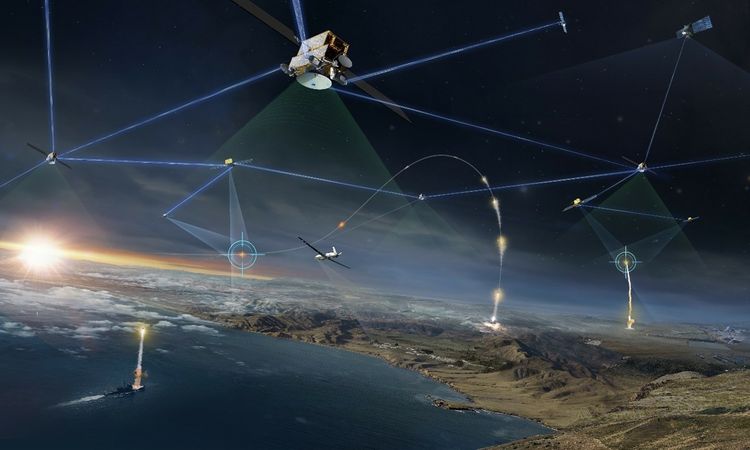
Reversing the Strategic Pause
The authorization marks a legislative intervention in the Space Force’s acquisition timeline. The service’s original FY26 budget request had eliminated funding for the Tranche 3 Transport Layer, effectively stalling plans to award contracts for the constellation’s next phase in 2026.
Space Force officials had sought the pause to conduct a broader review of the future data transport architecture, which is expected to conclude in time for the FY27 budget release next spring. This review is reportedly weighing the SDA’s proliferated low Earth orbit (LEO) model against other options, including a classified constellation known as MILNET developed by the National Reconnaissance Office (NRO) and the Space Force.
By reinstating the funding, Congress has signaled its intent to maintain the rapid cadence of the Proliferated Warfighter Space Architecture (PWSA), ensuring no gap in production between Tranche 2 and Tranche 3. If adopted in the final appropriations bill, the SDA’s total FY26 budget for the Transport Layer would rise to $1.8 billion.
Funding Breakdown and Priorities
The NDAA conference report prioritizes two distinct orbital regimes for missile warning and data transport:
- SDA Tranche 3 ($500 million): Supports the continuation of the LEO mesh network designed to provide low-latency connectivity to military platforms. This follows the agency’s progress on earlier tranches, including the award of Tranche 2 Transport Layer Beta contracts to Northrop Grumman and Lockheed Martin in 2023.
- Next-Gen OPIR Polar ($474 million): Bolsters the polar leg of the strategic missile warning architecture. The Space Force had previously planned to rely on reconciliation funding for this program, but lawmakers authorized nearly $1.2 billion total for the effort to ensure stability.
The bill also includes a provision requiring the Space Force to adjust its acquisition strategy for the polar program to integrate the Advanced Payload Suite-Alpha (APS-A) onto the satellites.
Program Status and Next Steps
The funding authorization comes as the SDA transitions from demonstration to operational deployment. The agency launched its first Tranche 1 mission on September 10, 2025, deploying 21 satellites to begin forming the operational mesh network.
While the NDAA authorizes these spending levels and sets policy, the funds must still be formally appropriated by Congress in a separate spending bill. The House cleared a key procedural vote on the NDAA on December 10, setting the stage for final passage and signature.
