

• Skip to primary navigation
  • Skip to main content
  • Skip to primary sidebar
  • Skip to secondary sidebar
  • Skip to footer
  • NEWS:
  • SatNews
  • SatMagazine
  • MilSatMagazine
  • SmallSat News
  • |     EVENTS:
  • SmallSat Symposium
  • Satellite Innovation
  • MilSat Symposium
  • SmallSat Europe

SatNews

Satellite Industry Intelligence Since 1983

Subscribe
  • LATEST
  • SatNews Events
  • Magazines
  • Calendar
  • Subscribe
  • Missions & Constellations
    • Exploration & Science Missions
    • In-Orbit Servicing & Orbital Operations
    • LEO Constellations
    • Mission Autonomy & Onboard Systems
    • Mission Deployments & Manifests
    • Navigation & PNT
    • SmallSat
    • Spacecraft & Payload Technology
    View All in Missions & Constellations →
    SpaceX’s Secret ‘Starfall’ Capsule Wins FAA Approval for Pacific Reentry TestsSpaceX’s Secret ‘Starfall’ Capsule Wins FAA Approval for Pacific Reentry Tests
    NOAA Activates First Dedicated U.S. Space Weather Satellite One Million Miles from EarthNOAA Activates First Dedicated U.S. Space Weather Satellite One Million Miles from Earth
    Thales Alenia Space to coordinate EROSS SC On-Orbit Servicing projectThales Alenia Space to coordinate EROSS SC On-Orbit Servicing project
    Astroscale Launches Industry Initiative to Study Atmospheric Impact of Spacecraft ReentryAstroscale Launches Industry Initiative to Study Atmospheric Impact of Spacecraft Reentry
  • Business
    • Contracts & Commercial Deals
    • Earnings & Financial Reporting
    • Events & Conferences
    • Funding & Venture Capital
    • Market Forecasts
    • Mergers & Acquisitions
    • Personnel Moves & Appointments
    View All in Business & Finance →
    SOMA Satellite Factory: Planet Labs Expands San Francisco HQ to Supercharge Production PipelineSOMA Satellite Factory: Planet Labs Expands San Francisco HQ to Supercharge Production Pipeline
    Riding the Starship: The SpaceX IPO Is Set to Rocket Seattle’s Aerospace EcosystemRiding the Starship: The SpaceX IPO Is Set to Rocket Seattle’s Aerospace Ecosystem
    Space Race Moves to Wall Street: China’s Private Rocket Makers Target IPOs as Historic SpaceX Flotation NearsSpace Race Moves to Wall Street: China’s Private Rocket Makers Target IPOs as Historic SpaceX Flotation Nears
    Behind the Screens: The Massive Video Over-IP Infrastructure Powering the World CupBehind the Screens: The Massive Video Over-IP Infrastructure Powering the World Cup
  • Defense
    • Counterspace & ASAT
    • Defense Budgets & Procurement
    • ISR & Reconnaissance
    • MILSATCOM
    • Missile Warning & Defense
    • National Security Programs
    • Space Domain Awareness
    View All in Military & Defense →
    Space-Based Shield: Spire Global and Diehl Defence Partner to Build European Missile Warning NetworkSpace-Based Shield: Spire Global and Diehl Defence Partner to Build European Missile Warning Network
    Qorvo Unveils Compact X-Band Radar Module to Enhance Defense System PerformanceQorvo Unveils Compact X-Band Radar Module to Enhance Defense System Performance
    Energration and Atombeam Partner on DARPA Proposal to Revolutionize Tactical Data Movement at the Defense EdgeEnergration and Atombeam Partner on DARPA Proposal to Revolutionize Tactical Data Movement at the Defense Edge
    American military space closed around one company in seven daysAmerican military space closed around one company in seven days
  • Gov
    • Export Controls & Compliance
    • International Space Agreements
    • National Space Policy
    • Space Law & Treaties
    • Space Sustainability & Debris Policy
    • Space Traffic Management / Debris Removal
    View All in Government & Regulation →
    Major opportunities for 2 GHz over EuropeMajor opportunities for 2 GHz over Europe
    “Dual-use” is the funding word. It’s also the label operators want off.“Dual-use” is the funding word. It’s also the label operators want off.
    Sovereignty got an answer on Day 3. Two answers, actually, and a commercial veto.Sovereignty got an answer on Day 3. Two answers, actually, and a commercial veto.
    Dependency killed the old debate. Sovereignty is the new one, and Europe hasn’t agreed what it means.Dependency killed the old debate. Sovereignty is the new one, and Europe hasn’t agreed what it means.
  • Launch
    • Launch Providers
    • Launch Schedule & Calendars
    • Launch Sites & Infrastructure
    • Rocket Technology & Vehicles
    View All in Launch →
    Breaking the TRL Bottleneck: Space Phoenix Systems Debuts Cost-Effective Space Test-and-Return ServiceBreaking the TRL Bottleneck: Space Phoenix Systems Debuts Cost-Effective Space Test-and-Return Service
    Twelve Scientific Payloads Experience Microgravity Aboard SubOrbital Express-5Twelve Scientific Payloads Experience Microgravity Aboard SubOrbital Express-5
    Amazon Leo Constellation Surpasses 330 Satellites Following Latest Atlas V LaunchAmazon Leo Constellation Surpasses 330 Satellites Following Latest Atlas V Launch
    If You Thought Space Was Hard Try to Get Your Satellite On a RocketIf You Thought Space Was Hard Try to Get Your Satellite On a Rocket
  • Software
    • Autonomous Ground Operations
    • Data Processing & AI/ML
    • Digital Twins & Modeling
    • Ground Segment & Teleports
    • Mission Planning & Simulation
    • Space Systems Software Engineering
    • Spectrum & Licensing
    View All in Software Automation & Ground Systems →
    Software Over the Air: FatPipe Launches Acceleration Tool to Unclog Starlink and Amazon LEO LinksSoftware Over the Air: FatPipe Launches Acceleration Tool to Unclog Starlink and Amazon LEO Links
    Three LEO Operators Bet 2026 on a Supply Chain Built for 2027Three LEO Operators Bet 2026 on a Supply Chain Built for 2027
    NASA Advances Interoperable Space Networks with Successful PExT DemonstrationNASA Advances Interoperable Space Networks with Successful PExT Demonstration
    KSAT and iQPS Expand Strategic Alliance to Accelerate High-Frequency SAR ConstellationKSAT and iQPS Expand Strategic Alliance to Accelerate High-Frequency SAR Constellation
  • Services & Apps
    • Climate & Environmental Monitoring
    • Disaster Response & Security Mapping
    • Earth Observation & Imaging
    • Maritime & Aviation Satcom
    • Satellite Communications
    View All in Services & Applications →
    Eutelsat and Tototheo Global Forge Partnership to Deliver LEO Connectivity Across Maritime and Government SectorsEutelsat and Tototheo Global Forge Partnership to Deliver LEO Connectivity Across Maritime and Government Sectors
    Marlink Equips Groupama-FDJ Cycling Team with Hybrid Starlink and LTE NetworkMarlink Equips Groupama-FDJ Cycling Team with Hybrid Starlink and LTE Network
    Viasat Secures Lockheed Martin Contract for NOAA’s Next-Generation AircraftViasat Secures Lockheed Martin Contract for NOAA’s Next-Generation Aircraft
    SES Partners with Viva to Launch Multi-Orbit In-Flight ConnectivitySES Partners with Viva to Launch Multi-Orbit In-Flight Connectivity

UPDATE: ULA’s Launch Readiness is GO! for Wednesday ViaSat-3 Flight 2 one of the most powerful commercial communication satellites

November 3, 2025

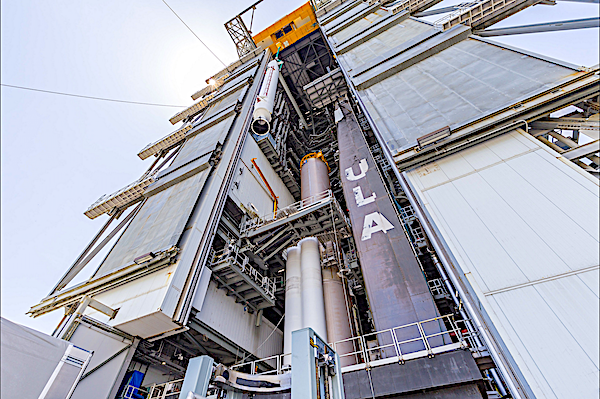
Solid Rocket Booster Mate: Atlas V ViaSat-3 F2
The solid rocket boosters (SRBs) are mounted onto the United Launch Alliance (ULA) Atlas V rocket that will launch the ViaSat-3 F2 ultra-high-capacity broadband satellite. Photo credit: United Launch Alliance

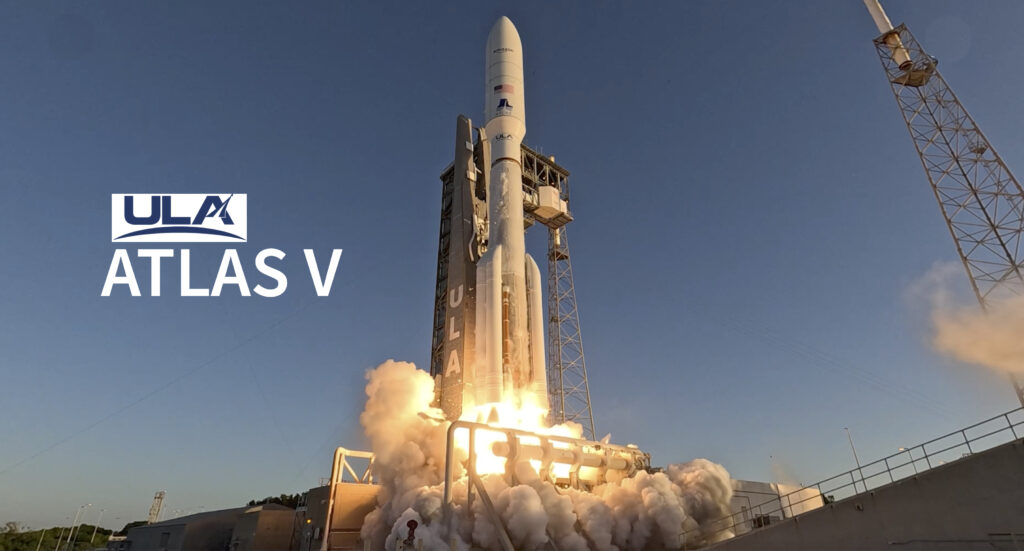
Everything continues to progress towards the ULA Atlas V launch carrying the ViaSat-3 Flight 2 (F2) mission for Viasat, a global technologies company. The mission is planned to lift off on Wednesday, Nov. 5, from Space Launch Complex-41 at Cape Canaveral Space Force Station in Florida. The launch is planned for 10:24 p.m. EST with a 44-minute window. Today’s forecast shows a 95 percent chance of favorable weather conditions for launch.  

An Atlas V 551 rocket, configured with five side-mounted solid rocket boosters and a standard-length payload fairing, will utilize several launch optimization features to place the ViaSat-3 Flight 2 spacecraft into a geosynchronous transfer orbit. The craft is one of the heaviest single-satellite payloads. Liftoff will occur from Space Launch Complex-41 at Cape Canaveral Space Force Station, Florida.

 Launch Readiness Review completed The Launch Readiness Review (LRR) is GO for Wednesday’s liftoff of the United Launch Alliance commercial Atlas V rocket with one of the most sophisticated and powerful commercial communications satellites — the ViaSat-3 Flight 2 ultra-high-capacity broadband spacecraft.
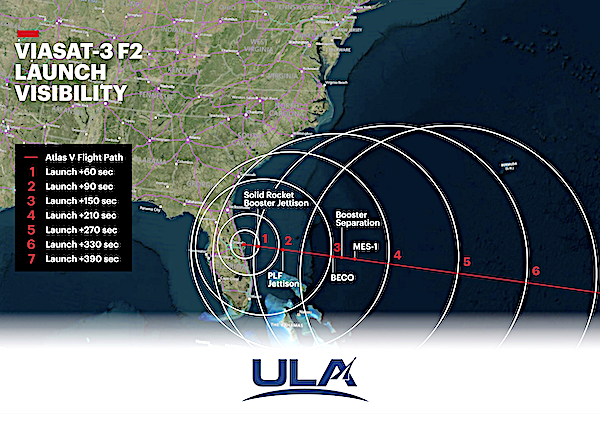
The LRR, led by ULA Launch Director James Whelan, was completed this morning at the Advanced Spaceflight Operations Center (ASOC).

Leadership from ULA, Viasat and Space Force assessed the readiness of the rocket, payload, mission assets and tracking support, discussed the status of pre-flight processing work, heard technical overviews of the countdown and flight, and previewed the weather forecast that projects a 95 percent chance of meeting the launch rules.

At the conclusion of the meeting, senior leaders were polled and gave a ready status for launch, then signed the Launch Readiness Certificate.

The Atlas V rocket, designated AV-100, stands 196 feet (59.7 meters) tall and will launch the payload into an elliptical geosynchronous transfer orbit (GTO). At liftoff, the rocket generates a combined thrust of 2.7 million pounds (12 megaNewtons) from its main engine and five solid rocket boosters. 

ULA will offer live reports from launch control in our automatically refreshing blog beginning Wednesday at 7:30 p.m. EST (0030 UTC). The launch webcast starts at L-20 minutes.

The forecast calls for a temperature of 80°F, overcast clouds, 100% cloud cover and a wind speed of 7mph.

 Launch Forecast Summary: 

  • Overall probability of violating weather constraints: 5%  
  • Primary concerns: Cumulus Cloud Rule
  • 24 hour back up: overall probability of violating weather constraints: 10%  
  • Primary concerns: Cumulus Cloud Rule  

ULA’s Atlas V plans ViaSat-3 F2 launch November 3 doubling the bandwidth of Viasat’s entire fleet
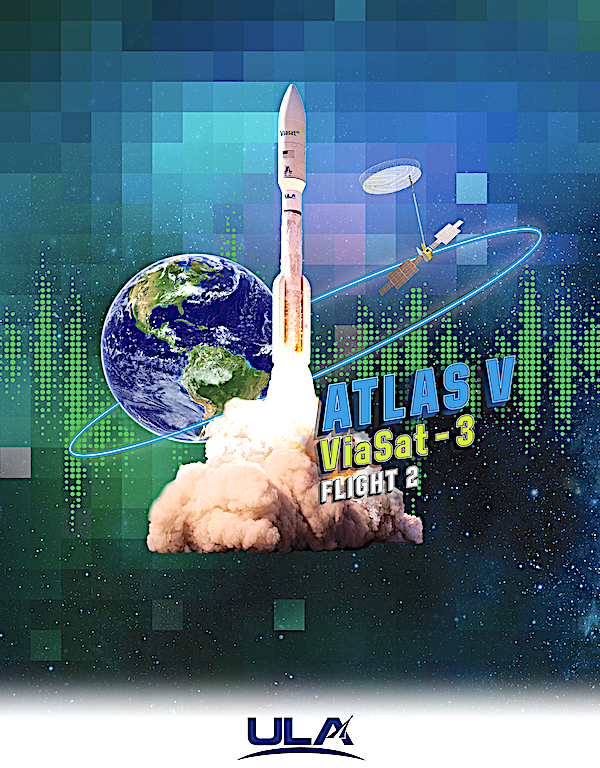
The launch of a United Launch Alliance (ULA) Atlas V 551 rocket carrying the ViaSat-3 Flight 2 (F2) mission for Viasat is planned for no earlier than Monday, November 3, 2025, pending range approval.

Once in service, VS-3 F2 is expected to more than double the bandwidth capacity of Viasat’s entire existing fleet and marks a significant milestone in our satellite roadmap.
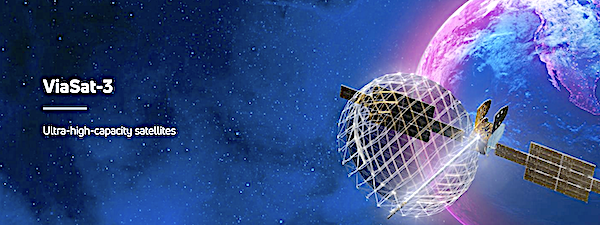
An Atlas V 551 rocket, configured with five side-mounted solid rocket boosters and a standard-length payload fairing, will utilize several launch optimization features to place the ViaSat-3 Flight 2 spacecraft into a geosynchronous transfer orbit. The craft is one of the heaviest single-satellite payloads. Liftoff will occur from Space Launch Complex-41 at Cape Canaveral Space Force Station, Florida.

The launch is scheduled for 10:36 p.m. EST at the opening of a 44-minute window, from Space Launch Complex-41 at Cape Canaveral Space Force Station, Florida.
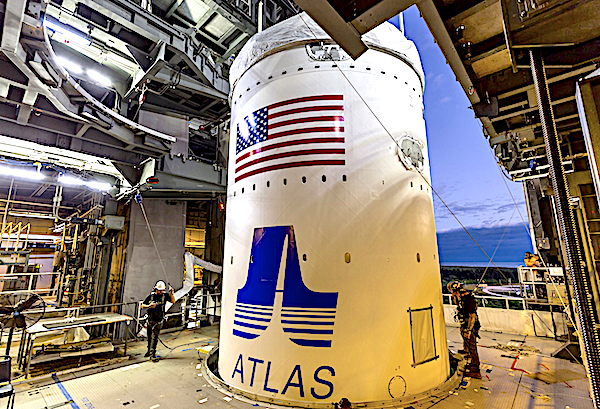
Initial buildup of the Atlas V 551 rocket is complete at ULA’s Vertical Integration Facility with five side-mounted solid rocket boosters and Centaur upper stage. Pre-flight testing is underway ahead of the ViaSat-3 F2 commercial satellite deployment mission.

ULA’s Atlas V ready to launch VIASAT-3 Flight 2 enhancing global connectivity
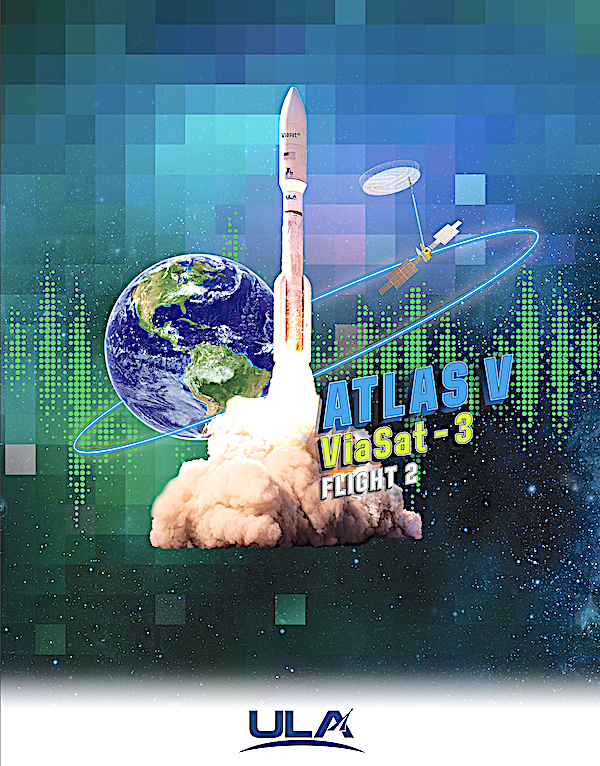
ULA’s Atlas V will soon be launching the ViaSat-3 Flight 2 ultra-high-capacity broadband spacecraft that is the second of three ultra-high-capacity satellites for Viasat, a global technology company.

Designed to significantly increase their global internet bandwidth capacity ViaSat is helping businesses, governments and communities transform their world through connectivity. Once in service, ViaSat-3 Flight 2 is expected to more than double the bandwidth capacity of Viasat’s entire existing satellite fleet and deliver enhanced global connectivity.  

The ViaSat-3 is scheduled to launch in the second half of October from Cape Canaveral Space Force Station, Florida, aboard a United Launch Alliance (ULA) Atlas V rocket.

Boeing built ViaSat-3 arrives at Cape Canaveral for upcoming launch
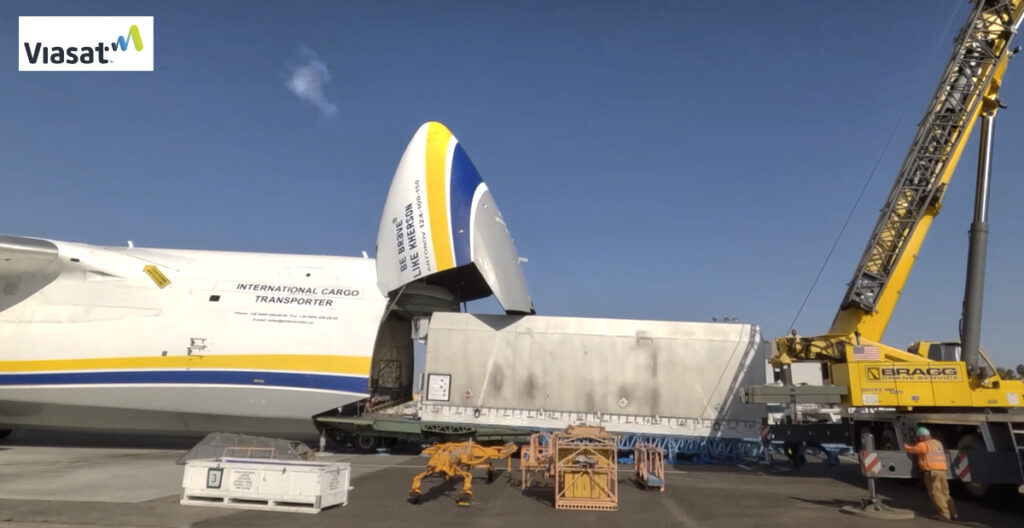
Photo of the ViaSat-3 F2 satellite being loaded into the Antonov aircraft for transportation to Kennedy Space Center, Florida. Photo is courtesy of Viasat.

Viasat’s ultra-high-capacity ViaSat-3 Flight 2 (VS-3 F2) satellite, built by Boeing, has completed its cross-country flight from Los Angeles International Airport (LAX) to Kennedy Space Center, Florida.
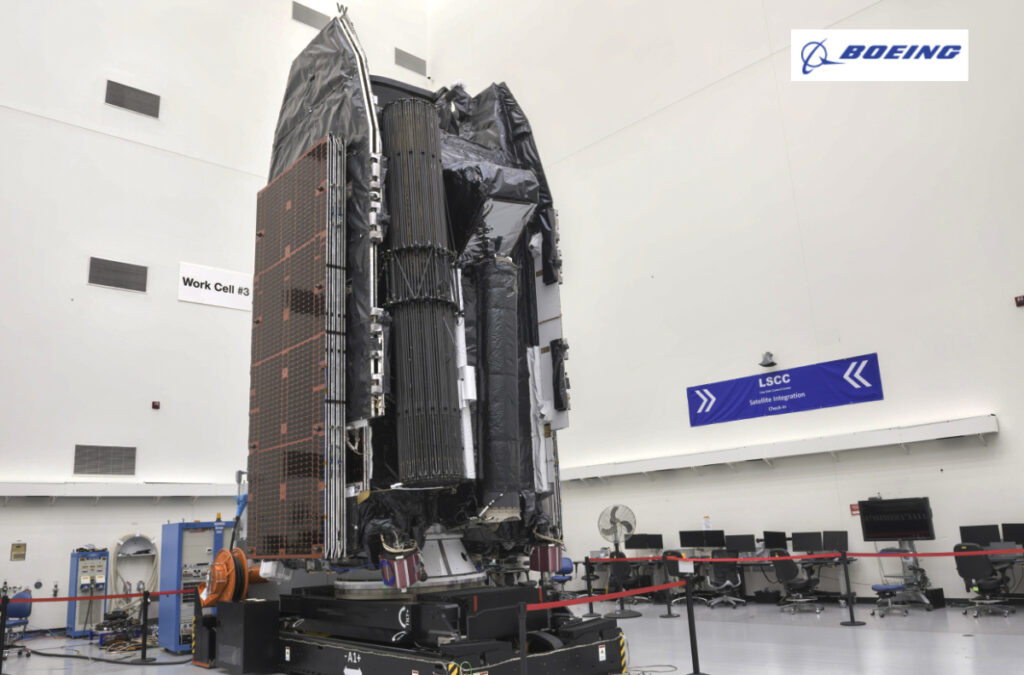
ViaSat-3 F2 satellite in the El Segundo, Calif. Boeing satellite factory ahead of containerization and shipment. Boeing photo by Erik Isakson.

VS-3 F2 was delivered to LAX by Boeing from its El Segundo, California, facility, before being transported in one of the world’s largest cargo airplanes, an Antonov AN-124, touching down in Florida in the early hours of September 30, 2025. 

The satellite was safely and securely shipped in a specialized container that carefully controls environmental factors such as temperature and air cleanliness as required to protect the highly complex technology throughout the flight. 

With precision down to the millimeter, loading the container onto an AN-124 cargo bay is an exceptionally intricate procedure that takes around four to six hours.

Now that VS-3 F2 has arrived at Cape Canaveral Space Force Station, the Boeing and Viasat teams, together with launch partner United Launch Alliance (ULA), are readying the spacecraft for launch in late October 2025, aboard a powerful ULA Atlas V 551 rocket. 
VS-3 F2 is the second of three ViaSat-3 Ka-band satellites and is designed to provide more than double the bandwidth capacity of Viasat’s entire existing fleet. Upon anticipated service entry in early 2026, VS-3 F2 is expected to add more than 1 Tbps capacity to our network over the Americas.

VS-3 F2 will now undergo comprehensive testing to verify all systems are go for launch following transport. After this, the satellite will be secured to the Atlas V launch vehicle adapter, enclosed within the payload fairing, which protects it during the three minutes of atmospheric flight, and then mated (attached) to the rocket.  From there, it will be put through final preparations ahead of launching VS-3 F2 into a GTO, from which the satellite will propel itself over the coming few months into GEO approximately 22,000 miles (36,000 km) above the Earth’s equator. 

The Atlas V rocket, which stands 196 feet (59.7 meters) tall and will weigh 1.3 million pounds (587,000 kg) when fully fueled at liftoff, will be rolled out to Space Launch Complex 41 (SLC-41) at Cape Canaveral Space Force Station the day before launch.

I’m extremely proud of the Viasat team and our partnership with Boeing in successfully completing ViaSat-3 F2’s manufacture and testing. Being just a few weeks out from launch is incredibly exciting – this achievement represents the dedication and innovative spirit of hundreds of talented professionals who’ve lent their expertise to this mission. A huge thank you to everyone who has contributed to this milestone. Now we turn our focus to getting F2 into orbit, where its tailored capabilities are expected to enable us to better serve our customers and meet increasing demand for resilient, global satellite communications,” said Dave Abrahamian, Vice President of Space Systems, Viasat. “The VS-3 constellation represents an important part of our global, multi-orbit, multi-band network, adding capacity that is secure, reliable, and highly flexible: with dynamic-beam-forming capabilities designed to rapidly shift capacity to wherever demand is greatest.”  

   

Filed Under: Climate & Environmental Monitoring, Launch Providers

Primary Sidebar

Coverage

  • Missions & Constellations
  • Business & Finance
  • Military & Defense
  • Launch
  • Software Automation & Ground Systems
  • Government & Regulation
  • Services & Applications

Most Read Stories

  • SpaceX Debuts Starship V3: Redefining Heavy-Lift Launch Capability
  • SpaceX Is Worth $1.75 Trillion. Only 7% of That Is Real.
  • SpaceX: 10,000 Launches Annually
  • American military space closed around one company in seven days
  • The end of GEO?

Secondary Sidebar

Footer


Satnews is a leading provider of satellite news, events, publications, research and other satellite industry information in both commercial and military enterprises worldwide.

Stories By Category

  • Business & Finance
  • Government & Regulation
  • Launch
  • Military & Defense
  • Missions & Constellations
  • Services & Applications
  • Software Automation & Ground Systems
  • Spectrum & Licensing
  • Startups & NewSpace Business

About Us

  • Leadership & Editorial Team
  • SatNews History
  • Free Satnews Subscription
  • SatNews Events
  • Magazines

Navigation

  • Latest Stories
  • Magazines
  • Events
  • Contact
  • Cookie & Privacy Policy for Satnews

We use cookies to ensure that we give you the best experience on our website. If you continue to use this site we will assume that you are happy with it.
x
Sign up Now (For Free)
Access daily or weekly satellite news updates covering all aspects of the commercial and military satellite industry.
Invalid email address
Notify Me Regarding ( At least one ):
We value your privacy and will not sell or share your email or other information with any other company. You may also unsubscribe at anytime.

Click Here to see our full privacy policy.
Thanks for subscribing!