

By Sean Payne – SatNews Events Reporter
SYDNEY — The United States and Australia have signed a treaty-level “Space Framework Agreement” at the 76th International Astronautical Congress (IAC), establishing a new legal foundation for bilateral cooperation in lunar exploration, earth science, and commercial spaceflight.
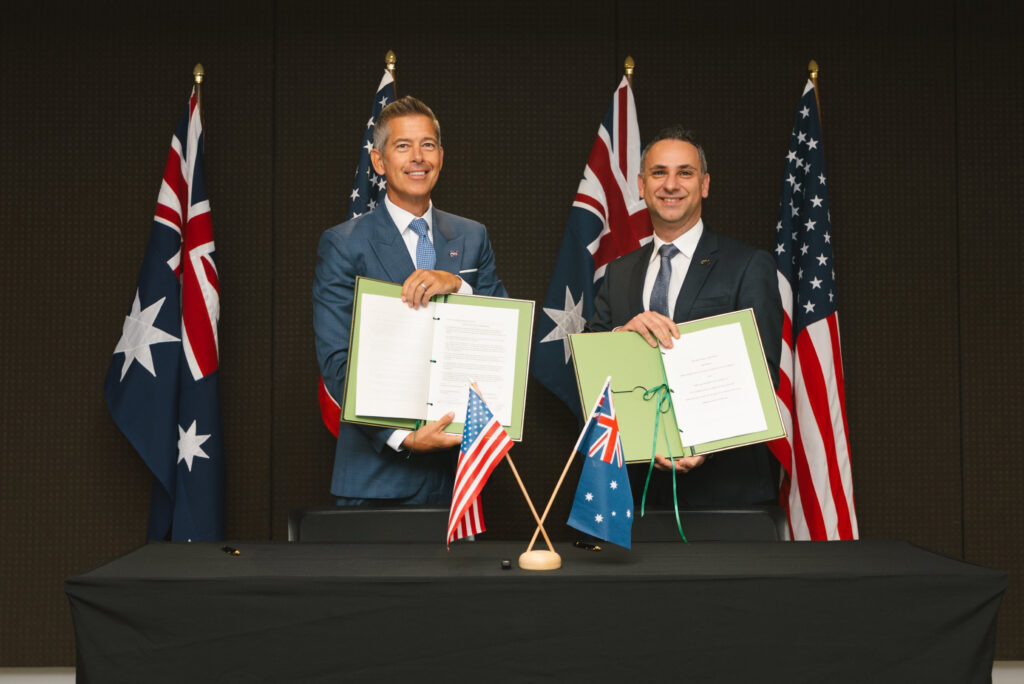
Acting NASA Administrator Sean Duffy and Australian Space Agency (ASA) Head Enrico Palermo signed the document on September 30, formally titled the “Framework Agreement between the Government of the United States of America and the Government of Australia on Cooperation in Aeronautics and the Exploration and Use of Airspace and Outer Space for Peaceful Purposes”. The treaty replaces older cooperative mechanisms and is designed to streamline legal hurdles for joint missions ranging from the Artemis program to Mars exploration.
Building on the TSA
This agreement serves as the strategic companion to the Technology Safeguards Agreement (TSA), which entered into force in 2024. While the TSA specifically addressed export controls to allow U.S. technology—such as rockets and satellite payloads—to launch from Australian spaceports, the new Framework Agreement covers broader civil and government-to-government collaboration.
Key areas covered under the new framework include:
- Space Exploration: Legal structures for Australian participation in Artemis and future Moon-to-Mars missions.
- Earth Science: Enhanced data sharing for geodesy, climate monitoring, and disaster management.
- Aeronautics: Cooperative research in advanced aviation technologies.
Industrial and Strategic Rationale
For Australia, the agreement is a critical step in maturing its domestic space sector. By reducing administrative barriers, the framework allows Australian industrial players to integrate more deeply into NASA supply chains. This alignment supports the ASA’s objective to boost national industrial capability and economic resilience by leveraging U.S. partnership opportunities.
Executive Commentary
Speaking at the signing ceremony in Sydney, Acting Administrator Duffy emphasized the historical depth of the partnership.
“Australia is an important and longtime space partner, from Apollo to Artemis, and this agreement depends on that partnership,” Duffy said. “International agreements like this one work to leverage our resources and increase our capacities and scientific returns for all.”
ASA Head Enrico Palermo highlighted the downstream economic benefits. “Strengthening Australia’s partnership with the U.S. and NASA creates new opportunities for Australian ideas and technologies, improving Australia’s industrial capability, boosting productivity, and building economic resilience,” Palermo said.
Ratification Timeline
Before the agreement formally enters into force, it must undergo parliamentary scrutiny in both nations. In Australia, the treaty will be tabled in both Houses of Parliament and reviewed by the Joint Standing Committee on Treaties (JSCOT), a process expected to take approximately four to six months.
