

• Skip to primary navigation
  • Skip to main content
  • Skip to primary sidebar
  • Skip to secondary sidebar
  • Skip to footer
  • NEWS:
  • SatNews
  • SatMagazine
  • MilSatMagazine
  • SmallSat News
  • |     EVENTS:
  • SmallSat Symposium
  • Satellite Innovation
  • MilSat Symposium
  • SmallSat Europe

SatNews

Satellite Industry Intelligence Since 1983

Subscribe
  • LATEST
  • Missions & Constellations
    • Exploration & Science Missions
    • In-Orbit Servicing & Orbital Operations
    • LEO Constellations
    • Mission Autonomy & Onboard Systems
    • Mission Deployments & Manifests
    • Navigation & PNT
    • SmallSat
    • Spacecraft & Payload Technology
    View All in Missions & Constellations →
    CAS Space Successfully Launches Kinetica-2, Aiming for Global Cost LeadershipCAS Space Successfully Launches Kinetica-2, Aiming for Global Cost Leadership
    Can SMEs Compete in Starlink-Dominated Space?Can SMEs Compete in Starlink-Dominated Space?
    Liftoff: NASA Successfully Launches Artemis II to the MoonLiftoff: NASA Successfully Launches Artemis II to the Moon
    Spire Global Successfully Deploys Satellite for NGA MagQuest Geomagnetic ChallengeSpire Global Successfully Deploys Satellite for NGA MagQuest Geomagnetic Challenge
  • Business
    • Contracts & Commercial Deals
    • Earnings & Financial Reporting
    • Events & Conferences
    • Funding & Venture Capital
    • Market Forecasts
    • Mergers & Acquisitions
    • Personnel Moves & Appointments
    View All in Business & Finance →
    L3Harris Taps Mercury Systems for High-Capacity Data Storage on SDA Tranche 3 SatellitesL3Harris Taps Mercury Systems for High-Capacity Data Storage on SDA Tranche 3 Satellites
    Antaris Secures $28M Series A to Advance AI-Powered Satellite Mission PlatformAntaris Secures $28M Series A to Advance AI-Powered Satellite Mission Platform
    Amazon in Reported Talks to Acquire Globalstar in $9 Billion Move to Challenge StarlinkAmazon in Reported Talks to Acquire Globalstar in $9 Billion Move to Challenge Starlink
    Fortastra Expands Leadership Team with Defense and Intelligence Veterans to Drive National Security MissionFortastra Expands Leadership Team with Defense and Intelligence Veterans to Drive National Security Mission
  • Defense
    • Counterspace & ASAT
    • Defense Budgets & Procurement
    • ISR & Reconnaissance
    • MILSATCOM
    • Missile Warning & Defense
    • National Security Programs
    • Space Domain Awareness
    View All in Military & Defense →
    The Downlink Deficit: The Pentagon’s Optical Mesh Network and the Terrestrial BottleneckThe Downlink Deficit: The Pentagon’s Optical Mesh Network and the Terrestrial Bottleneck
    Declassified National Reconnaissance Office Documents Reveal Early Tensions with Space Shuttle ProgramDeclassified National Reconnaissance Office Documents Reveal Early Tensions with Space Shuttle Program
    SPARC AI Appoints On-Ground Referral Agent in Ukraine to Accelerate Defense EngagementSPARC AI Appoints On-Ground Referral Agent in Ukraine to Accelerate Defense Engagement
    Indra Showcases Sovereign Space and Defense Technologies at FIDAE 2026Indra Showcases Sovereign Space and Defense Technologies at FIDAE 2026
  • Gov
    • Export Controls & Compliance
    • International Space Agreements
    • National Space Policy
    • Space Law & Treaties
    • Space Sustainability & Debris Policy
    • Space Traffic Management / Debris Removal
    View All in Government & Regulation →
    FCC Seeks Comment on Expanding Spectrum Access for “Weird Space Stuff”FCC Seeks Comment on Expanding Spectrum Access for “Weird Space Stuff”
    The FCC Must Choose: Enforce the Rules or Preserve LEO CompetitionThe FCC Must Choose: Enforce the Rules or Preserve LEO Competition
    Space Force Reassigns Final GPS III Mission to SpaceX Following Vulcan AnomalySpace Force Reassigns Final GPS III Mission to SpaceX Following Vulcan Anomaly
    NASA Realignment ‘Ignition’ Accelerates Shift Toward Commercial Lunar EconomyNASA Realignment ‘Ignition’ Accelerates Shift Toward Commercial Lunar Economy
  • Launch
    • Launch Providers
    • Launch Schedule & Calendars
    • Launch Sites & Infrastructure
    • Rocket Technology & Vehicles
    View All in Launch →
    CAS Space Successfully Launches Kinetica-2, Aiming for Global Cost LeadershipCAS Space Successfully Launches Kinetica-2, Aiming for Global Cost Leadership
    Liftoff: NASA Successfully Launches Artemis II to the MoonLiftoff: NASA Successfully Launches Artemis II to the Moon
    AAC Clyde Space Expands Orbital Presence with Transporter-16 LaunchAAC Clyde Space Expands Orbital Presence with Transporter-16 Launch
    Built by Thales Alenia Space for ESA’s Celeste mission, IOD-2 Satellite lifts off today from New ZealandBuilt by Thales Alenia Space for ESA’s Celeste mission, IOD-2 Satellite lifts off today from New Zealand
  • Software
    • Autonomous Ground Operations
    • Data Processing & AI/ML
    • Digital Twins & Modeling
    • Ground Segment & Teleports
    • Mission Planning & Simulation
    • Space Systems Software Engineering
    • Spectrum & Licensing
    View All in Software Automation & Ground Systems →
    The Downlink Deficit: The Pentagon’s Optical Mesh Network and the Terrestrial BottleneckThe Downlink Deficit: The Pentagon’s Optical Mesh Network and the Terrestrial Bottleneck
    NexSat Space Systems Debuts with ACE ‘Invisible’ Aero-Conformal AntennaNexSat Space Systems Debuts with ACE ‘Invisible’ Aero-Conformal Antenna
    Laser Communications and the Rise of Orbital Data CentersLaser Communications and the Rise of Orbital Data Centers
    ThinKom Showcases Modular MILSATCOM Architecture for Contested EnvironmentsThinKom Showcases Modular MILSATCOM Architecture for Contested Environments
  • Services & Apps
    • Climate & Environmental Monitoring
    • Disaster Response & Security Mapping
    • Earth Observation & Imaging
    • Maritime & Aviation Satcom
    • Satellite Communications
    View All in Services & Applications →
    The Downlink Deficit: The Pentagon’s Optical Mesh Network and the Terrestrial BottleneckThe Downlink Deficit: The Pentagon’s Optical Mesh Network and the Terrestrial Bottleneck
    Cinemo Reimagines the Vehicle as a Software-Defined Entertainment HubCinemo Reimagines the Vehicle as a Software-Defined Entertainment Hub
    IEC Telecom Wins CSR Initiative of the Year at the Oil & Gas Middle East Awards 2026IEC Telecom Wins CSR Initiative of the Year at the Oil & Gas Middle East Awards 2026
    Can SMEs Compete in Starlink-Dominated Space?Can SMEs Compete in Starlink-Dominated Space?
  • SatNews Events
  • Magazines
  • Calendar

Satellites tracked a volcano’s secret collapse for 12 years — then it sparked a killer wave

May 8, 2025

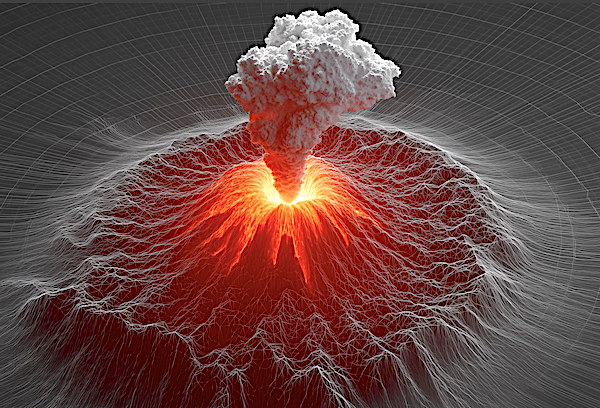
Anak Krakatau’s deadly 2018 collapse was preceded by years of unnoticed ground movement, now exposed through satellite radar analysis. Researchers believe such data could offer crucial early warnings for similar volcanic threats worldwide. Credit: SciTechDaily.com

In 2018, the Anak Krakatau volcano in Indonesia collapsed catastrophically, generating a deadly tsunami.

Now, researchers reveal that the volcano’s flank had been slowly slipping for years — an invisible danger detectable through satellite radar long before disaster struck.
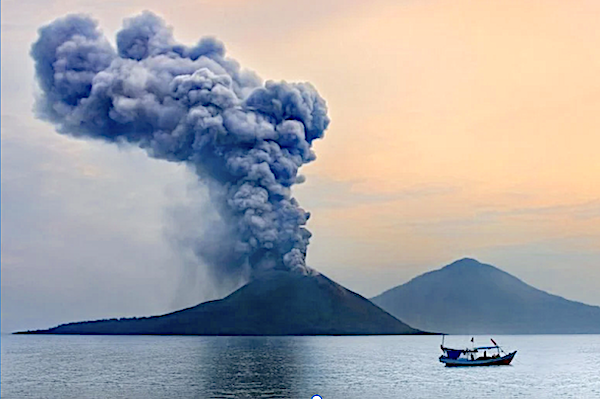
The 2018 eruption of Anak Krakatau unleashed a catastrophic chain of events as the volcano’s flank collapsed into the sea, creating a tsunami that slammed into coastal communities with devastating force. Over 400 lives were lost in one of Indonesia’s deadliest recent natural disasters.

Silent Slippage Before Disaster

In 2018, a massive eruption caused the southwest flank of Indonesia’s Anak Krakatau volcano to collapse into the sea, triggering a devastating tsunami that struck nearby islands. The disaster killed over 400 people and injured thousands more across Java and Sumatra.

Now, a new study by researchers at Penn State reveals that the mountainside had been slowly shifting for years before the collapse — and that movement significantly accelerated in the months leading up to the eruption. Their findings, recently published in Geophysical Research Letters, suggest the tragedy might have been predicted with the right monitoring tools.

No Warning for a Deadly Collapse

“Ocean volcanoes, when they are unstable, can collapse catastrophically and generate a tsunami,” said Christelle Wauthier, associate professor of geosciences at Penn State and co-author of the study. “And when that happened in 2018, more than 400 people died because nobody had instruments on the ground to know potentially if there was acceleration or change in the deformation behavior. Nobody knew the collapse was imminent. This study shows, unfortunately retrospectively, that we could forecast it if we had this remote sensing data set to get the surface deformation.”

To uncover the signs of instability, the team used a technique called Interferometric Synthetic Aperture Radar (InSAR) — a remote sensing method that uses radar satellites to detect tiny changes in the Earth’s surface, often just a few inches.

The researchers analyzed more than 10 years of satellite data from ALOS-1, COSMO-SkyMED, and Sentinel-1, mapping ground deformation on Anak Krakatau in the years before the 2018 disaster. Their results revealed long-term slippage along a fault on the volcano’s flank, punctuated by clear periods of acceleration before the collapse.

Creeping Toward Collapse

“Overall, the detachment fault experienced approximately 15 meters (roughly 50 feet) of slip from 2006 to 2018 with acceleration and deceleration periods, and a notable acceleration prior to the 2018 collapse,” said Young Cheol Kim, a doctoral candidate at Penn State and lead author of the study.

While the InSAR technique is not novel, it is rare to analyze such a large amount of data, the scientists said. The work required access to the high-performance Roar computer cluster managed by the Penn State Institute for Computational and Data Sciences (ICDS).

“Integrating hundreds of radar images requires a great deal of computational power,” said Wauthier, who is also associate director and a co-hire in ICDS. “It’s a lot of data storage and data processing and it takes some time and resources.”

Promise of Real-Time Volcano Monitoring

Still, the technique may show promise for near-real-time monitoring of active ocean volcanoes, especially in locations where other monitoring is not available, the scientists said.

Slip occurs when there is a weakness or fault under a volcano. The volcano grows larger as it erupts over time, and eventually it reaches a threshold where there is too much weight for the fault to support, leading to a collapse.

This process may start like a “slow landslide” over years, Wauthier said, but when it begins to accelerate it can be a sign that collapse is imminent.

Acceleration as a Red Flag

“The whole chunk of the volcano that collapsed was already moving — like a slow landslide,” said Wauthier, who is Kim’s adviser. “And, so, it’s very important to be able to look at the temporal evolution of that deformation, because if you have an acceleration, it can lead to a collapse. Our data shows that, basically, there was a precursor to the collapse.”

The researchers said that other ways to track deformation, like ground-based GPS instruments are often lacking in locations like Anak Krakatau. Because it is an active volcano, there are safety and permitting issues. Ground-based equipment is costly to deploy and maintain and funding is not always available.

InSAR’s Role in Future Warnings

“If you have a sudden acceleration of slip, it might be the sign that you will have a collapse happening,” Wauthier said. “Whether it’s this volcano or others susceptible to collapse worldwide, if you don’t have ground-based data in real time, maybe having near-real-time InSAR processing can help researchers be on the lookout for any significant acceleration in slip.”

Reference:
“Satellite Geodesy Uncovers 15 m of Slip on a Detachment Fault Prior to the 2018 Collapse at Anak Krakatau, Indonesia” by Young Cheol Kim, Christelle Wauthier and Thomas R. Walter, 16 November 2024, Geophysical Research Letters.
DOI: 10.1029/2024GL112296

Thomas R. Walter, professor at the GFZ German Research Centre for Geosciences, also contributed to this work.

NASA, the U.S. National Science Foundation and the Federal Ministry of Education and Research of Germany supported researchers involved in this project.

By Matthew Carroll, Penn State, SciTech Daily

Filed Under: Climate & Environmental Monitoring, Disaster Response & Security Mapping

Primary Sidebar

Coverage

  • Missions & Constellations
  • Business & Finance
  • Military & Defense
  • Launch
  • Software Automation & Ground Systems
  • Government & Regulation
  • Services & Applications

Most Read Stories

  • Rheinmetall Withdraws From Mynaric Bidding Process; Rocket Lab Acquisition Clears Major Competitive Hurdle
  • L3Harris Unveils XL-300P: The First P25 Handheld with 5G and Satellite Direct-to-Device Connectivity
  • Rheinmetall Walked Away. Germany Should Take the Hint.
  • Guardians in the Kill Chain: How the Space Force Led the Opening Salvo of Operation Epic Fury
  • Rocket Lab Emerging as Potential Bus Provider for 2,800-Satellite Equatys Constellation

Secondary Sidebar

Footer


Satnews is a leading provider of satellite news, events, publications, research and other satellite industry information in both commercial and military enterprises worldwide.

Stories By Category

  • Business & Finance
  • Government & Regulation
  • Launch
  • Military & Defense
  • Missions & Constellations
  • Services & Applications
  • Software Automation & Ground Systems
  • Spectrum & Licensing
  • Startups & NewSpace Business

About Us

  • Leadership & Editorial Team
  • SatNews History
  • Free Satnews Subscription
  • SatNews Events
  • Magazines

Navigation

  • Latest Stories
  • Magazines
  • Events
  • Contact
  • Cookie & Privacy Policy for Satnews

We use cookies to ensure that we give you the best experience on our website. If you continue to use this site we will assume that you are happy with it.
x
Sign up Now (For Free)
Access daily or weekly satellite news updates covering all aspects of the commercial and military satellite industry.
Invalid email address
Notify Me Regarding ( At least one ):
We value your privacy and will not sell or share your email or other information with any other company. You may also unsubscribe at anytime.

Click Here to see our full privacy policy.
Thanks for subscribing!