

• Skip to primary navigation
  • Skip to main content
  • Skip to primary sidebar
  • Skip to secondary sidebar
  • Skip to footer
  • NEWS:
  • SatNews
  • SatMagazine
  • MilSatMagazine
  • SmallSat News
  • |     EVENTS:
  • SmallSat Symposium
  • Satellite Innovation
  • MilSat Symposium
  • SmallSat Europe

SatNews

Satellite Industry Intelligence Since 1983

Subscribe
  • LATEST
  • SatNews Events
  • Magazines
  • Calendar
  • Subscribe
  • Missions & Constellations
    • Exploration & Science Missions
    • In-Orbit Servicing & Orbital Operations
    • LEO Constellations
    • Mission Autonomy & Onboard Systems
    • Mission Deployments & Manifests
    • Navigation & PNT
    • SmallSat
    • Spacecraft & Payload Technology
    View All in Missions & Constellations →
    Rohde & Schwarz Introduces Pulsar Signal Simulation to Advance Next-Gen PNT TestingRohde & Schwarz Introduces Pulsar Signal Simulation to Advance Next-Gen PNT Testing
    China Accelerates Orbital Internet Deployment with Successful Smart Dragon-3 Sea LaunchChina Accelerates Orbital Internet Deployment with Successful Smart Dragon-3 Sea Launch
    Smallsats Dominate 2025 Launch Landscape as Mass Efficiency PeaksSmallsats Dominate 2025 Launch Landscape as Mass Efficiency Peaks
    MIT STAR Lab Expands Scope from Lasercom Innovation to Space Policy ArchitectureMIT STAR Lab Expands Scope from Lasercom Innovation to Space Policy Architecture
  • Business
    • Contracts & Commercial Deals
    • Earnings & Financial Reporting
    • Events & Conferences
    • Funding & Venture Capital
    • Market Forecasts
    • Mergers & Acquisitions
    • Personnel Moves & Appointments
    View All in Business & Finance →
    Global Defense Leaders Convene as Space Symposium 41 Addresses Orbital SecurityGlobal Defense Leaders Convene as Space Symposium 41 Addresses Orbital Security
    SmallSat Europe Speaker Focus: Chris Quilty, Quilty SpaceSmallSat Europe Speaker Focus: Chris Quilty, Quilty Space
    “SpaceX and the biggest IPO in history”“SpaceX and the biggest IPO in history”
    SmallSat Europe Speaker Focus: Chiara Manfletti, NeuraspaceSmallSat Europe Speaker Focus: Chiara Manfletti, Neuraspace
  • Defense
    • Counterspace & ASAT
    • Defense Budgets & Procurement
    • ISR & Reconnaissance
    • MILSATCOM
    • Missile Warning & Defense
    • National Security Programs
    • Space Domain Awareness
    View All in Military & Defense →
    NRL to Showcase Sovereign Space Capabilities at 41st Space SymposiumNRL to Showcase Sovereign Space Capabilities at 41st Space Symposium
    Northrop Grumman Minotaur IV Lofted USSF Tech Demonstration Payloads to OrbitNorthrop Grumman Minotaur IV Lofted USSF Tech Demonstration Payloads to Orbit
    The End of the VSAT Parts BinThe End of the VSAT Parts Bin
    Procurement Lag vs. Conflict Speed: Can Defense Buying Cycles Keep Up with Space Innovation?Procurement Lag vs. Conflict Speed: Can Defense Buying Cycles Keep Up with Space Innovation?
  • Gov
    • Export Controls & Compliance
    • International Space Agreements
    • National Space Policy
    • Space Law & Treaties
    • Space Sustainability & Debris Policy
    • Space Traffic Management / Debris Removal
    View All in Government & Regulation →
    FCC Modernizes Satellite Spectrum Rules to Unleash Next-Generation BroadbandFCC Modernizes Satellite Spectrum Rules to Unleash Next-Generation Broadband
    SmallSat Europe Speaker Focus: Daniel Bock, Morpheus SpaceSmallSat Europe Speaker Focus: Daniel Bock, Morpheus Space
    SmallSat Europe Speaker Focus: Dr. Ane Aanesland, ThrustMeSmallSat Europe Speaker Focus: Dr. Ane Aanesland, ThrustMe
    Isaacman’s Budget Math: How NASA Plans to Reach the Moon With a Quarter Less MoneyIsaacman’s Budget Math: How NASA Plans to Reach the Moon With a Quarter Less Money
  • Launch
    • Launch Providers
    • Launch Schedule & Calendars
    • Launch Sites & Infrastructure
    • Rocket Technology & Vehicles
    View All in Launch →
    What the SpaceX IPO Changes for Every Satellite OperatorWhat the SpaceX IPO Changes for Every Satellite Operator
    €30 million Financing for PLD Space’s Small Satellite Launcher€30 million Financing for PLD Space’s Small Satellite Launcher
    Satellite Deployers to be Used on JAXA Small Satellite Mission by ExolaunchSatellite Deployers to be Used on JAXA Small Satellite Mission by Exolaunch
    CAS Space Successfully Launches Kinetica-2, Aiming for Global Cost LeadershipCAS Space Successfully Launches Kinetica-2, Aiming for Global Cost Leadership
  • Software
    • Autonomous Ground Operations
    • Data Processing & AI/ML
    • Digital Twins & Modeling
    • Ground Segment & Teleports
    • Mission Planning & Simulation
    • Space Systems Software Engineering
    • Spectrum & Licensing
    View All in Software Automation & Ground Systems →
    Cloudcomputing Targets 1.5M Identities in Spain and Finalizes Innovate IT AcquisitionCloudcomputing Targets 1.5M Identities in Spain and Finalizes Innovate IT Acquisition
    Archangel Lightworks Secures £10M Series A to Scale Optical Ground InfrastructureArchangel Lightworks Secures £10M Series A to Scale Optical Ground Infrastructure
    Keysight and Sateliot Win ESA and GSMA Foundry Challenge for 6G InnovationKeysight and Sateliot Win ESA and GSMA Foundry Challenge for 6G Innovation
    Automation and Agility: How SSC Space Go is Designed for the New Age of GroundAutomation and Agility: How SSC Space Go is Designed for the New Age of Ground
  • Services & Apps
    • Climate & Environmental Monitoring
    • Disaster Response & Security Mapping
    • Earth Observation & Imaging
    • Maritime & Aviation Satcom
    • Satellite Communications
    View All in Services & Applications →
    Kraken Robotics Integrates KATFISH Sonar on SEFINE RD-22 USV Following Multi-Naval DemonstrationsKraken Robotics Integrates KATFISH Sonar on SEFINE RD-22 USV Following Multi-Naval Demonstrations
    Astroscale Plans World-First Multi-Orbit Satellite Inspection MissionAstroscale Plans World-First Multi-Orbit Satellite Inspection Mission
    The Downlink Deficit: The Pentagon’s Optical Mesh Network and the Terrestrial BottleneckThe Downlink Deficit: The Pentagon’s Optical Mesh Network and the Terrestrial Bottleneck
    Cinemo Reimagines the Vehicle as a Software-Defined Entertainment HubCinemo Reimagines the Vehicle as a Software-Defined Entertainment Hub

XMM-Newton catches giant black hole’s X-ray oscillations

January 13, 2025

XMM-Newton

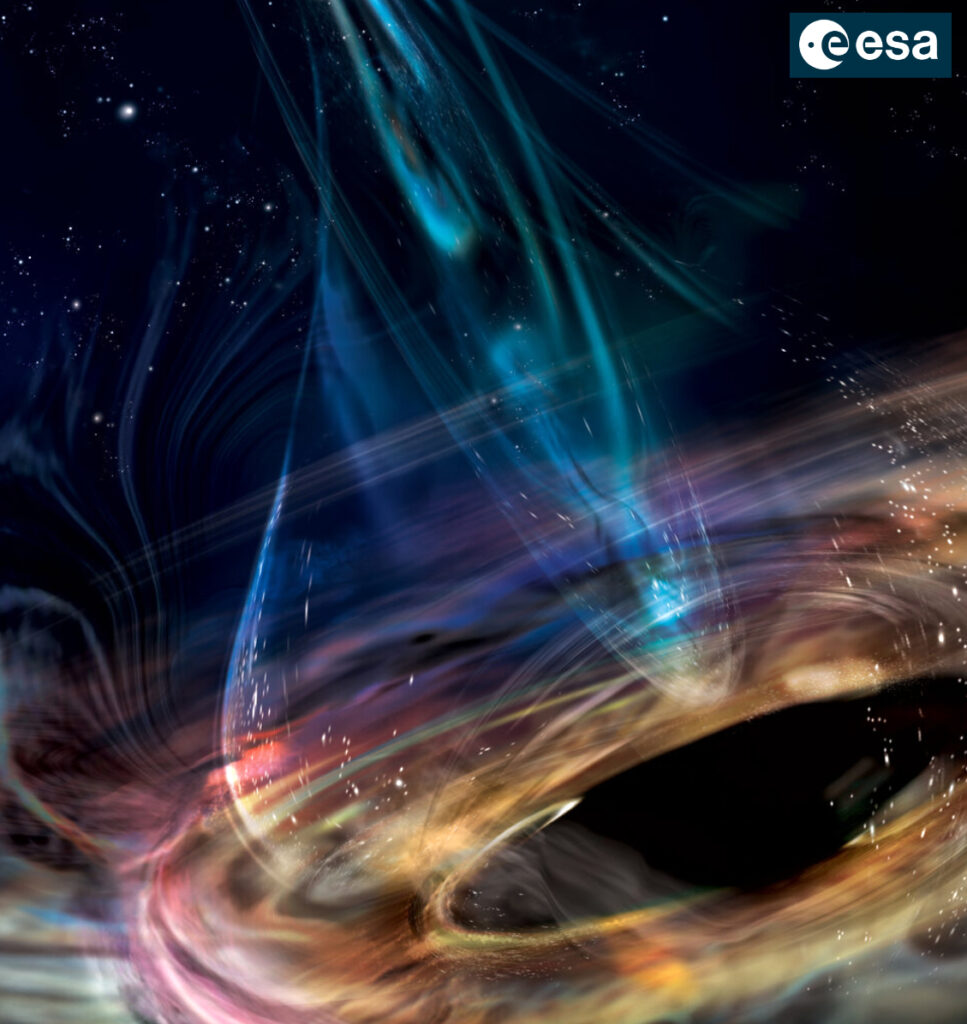
The European Space Agency’s XMM-Newton has detected rapidly fluctuating X-rays coming from the very edge of a supermassive black hole in the heart of a nearby galaxy. The results paint a fascinating picture that defies how we thought matter falls into such black holes, and points to a potential source of gravitational waves that ESA’s future mission, LISA, could see.
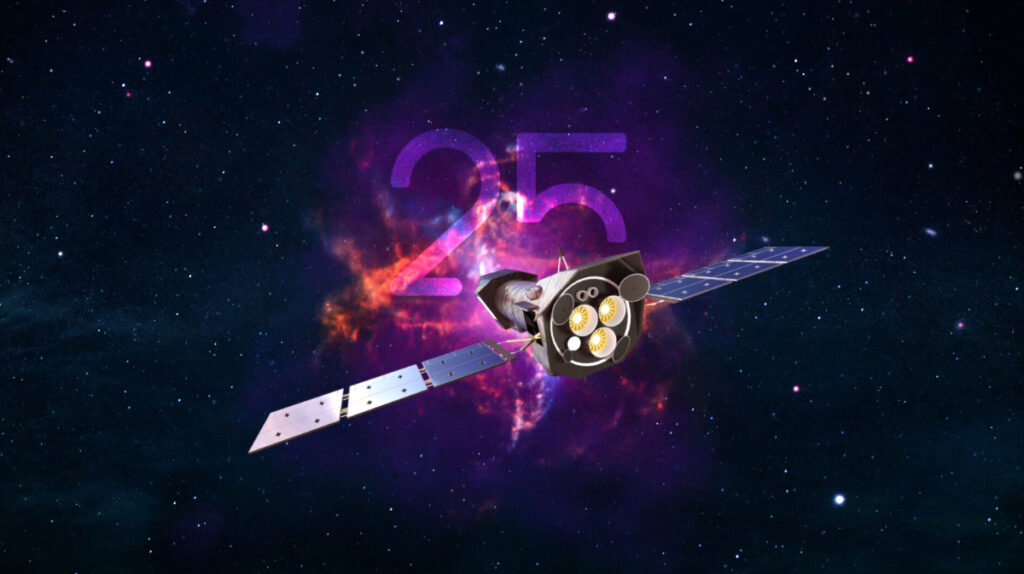
Artistic rendition of ESA’s XMM-Newton, which is now celebrating 25 years of breakthroughs.

XMM-Newton is showing us that black holes devour matter in more complex ways than astronomers first thought. Black holes are predictions of Albert Einstein’s theory of general relativity. They are gravitational monsters that imprison any piece of matter or energy that crosses their ‘surface’, a region of spacetime known as the event horizon.

During its final descent into the black hole, a process known as accretion, the doomed matter forms a disc around the black hole. The gas in the accretion disc heats up and gives off mostly ultraviolet (UV) light.

The UV rays interact with a cloud of electrically charged gas, or plasma, that surrounds the black hole and accretion disc. This cloud is known as the corona and the interactions give the UV rays energy, boosting them up to X-rays, which XMM-Newton can capture.

XMM-Newton has been observing the supermassive black hole 1ES 1927+654 since 2011. Back then, everything was pretty normal. But in 2018, things changed.

1ES 1927+654 suffered a large outburst that appeared to disrupt its surroundings because the X-ray corona disappeared. Gradually, the corona returned, and by early 2021 normality appeared to have been restored.

Puzzling behavior

However, in July 2022, XMM-Newton started to observe that the X-ray output was varying at levels of around 10% on timescales between 400 and 1000 seconds. Quasi-periodic oscillations (QPO), as this type of variability is called, are notoriously difficult to detect in supermassive black holes.

“This was our first indication that something strange was going on,” says Megan Masterson, PhD student at Massachusetts Institute of Technology, USA, who led the XMM-Newton study.

The oscillations could suggest that a massive object, like a star, is embedded in the accretion disk, and is rapidly orbiting the black hole on its way to being swallowed. As the object gets closer to the black hole, the time it takes to orbit decreases, causing the frequency of the oscillations to increase.

Calculations showed that this orbiting object is probably a stellar corpse known as a white dwarf, with around 0.1 times the mass of the Sun, traveling at an incredible speed. It was completing one orbit of the central monster, covering a distance of around 100 million km, every eighteen minutes or so.

Then things got even weirder.
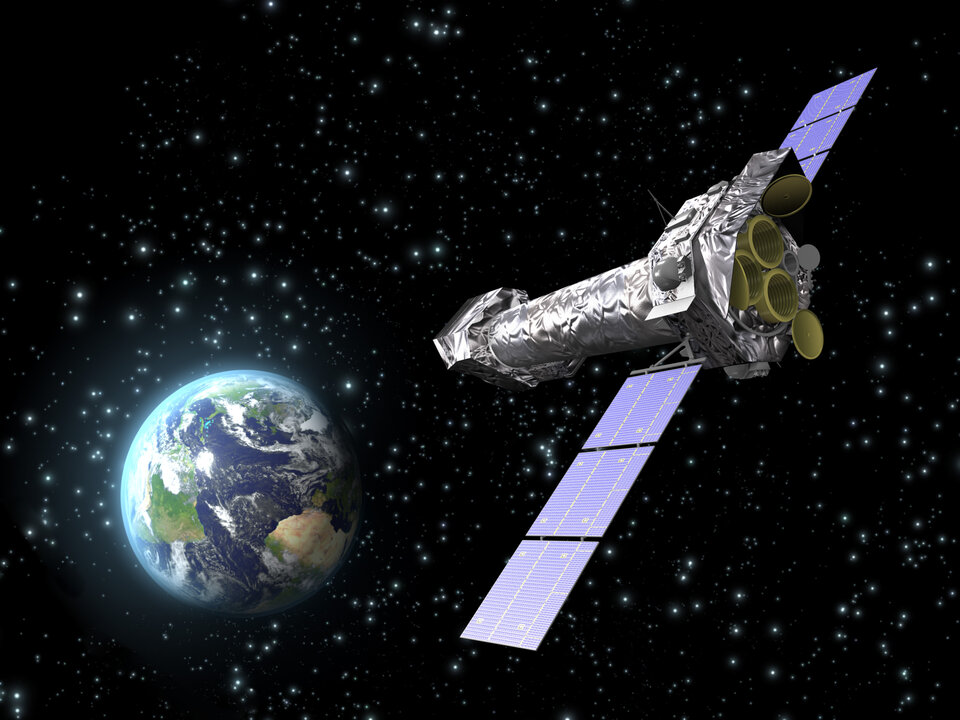
XMM-Newton
XMM-Newton

Over the course of almost two years, XMM-Newton showed that the oscillations were increasing in strength and frequency — but not in the way the researchers expected.

The team assumed that the object’s orbital energy was being emitted as gravitational waves as dictated by general relativity. To test the idea, Megan calculated when this object would cross the event horizon, disappear from view, and the oscillations would stop. It turned out to be 4 January 2024.

“I’ve never in my career been able to make a prediction that precisely before,” says Erin Kara, Massachusetts Institute of Technology, and Megan’s PhD supervisor.

XMM-Newton investigates further

In March 2024, XMM-Newton looked again — and the oscillations were still there. The object was now traveling at about half the speed of light and completing an orbit every seven minutes. Whatever was in the accretion disc, it was stubbornly refusing to be devoured by the black hole. Either there were more than just gravitational waves at play, or the entire hypothesis needed to change.

The researchers also considered another possibility for the origin of the oscillations. Remembering the disappearance of the X-ray corona in 2018, they wondered whether this cloud itself could be oscillating.

The trouble was that there is no established theory to explain such behavior and so with no clear path to further this idea, they returned to the original model, and realized that there was a way to modify it.

Astronomers have discovered pairs of white dwarfs gradually spiraling towards each other. As they close in, instead of remaining intact, one can start pulling matter off the other, and this slows down the approach of the two objects. Could the same be happening here and instead of heading intact into the black hole, the white dwarf is being slowly ripped apart?

There is a way to decide.

LISA’s future study

In the 2030s, ESA will launch the Laser Interferometer Space Antenna (LISA), which is designed to detect gravitational waves in exactly the frequency range that 1ES 1927+654 is emitting. “We predict that if there is a white dwarf in orbit around this supermassive black hole, LISA should see it,” says Megan. If so, it would be a fascinating look at what happens so close to the gravitational monster.

“This is another great example of XMM-Newton’s unique abilities. It was critical to this result and is the only observatory capable of capturing this QPO signal with such clarity. The detection relied on XMM-Newton’s exquisite combination of long observations, large collecting area across the entire X-ray band, and timing resolution,” says Norbert Schartel, ESA XMM-Newton Project Scientist.


LISA-inspired artwork

Filed Under: International Space Agreements

Primary Sidebar

Coverage

  • Missions & Constellations
  • Business & Finance
  • Military & Defense
  • Launch
  • Software Automation & Ground Systems
  • Government & Regulation
  • Services & Applications

Most Read Stories

  • L3Harris Unveils XL-300P: The First P25 Handheld with 5G and Satellite Direct-to-Device Connectivity
  • SpaceX Loses Contact With Starlink Satellite
  • Rheinmetall Walked Away. Germany Should Take the Hint.
  • Rocket Lab Emerging as Potential Bus Provider for 2,800-Satellite Equatys Constellation
  • SpaceX Accelerates Record-Breaking IPO Following Trillion-Dollar xAI Merger

Secondary Sidebar

Footer


Satnews is a leading provider of satellite news, events, publications, research and other satellite industry information in both commercial and military enterprises worldwide.

Stories By Category

  • Business & Finance
  • Government & Regulation
  • Launch
  • Military & Defense
  • Missions & Constellations
  • Services & Applications
  • Software Automation & Ground Systems
  • Spectrum & Licensing
  • Startups & NewSpace Business

About Us

  • Leadership & Editorial Team
  • SatNews History
  • Free Satnews Subscription
  • SatNews Events
  • Magazines

Navigation

  • Latest Stories
  • Magazines
  • Events
  • Contact
  • Cookie & Privacy Policy for Satnews

We use cookies to ensure that we give you the best experience on our website. If you continue to use this site we will assume that you are happy with it.
x
Sign up Now (For Free)
Access daily or weekly satellite news updates covering all aspects of the commercial and military satellite industry.
Invalid email address
Notify Me Regarding ( At least one ):
We value your privacy and will not sell or share your email or other information with any other company. You may also unsubscribe at anytime.

Click Here to see our full privacy policy.
Thanks for subscribing!