

• Skip to primary navigation
  • Skip to main content
  • Skip to primary sidebar
  • Skip to secondary sidebar
  • Skip to footer
  • NEWS:
  • SatNews
  • SatMagazine
  • MilSatMagazine
  • SmallSat News
  • |     EVENTS:
  • SmallSat Symposium
  • Satellite Innovation
  • MilSat Symposium
  • SmallSat Europe

SatNews

Satellite Industry Intelligence Since 1983

Subscribe
  • LATEST
  • Missions & Constellations
    • Exploration & Science Missions
    • In-Orbit Servicing & Orbital Operations
    • LEO Constellations
    • Mission Autonomy & Onboard Systems
    • Mission Deployments & Manifests
    • Navigation & PNT
    • SmallSat
    • Spacecraft & Payload Technology
    View All in Missions & Constellations →
    New Boeing Satellite Spacecraft Delivered.New Boeing Satellite Spacecraft Delivered.
    What the SpaceX IPO Changes for Every Satellite OperatorWhat the SpaceX IPO Changes for Every Satellite Operator
    Empowering the Next Generation at SmallSat Europe 2026Empowering the Next Generation at SmallSat Europe 2026
    SmallSat Europe Speaker Focus: Carissa Christensen, BryceTechSmallSat Europe Speaker Focus: Carissa Christensen, BryceTech
  • Business
    • Contracts & Commercial Deals
    • Earnings & Financial Reporting
    • Events & Conferences
    • Funding & Venture Capital
    • Market Forecasts
    • Mergers & Acquisitions
    • Personnel Moves & Appointments
    View All in Business & Finance →
    Industry Sentiment Shifts as Quilty Space Reveals Top 5 Takeaways from Satellite 2026Industry Sentiment Shifts as Quilty Space Reveals Top 5 Takeaways from Satellite 2026
    e-GEOS and VENG Strengthen Global Partnership for SAOCOM Satellite Data Distributione-GEOS and VENG Strengthen Global Partnership for SAOCOM Satellite Data Distribution
    SmallSat Europe Speaker Focus: Dr. Ane Aanesland, ThrustMeSmallSat Europe Speaker Focus: Dr. Ane Aanesland, ThrustMe
    Redwire’s ESA Quantum Satellite Deal Expands European Defense Growth StoryRedwire’s ESA Quantum Satellite Deal Expands European Defense Growth Story
  • Defense
    • Counterspace & ASAT
    • Defense Budgets & Procurement
    • ISR & Reconnaissance
    • MILSATCOM
    • Missile Warning & Defense
    • National Security Programs
    • Space Domain Awareness
    View All in Military & Defense →
    Procurement Lag vs. Conflict Speed: Can Defense Buying Cycles Keep Up with Space Innovation?Procurement Lag vs. Conflict Speed: Can Defense Buying Cycles Keep Up with Space Innovation?
    ParaZero Technologies Expands Israeli Defense Contract with New Order for Anti-Drone SystemsParaZero Technologies Expands Israeli Defense Contract with New Order for Anti-Drone Systems
    Russia Replaces Starlink With European-Built SatellitesRussia Replaces Starlink With European-Built Satellites
    Chief Data and Artificial Intelligence Officer for the United States Space Force, Chandra Donelson, Steps AwayChief Data and Artificial Intelligence Officer for the United States Space Force, Chandra Donelson, Steps Away
  • Gov
    • Export Controls & Compliance
    • International Space Agreements
    • National Space Policy
    • Space Law & Treaties
    • Space Sustainability & Debris Policy
    • Space Traffic Management / Debris Removal
    View All in Government & Regulation →
    Isaacman’s Budget Math: How NASA Plans to Reach the Moon With a Quarter Less MoneyIsaacman’s Budget Math: How NASA Plans to Reach the Moon With a Quarter Less Money
    FCC Seeks Comment on Expanding Spectrum Access for “Weird Space Stuff”FCC Seeks Comment on Expanding Spectrum Access for “Weird Space Stuff”
    The FCC Must Choose: Enforce the Rules or Preserve LEO CompetitionThe FCC Must Choose: Enforce the Rules or Preserve LEO Competition
    Space Force Reassigns Final GPS III Mission to SpaceX Following Vulcan AnomalySpace Force Reassigns Final GPS III Mission to SpaceX Following Vulcan Anomaly
  • Launch
    • Launch Providers
    • Launch Schedule & Calendars
    • Launch Sites & Infrastructure
    • Rocket Technology & Vehicles
    View All in Launch →
    €30 million Financing for PLD Space’s Small Satellite Launcher€30 million Financing for PLD Space’s Small Satellite Launcher
    Satellite Deployers to be Used on JAXA Small Satellite Mission by ExolaunchSatellite Deployers to be Used on JAXA Small Satellite Mission by Exolaunch
    CAS Space Successfully Launches Kinetica-2, Aiming for Global Cost LeadershipCAS Space Successfully Launches Kinetica-2, Aiming for Global Cost Leadership
    Liftoff: NASA Successfully Launches Artemis II to the MoonLiftoff: NASA Successfully Launches Artemis II to the Moon
  • Software
    • Autonomous Ground Operations
    • Data Processing & AI/ML
    • Digital Twins & Modeling
    • Ground Segment & Teleports
    • Mission Planning & Simulation
    • Space Systems Software Engineering
    • Spectrum & Licensing
    View All in Software Automation & Ground Systems →
    Automation and Agility: How SSC Space Go is Designed for the New Age of GroundAutomation and Agility: How SSC Space Go is Designed for the New Age of Ground
    Intellian Unveils Future Military and Aerospace Antenna Technologies at Satellite 2026Intellian Unveils Future Military and Aerospace Antenna Technologies at Satellite 2026
    The Downlink Deficit: The Pentagon’s Optical Mesh Network and the Terrestrial BottleneckThe Downlink Deficit: The Pentagon’s Optical Mesh Network and the Terrestrial Bottleneck
    NexSat Space Systems Debuts with ACE ‘Invisible’ Aero-Conformal AntennaNexSat Space Systems Debuts with ACE ‘Invisible’ Aero-Conformal Antenna
  • Services & Apps
    • Climate & Environmental Monitoring
    • Disaster Response & Security Mapping
    • Earth Observation & Imaging
    • Maritime & Aviation Satcom
    • Satellite Communications
    View All in Services & Applications →
    Kraken Robotics Integrates KATFISH Sonar on SEFINE RD-22 USV Following Multi-Naval DemonstrationsKraken Robotics Integrates KATFISH Sonar on SEFINE RD-22 USV Following Multi-Naval Demonstrations
    Astroscale Plans World-First Multi-Orbit Satellite Inspection MissionAstroscale Plans World-First Multi-Orbit Satellite Inspection Mission
    Cinemo Reimagines the Vehicle as a Software-Defined Entertainment HubCinemo Reimagines the Vehicle as a Software-Defined Entertainment Hub
    IEC Telecom Wins CSR Initiative of the Year at the Oil & Gas Middle East Awards 2026IEC Telecom Wins CSR Initiative of the Year at the Oil & Gas Middle East Awards 2026
  • SatNews Events
  • Magazines
  • Calendar

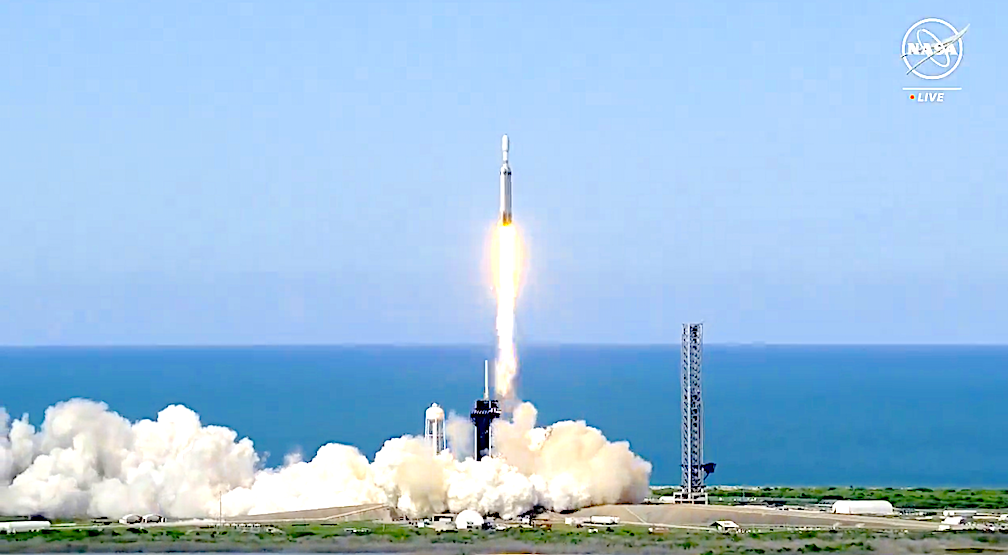
SpaceX launches NOAA’s “monumental” GOES-U mission claiming “the nation’s most advanced weather observing and environmental monitoring satellite system” 

June 25, 2024

Photo captured on Tuesday, June 25, by Satnews from NASA TV’s video stream.

On Tuesday, June 25 at 5:26 p.m. ET, Falcon Heavy launched the National Oceanic and Atmospheric Administration’s (NOAA) GOES-U mission to a geostationary orbit from Launch Complex 39A (LC-39A) at NASA’s Kennedy Space Center in Florida. In addtion the event included a most impressive double booster landing of the Falcon Heavy’s side boosters (see below).

The GOES-U satellite will orbit above the Earth’s equator at approximately 35,700 km (22,236 mi) observing weather patterns in the contiguous USA, Central and South America, and Atlantic Ocean. GOES-U is part of NOAA’s most sophisticated Geostationary Operational Environmental Satellites (GOES) series and will assist weather forecasters and climate researchers with real-time high-resolution imagery, earlier detection of severe weather that could save lives, and tropical cyclone forecasts. The weather satellite also carries a suite of space weather instruments that will be used to detect solar storms early and help predict their possible impacts.

GOES-U hosts a suite of instruments that improve the detection of approaching space weather hazards. The Solar Ultraviolet Imager (SUVI) and Extreme Ultraviolet and X-ray Irradiance Sensors (EXIS) provide imaging of the sun and detection of solar flares. The Compact Coronagraph-1 (CCOR-1) images the solar corona (outer layer of the sun’s atmosphere) to detect and characterize coronal mass ejections (CMEs). CCOR-1 is a new instrument for GOES-U and is part of NOAA’s Space Weather Follow On mission. 

The Space Environment In-Situ Suite (SEISS) and Magnetometer monitor, respectively, energetic particles and the magnetic field variations that are associated with space weather. Together, observations from these instruments contribute to space weather forecasts and early warning of disruptions to power utilities and communication and navigation systems as well as radiation damage to orbiting satellites. 
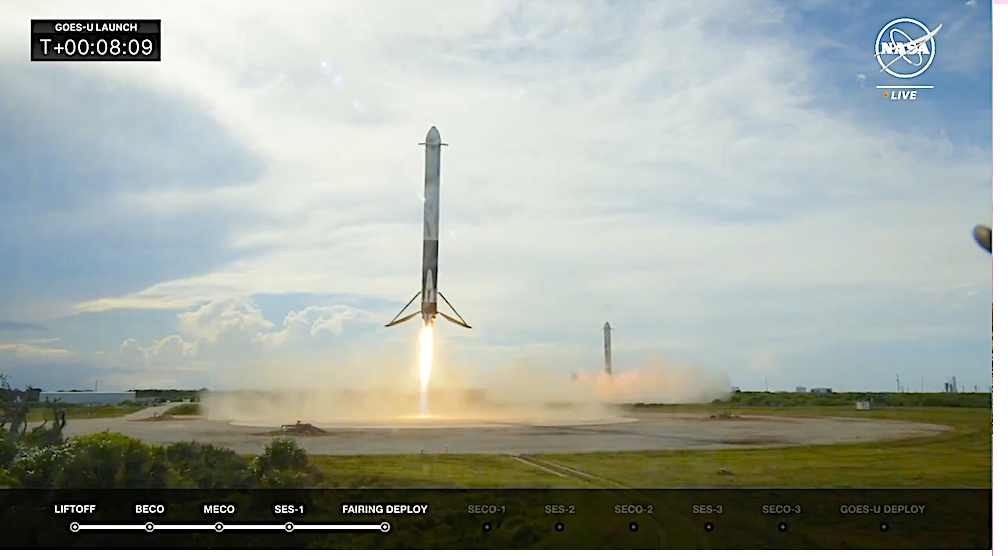
Photo captured on Tuesday, June 25, by Satnews from NASA TV’s video stream.

This was the first launch for Falcon Heavy’s two side boosters. Following booster separation, the boosters successfully landed on SpaceX’s Landing Zones 1 and 2 (LZ-1 and LZ-2) at Cape Canaveral Space Force Station in Florida.
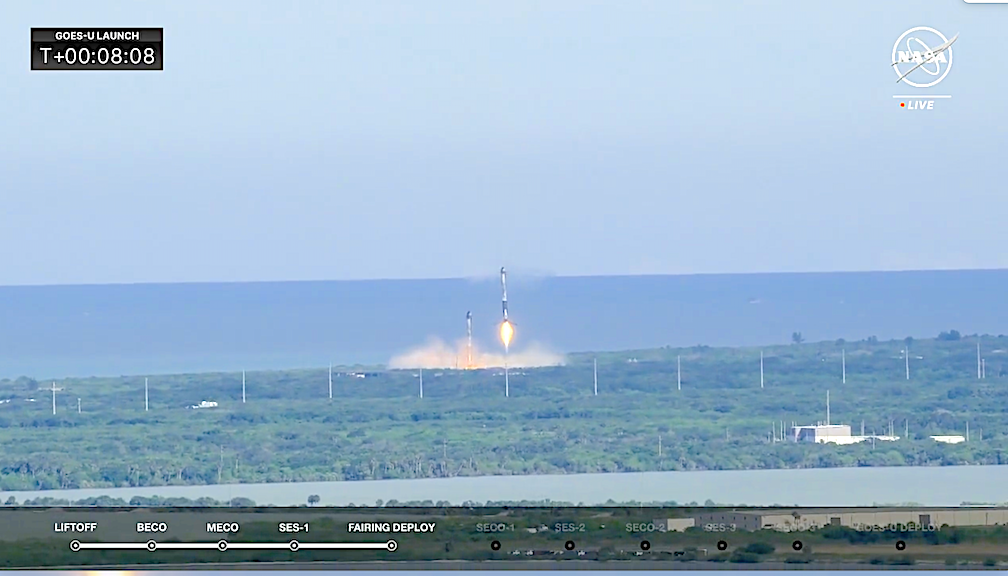
Photo captured on Tuesday, June 25, by Satnews from NASA TV’s video stream.

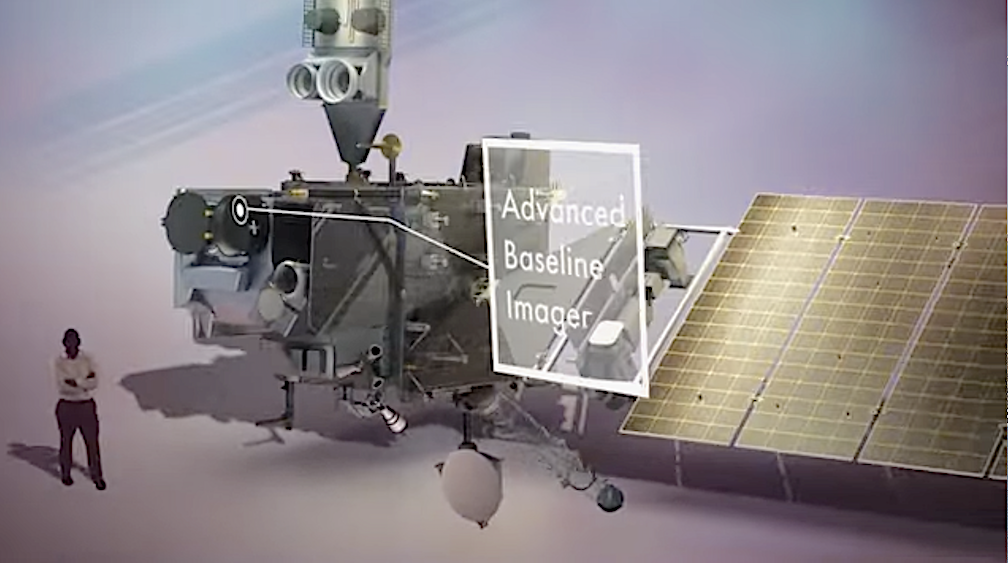
The Advanced Baseline Imager (ABI) is the primary instrument on the GOES-R Series satellites for imaging Earth’s weather, ocean and environment. Forecasters use ABI data for a wide range of applications related to severe weather, hurricanes, aviation, natural hazards, the atmosphere, ocean and cryosphere. 

The Geostationary Lightning Mapper (GLM) is the first operational lightning mapper flown in geostationary orbit. Developing severe storms often exhibit a significant increase in lightning activity and GLM data can help forecasters focus on initial  thunderstorm development and intensifying severe storms before they produce damaging winds, hail or even tornadoes. 

GOES-U will provide critical atmospheric, hydrologic, oceanic, climatic, solar and space data for advanced detection and monitoring of environmental phenomena that threaten the security and well-being of everyone in the Western Hemisphere.

  • Hurricane track and intensity forecasts 
  • Early warning of severe storms and tornadoes 
  • Fire detection, monitoring, and intensity estimation 
  • Identification of lightning strikes most likely to ignite fires 
  • Detection of low clouds and fog 
  • Monitoring of atmospheric river events that can cause flooding and mudslides 
  • Monitoring of smoke, dust and aerosols 
  • Data for air quality warnings and alerts 
  • Data for aviation route planning and reducing weather-related flight delays 
  • Detection of volcanic eruptions and monitoring of ash and sulfur dioxide 
  • Detection of heavy rainfall and flash flood risks 
  • Sea surface temperature data for monitoring fisheries and marine life 
  • Monitoring of vegetative health 
  • Data for long-term climate variability studies 
  • Detection of meteors entering Earth’s atmosphere 
  • Detection of coronal holes, solar flares, and coronal mass ejection source regions 
  • Characterization of size, velocity, density and direction of coronal mass ejections 
  • Warning of space weather hazards responsible for communications and navigation disruptions and power blackouts 
  • Monitoring of energetic particles responsible for radiation hazards

SpaceX’s Falcon Heavy to launch second NOAA’s GOES-U weather satellite Tuesday after leak causes delay
NOAA and SpaceX have finally set a date to launch the last satellite of the GOES-R Series into geostationary orbit on June 25 after a lengthy delay due to a rocket booster leak. The launch is to take place at Kennedy Space Center, Florida, 2:16 – 4:16 PM PSDT.

The Geostationary Operational Environmental Satellite-S Series (GOES-S) is the second of the next generation of geostationary weather satellites. The four satellites of the series will provide advanced imaging with increased spatial resolution and faster coverage for more accurate forecasts, real-time mapping of lightning activity, and improved monitoring of solar activity. The cost is $90Million.
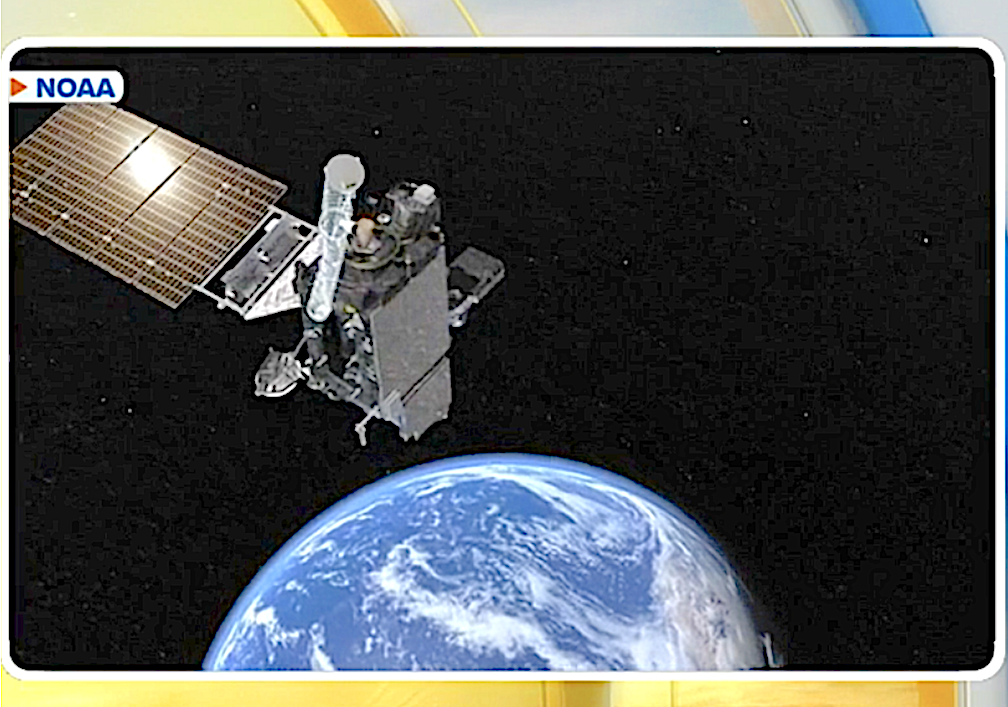
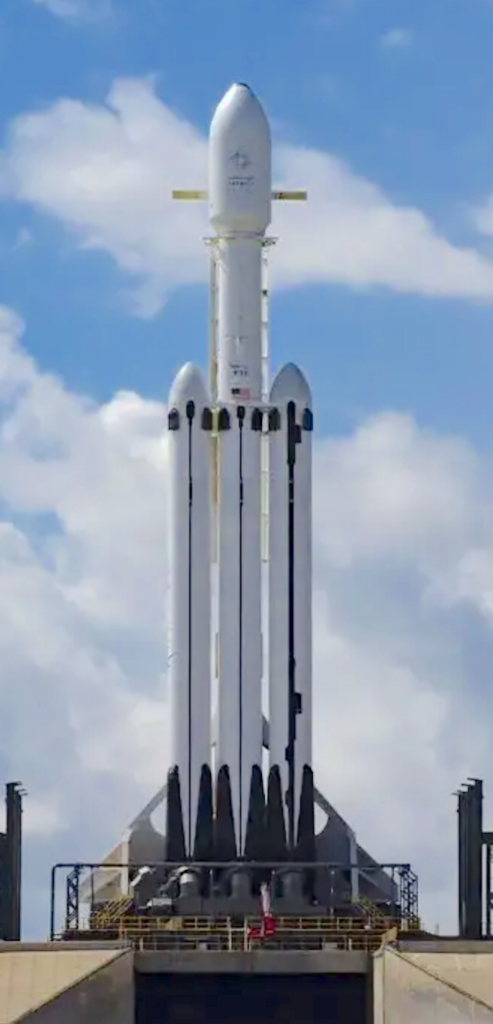
NOAA called this launch “monumental” and claimed its network of Geostationary Operational Environmental Satellites is “the nation’s most advanced weather observing and environmental monitoring satellite system.” 

GOES-U is the fourth and last satellite to join the series. Once in orbit, it will be renamed GOES-19. From 22,236 miles above the equator, GOES-19 will continuously observe weather systems across the Western Hemisphere. It will replace GOES-16 in the GOES-East orbit.

The view from GOES-East and West stretches from the west coast of Africa to New Zealand and from near the Arctic Circle to the Antarctic Circle, according to NOAA.

According to weather officials, there’s a 30% chance of favorable weather conditions at the time of the launch. The forecast calls for a temperature of 86°F, few clouds, 24% cloud cover and a wind speed of 17mph.

The Launch Complex 39A has witnessed the launch of 180 rockets, including 179 orbital launch attempts, while Kennedy Space Center, Florida, has been the site for 238 rocket launches.


Filed Under: Climate & Environmental Monitoring, Earth Observation & Imaging Tagged With: Featured

Primary Sidebar

Coverage

  • Missions & Constellations
  • Business & Finance
  • Military & Defense
  • Launch
  • Software Automation & Ground Systems
  • Government & Regulation
  • Services & Applications

Most Read Stories

  • Rheinmetall Withdraws From Mynaric Bidding Process; Rocket Lab Acquisition Clears Major Competitive Hurdle
  • L3Harris Unveils XL-300P: The First P25 Handheld with 5G and Satellite Direct-to-Device Connectivity
  • Rheinmetall Walked Away. Germany Should Take the Hint.
  • Rocket Lab Emerging as Potential Bus Provider for 2,800-Satellite Equatys Constellation
  • SpaceX Loses Contact With Starlink Satellite

Secondary Sidebar

Footer


Satnews is a leading provider of satellite news, events, publications, research and other satellite industry information in both commercial and military enterprises worldwide.

Stories By Category

  • Business & Finance
  • Government & Regulation
  • Launch
  • Military & Defense
  • Missions & Constellations
  • Services & Applications
  • Software Automation & Ground Systems
  • Spectrum & Licensing
  • Startups & NewSpace Business

About Us

  • Leadership & Editorial Team
  • SatNews History
  • Free Satnews Subscription
  • SatNews Events
  • Magazines

Navigation

  • Latest Stories
  • Magazines
  • Events
  • Contact
  • Cookie & Privacy Policy for Satnews

We use cookies to ensure that we give you the best experience on our website. If you continue to use this site we will assume that you are happy with it.
x
Sign up Now (For Free)
Access daily or weekly satellite news updates covering all aspects of the commercial and military satellite industry.
Invalid email address
Notify Me Regarding ( At least one ):
We value your privacy and will not sell or share your email or other information with any other company. You may also unsubscribe at anytime.

Click Here to see our full privacy policy.
Thanks for subscribing!