• Skip to primary navigation
  • Skip to main content
  • Skip to primary sidebar
  • Skip to secondary sidebar
  • Skip to footer
  • NEWS:
  • SatNews
  • SatMagazine
  • MilSatMagazine
  • SmallSat News
  • |     EVENTS:
  • SmallSat Symposium
  • Satellite Innovation
  • MilSat Symposium
  • SmallSat Europe

SatNews

Satellite Industry Intelligence Since 1983

Subscribe
  • LATEST
  • SatNews Events
  • Magazines
  • Calendar
  • Subscribe
  • Missions & Constellations
    • Exploration & Science Missions
    • In-Orbit Servicing & Orbital Operations
    • LEO Constellations
    • Mission Autonomy & Onboard Systems
    • Mission Deployments & Manifests
    • Navigation & PNT
    • SmallSat
    • Spacecraft & Payload Technology
    View All in Missions & Constellations →
    CesiumAstro Secures $730M Series D at $4.5B Valuation to Deploy Synchronicity ConstellationCesiumAstro Secures $730M Series D at $4.5B Valuation to Deploy Synchronicity Constellation
    Pentagon Commits $150M OSC Loan to LeoLabs in $300M Radar Network ExpansionPentagon Commits $150M OSC Loan to LeoLabs in $300M Radar Network Expansion
    Redwire Wins $20M DARPA Contract for Scaled SabreSat VLEO Precursor FlightRedwire Wins $20M DARPA Contract for Scaled SabreSat VLEO Precursor Flight
    NASA Awards $1.07B in Ka-Band Space Relay Contracts to Viasat, SES and AstranisNASA Awards $1.07B in Ka-Band Space Relay Contracts to Viasat, SES and Astranis
  • Business
    • Contracts & Commercial Deals
    • Earnings & Financial Reporting
    • Events & Conferences
    • Funding & Venture Capital
    • Market Forecasts
    • Mergers & Acquisitions
    • Personnel Moves & Appointments
    View All in Business & Finance →
    SpaceX Selects Qualcomm to Supply Terrestrial Base Stations for Starlink Mobile NetworkSpaceX Selects Qualcomm to Supply Terrestrial Base Stations for Starlink Mobile Network
    SpaceX Explores Boost Mobile Acquisition in Push to Build Hybrid Terrestrial-Satellite NetworkSpaceX Explores Boost Mobile Acquisition in Push to Build Hybrid Terrestrial-Satellite Network
    MDA Space Secures C$100M+ Thales Alenia Space Award for First 66 IRIS² SatellitesMDA Space Secures C$100M+ Thales Alenia Space Award for First 66 IRIS² Satellites
    Northwood Space Secures $375M Series C at $2B Valuation to Expand Shared Ground Station NetworkNorthwood Space Secures $375M Series C at $2B Valuation to Expand Shared Ground Station Network
  • Defense
    • Counterspace & ASAT
    • Defense Budgets & Procurement
    • ISR & Reconnaissance
    • MILSATCOM
    • Missile Warning & Defense
    • National Security Programs
    • Space Domain Awareness
    View All in Military & Defense →
    ThinKom and Space Systems Command Demonstrate GECKO Multi-Orbit Containerized SATCOM SystemThinKom and Space Systems Command Demonstrate GECKO Multi-Orbit Containerized SATCOM System
    Vantor Cuts Satellite Imagery Delivery Time to Seven Minutes in Ukrainian Field DemonstrationVantor Cuts Satellite Imagery Delivery Time to Seven Minutes in Ukrainian Field Demonstration
    L3Harris Secures $36M Army SATCOM Order for Hawkeye 4 Lite Terminals Supporting C2NOWL3Harris Secures $36M Army SATCOM Order for Hawkeye 4 Lite Terminals Supporting C2NOW
    Space Force Awards Lockheed Martin $95M GPS IIIF Modification, Bringing Contract Face Value to $4.73BSpace Force Awards Lockheed Martin $95M GPS IIIF Modification, Bringing Contract Face Value to $4.73B
  • Gov
    • Export Controls & Compliance
    • International Space Agreements
    • National Space Policy
    • Space Law & Treaties
    • Space Sustainability & Debris Policy
    • Space Traffic Management / Debris Removal
    View All in Government & Regulation →
    Globalstar Petitions FCC to Scrutinize Rocket Lab Supplier Conflict Over $8B Iridium DealGlobalstar Petitions FCC to Scrutinize Rocket Lab Supplier Conflict Over $8B Iridium Deal
    Russia Files ITU Plan for 374-Satellite Rassvet-4 Constellation Following Rassvet-3 Orbital SetbacksRussia Files ITU Plan for 374-Satellite Rassvet-4 Constellation Following Rassvet-3 Orbital Setbacks
    FCC Proposes 25 MHz Mid-Band Spectrum Auction with Dual 5G and Direct-to-Device AllocationsFCC Proposes 25 MHz Mid-Band Spectrum Auction with Dual 5G and Direct-to-Device Allocations
    Part 100 Puts FCC Satellite Licensing on an Assembly LinePart 100 Puts FCC Satellite Licensing on an Assembly Line
  • Launch
    • Launch Providers
    • Launch Schedule & Calendars
    • Launch Sites & Infrastructure
    • Rocket Technology & Vehicles
    View All in Launch →
    Amazon Navigates Launch Delays with Under 400 Satellites in Orbit Ahead of Nov. 13 Vulcan ReturnAmazon Navigates Launch Delays with Under 400 Satellites in Orbit Ahead of Nov. 13 Vulcan Return
    NASA Outlines Artemis IV Starship Refueling Architecture as Launch Estimates VaryNASA Outlines Artemis IV Starship Refueling Architecture as Launch Estimates Vary
    HIMERA and GomSpace Begin Orbital Operations of OBRIA NANO Test Satellite for Sovereign Ukrainian NetworkHIMERA and GomSpace Begin Orbital Operations of OBRIA NANO Test Satellite for Sovereign Ukrainian Network
    Blue Origin Reconstructs Launch Complex 36 Tower, Targets November Return to Flight for New GlennBlue Origin Reconstructs Launch Complex 36 Tower, Targets November Return to Flight for New Glenn
  • Software
    • Autonomous Ground Operations
    • Data Processing & AI/ML
    • Digital Twins & Modeling
    • Ground Segment & Teleports
    • Mission Planning & Simulation
    • Space Systems Software Engineering
    • Spectrum & Licensing
    View All in Software Automation & Ground Systems →
    MBSat Selects ST Engineering iDirect Intuition Platform for Ground Infrastructure in OmanMBSat Selects ST Engineering iDirect Intuition Platform for Ground Infrastructure in Oman
    AnySignal Co-Founder Urges Ground Station Interoperability to Resolve Orbital Data BottlenecksAnySignal Co-Founder Urges Ground Station Interoperability to Resolve Orbital Data Bottlenecks
    Arqiva Secures Three-Year Satellite Services Agreement with Kuwait’s GulfsatArqiva Secures Three-Year Satellite Services Agreement with Kuwait’s Gulfsat
    TrustPoint and Calian Deliver Industry’s First Mass-Market Ready C-band GNSS AntennaTrustPoint and Calian Deliver Industry’s First Mass-Market Ready C-band GNSS Antenna
  • Services & Apps
    • Climate & Environmental Monitoring
    • Disaster Response & Security Mapping
    • Earth Observation & Imaging
    • Maritime & Aviation Satcom
    • Satellite Communications
    View All in Services & Applications →
    Ubotica Demonstrates Autonomous Onboard Satellite Scheduling for Maritime SurveillanceUbotica Demonstrates Autonomous Onboard Satellite Scheduling for Maritime Surveillance
    UniSQ Demonstrates Tomographic Spectrometer During KREPE-3 Re-Entry CampaignUniSQ Demonstrates Tomographic Spectrometer During KREPE-3 Re-Entry Campaign
    Orbital Sentry Develops Persistent Geostationary Infrared Sensor for Real-Time Wildfire DetectionOrbital Sentry Develops Persistent Geostationary Infrared Sensor for Real-Time Wildfire Detection
    NASA’s Swift Observatory Expected to Burn Up in Atmospheric Reentry Following Failed Commercial RescueNASA’s Swift Observatory Expected to Burn Up in Atmospheric Reentry Following Failed Commercial Rescue

Update to ULA’s first human launch of NASA astronauts Wilmore and Williams to ISS

May 1, 2024

Launch Vehicle on Stand: Atlas V Starliner Crew Flight Test
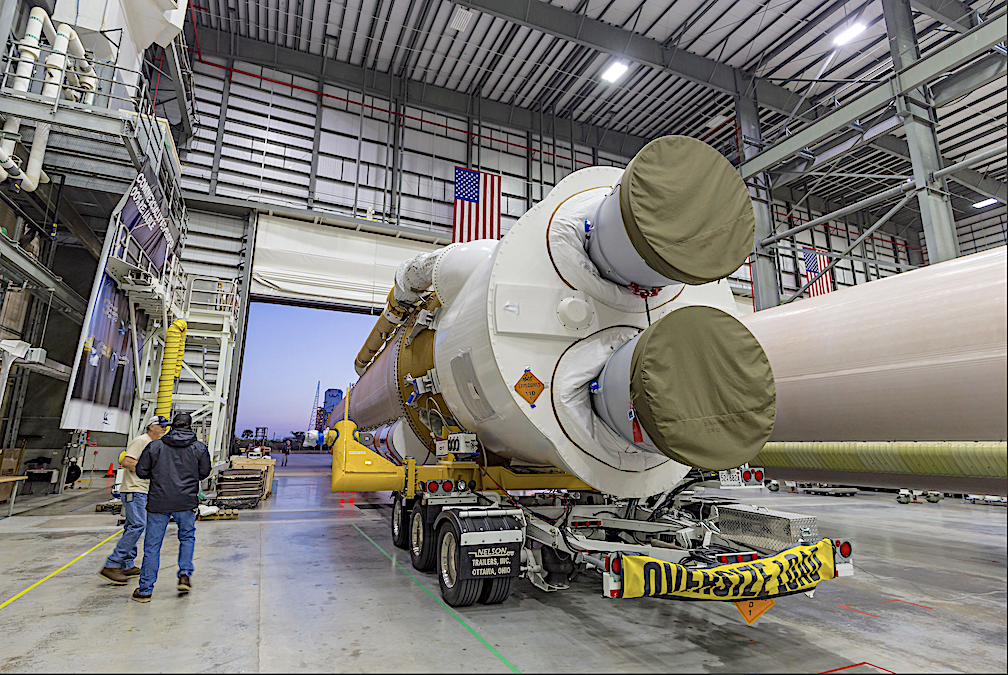
The United Launch Alliance (ULA) Atlas V booster arrives at the Vertical Integration Facility (VIF) adjacent to Space Launch Complex-41 at Cape Canaveral Space Force Station. The rocket will launch Boeing’s Starliner spacecraft on the Crew Flight Test (CFT) with NASA astronauts Butch Wilmore and Suni Williams to the International Space Station. Photo by United Launch Alliance

Daily routines and dress rehearsals keep everyone busy in preparation for the first launch of humans in an ULA Atlas V rocket to the ISS. Here’s a peek at some of the proceedings that are taking place in beautiful Florida and the weather is picture perfect.
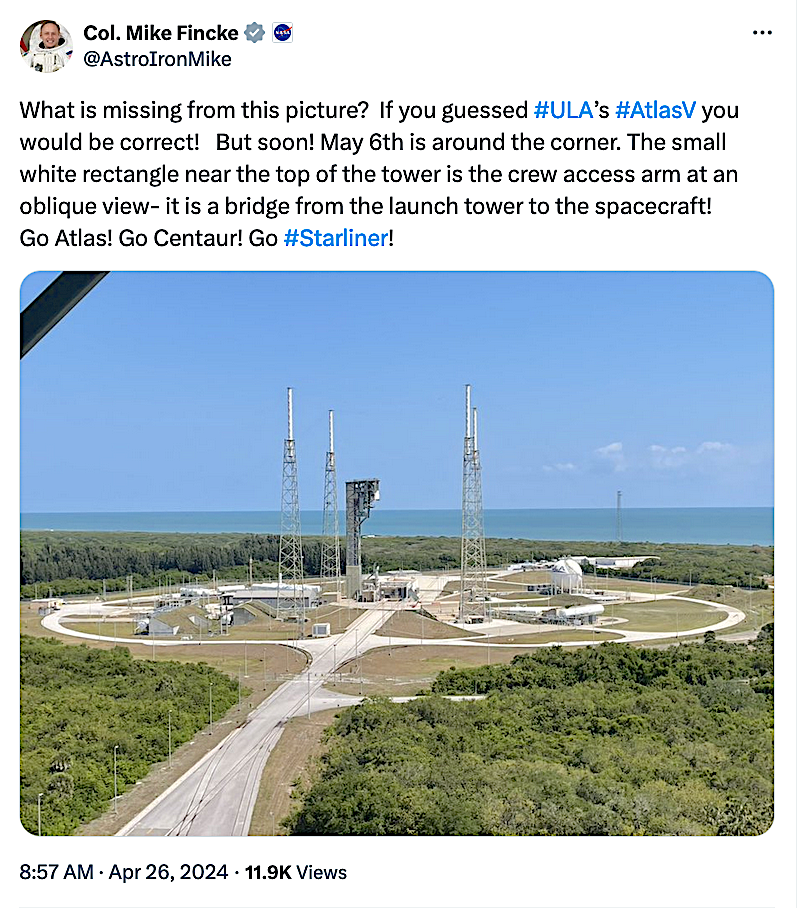
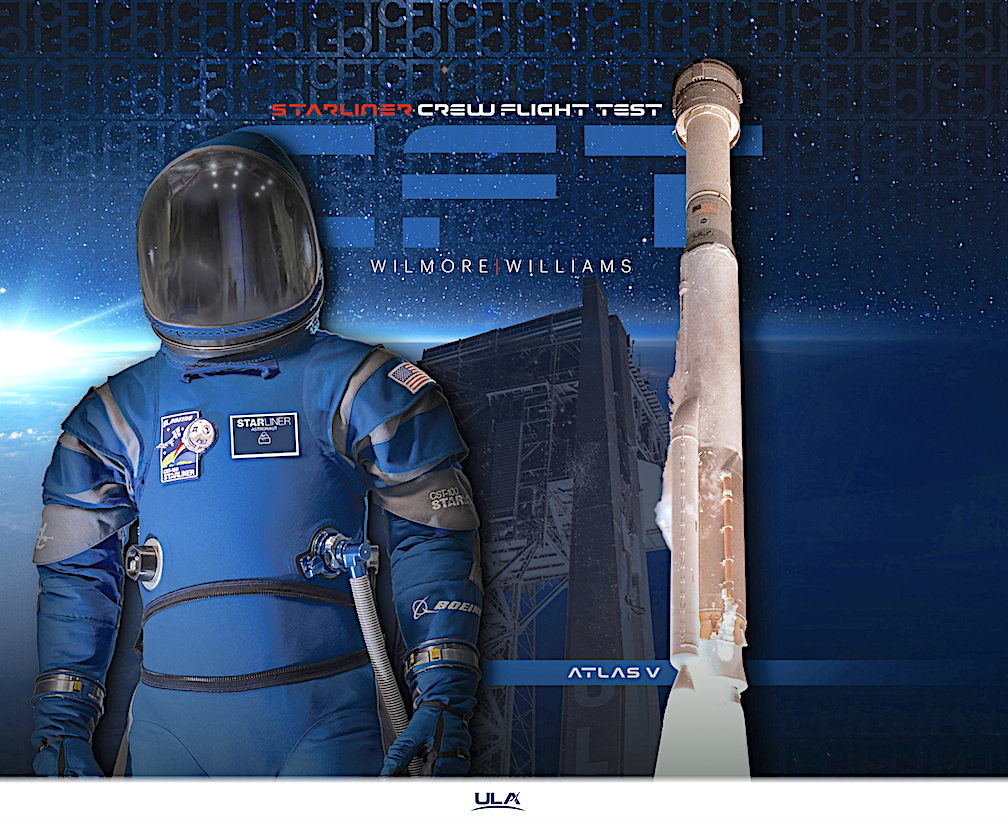
A United Launch Alliance (ULA) Atlas V rocket will launch on May 6, 2024 at 10:34 p.m. EDT  Boeing’s Crew Space Transportation (CST)-100 Starliner spacecraft with two NASA astronauts, Barry “Butch” Wilmore and Sunita (Suni) Williams on the Crew Flight Test (CFT).
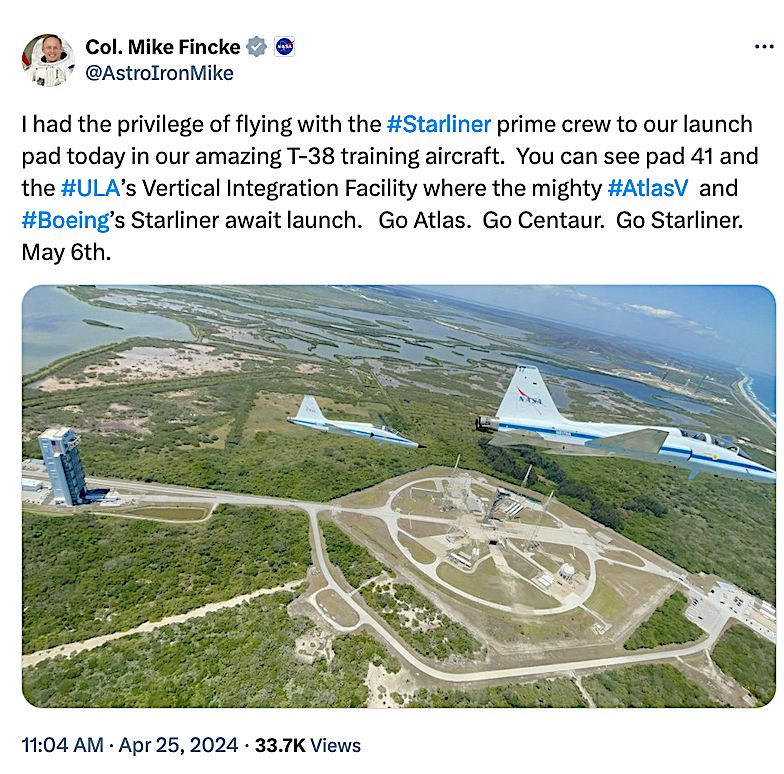

Ed Van Cise @ Carbon_Flight
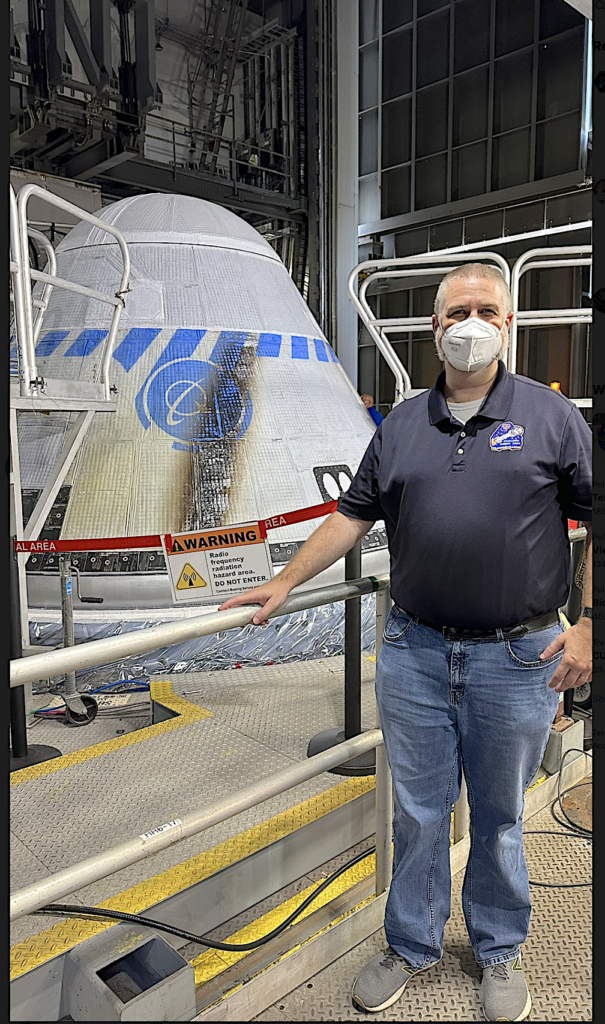
A very successful mission dress rehearsal is complete! This was the last integrated training event before launch. I was fortunate to be able to observe the crew with @AstroIronMi
while @Saturn_Flight
led the MCC activities. Go #Starliner! Go CFT!


ULA’s Atlas V Starliner’s first human launch of NASA astronauts Wilmore and Williams to ISS

This image has an empty alt attribute; its file name is Screen-Shot-2024-04-29-at-6.18.35-PM.png

A United Launch Alliance (ULA) Atlas V rocket will launch on May 6, 2024 at 10:34 p.m. EDT  Boeing’s Crew Space Transportation (CST)-100 Starliner spacecraft with two NASA astronauts, Barry “Butch” Wilmore and Sunita (Suni) Williams on the Crew Flight Test (CFT).
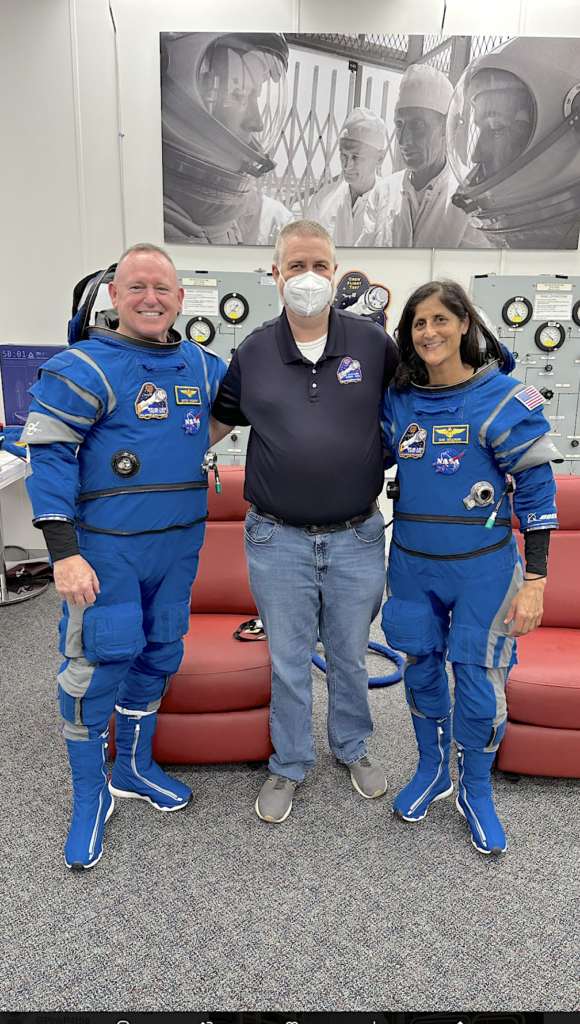
Following separation from Atlas V, Starliner engines will burn taking it the rest of the way to orbit and on to the International Space Station. CFT is ULA’s first human launch. Liftoff will occur from Space Launch Complex-41 at Cape Canaveral Space Force Station, Florida. Go Atlas! Go Centaur! Go Starliner! 

Mission Overview

A United Launch Alliance (ULA) Atlas V rocket will launch Boeing’s Crew Space Transportation (CST)-100 Starliner spacecraft with two NASA astronauts on the Crew Flight Test (CFT). Following separation from Atlas V, Starliner engines will burn taking it the rest of the way to orbit and on to the International Space Station. CFT is ULA’s first human launch. Liftoff will occur from Space Launch Complex-41 at Cape Canaveral Space Force Station, Florida.

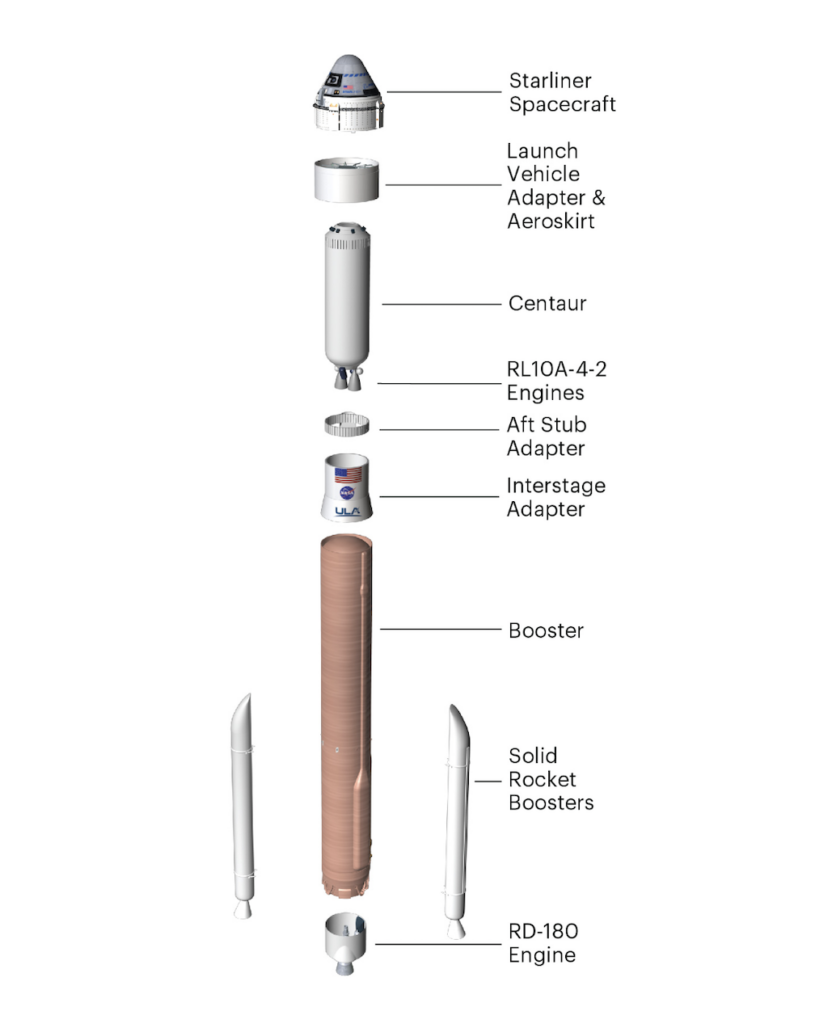
CFT is the final test to demonstrate the full end-of-end capabilities of the Starliner system to deliver crews to and from the space station as part of NASA’s Commercial Crew Program. The unique Atlas configuration for Starliner includes a dual-engine Centaur upper stage to deliver the performance needed to shape the trajectory for crew safety; a launch vehicle adapter that structurally attaches the Starliner to the Atlas V rocket for ascent; a 70-inch-long (1.8-m) aeroskirt to enhance the aerodynamic characteristics, stability and loads of the Atlas V; and an Emergency Detection System that provides an extra layer of safety for astronauts riding the reliable Atlas V. The Atlas V Starliner launch countdown features a four-hour planned, built-in hold at the T-minus 4-minute mark. This allows the rocket to be fueled and placed in a quiescent state before boarding of the astronauts into the spacecraft.

CFT bridges the history of Atlas with today’s rocket. The first orbital spaceflights of American astronauts in the 1960s were launched in Project Mercury by Atlas rockets from Cape Canaveral. That legacy continues with Atlas V launching crews from U.S. soil.

Launch Vehicle

Spacecraft

Modified specifically for the Boeing CST-100 Starliner spacecraft, the Atlas V Starliner configuration does not include a payload fairing. Instead, the Starliner’s insulated surfaces take the place of the fairing to protect the uncrewed spacecraft during ascent. The vehicle’s height with the Boeing CST-100 Starliner is approximately 172 ft (52.4 meters).

The CST-100 Starliner is attached to the Atlas V using a launch vehicle adapter (LVA), which also includes an aeroskirt to reduce the aerodynamic loads on the vehicle. The aeroskirt is jettisoned for improved performance following booster stage separation.

Centaur

The Centaur second stage is 10 ft (3 meters) in diameter and 41.5 ft (12.6 meters) in length. Its propellant tanks are pressure-stabilized and constructed of corrosion-resistant stainless steel. Centaur is a cryogenic vehicle, fueled with liquid hydrogen and liquid oxygen. The Atlas V configuration for this mission is powered by dual RL10A-4-2 engines, each producing 22,600 lbs (100.5 kilo-Newtons) of thrust. The cryogenic tanks are insulated with a combination of helium-purged blankets, radiation shields and spray-on foam insulation (SOFI). The Centaur forward adapter (CFA) provides structural mountings for the fault-tolerant avionics system and electrical interfaces with the spacecraft. The Centaur also includes an Emergency Detection System (EDS) that monitors for critical hazards to detect an imminent or occurring failure. The EDS also provides critical in-flight data which supports jettison of the ascent cover and initiates CST-100 Starliner spacecraft separation.

Booster

The booster is 12.5 ft (3.81 meters) in diameter and 106.5 ft (32.4 meters) in length. The booster’s tanks are structurally rigid and constructed of isogrid aluminum barrels, spun-formed aluminum domes and intertank skirts. Booster propulsion is provided by the RD-180 engine system (a single engine with two thrust chambers). The RD-180 burns RP-1 (Rocket Propellant-1 or highly purified kerosene) and liquid oxygen and delivers 860,200 lbs (3.83 mega-Newtons) of thrust at sea level. Two solid rocket boosters (SRBs) generate the additional power required at liftoff, with each SRB providing 348,500 lbs (1.55 mega-Newtons) of thrust. The Centaur avionics system provides guidance, flight control and vehicle sequencing functions during the booster and Centaur phases of flight.

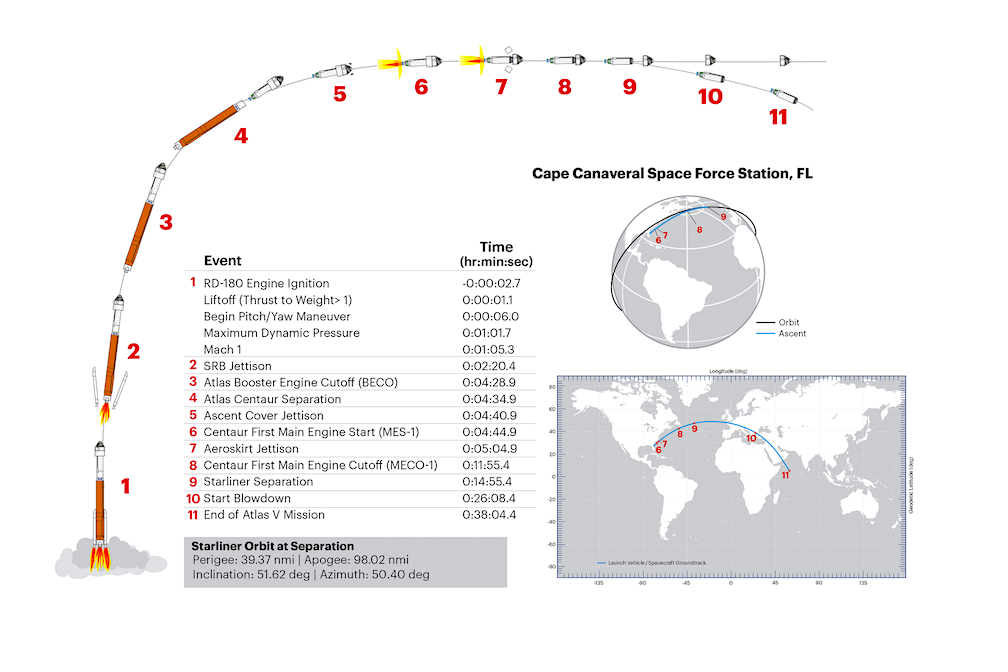
Flight Profile
This image has an empty alt attribute; its file name is Screen-Shot-2024-04-29-at-6.46.05-PM-815x1024.png
This image has an empty alt attribute; its file name is Screen-Shot-2024-04-29-at-6.47.03-PM.png

Space Launch Complex-41 // Processing
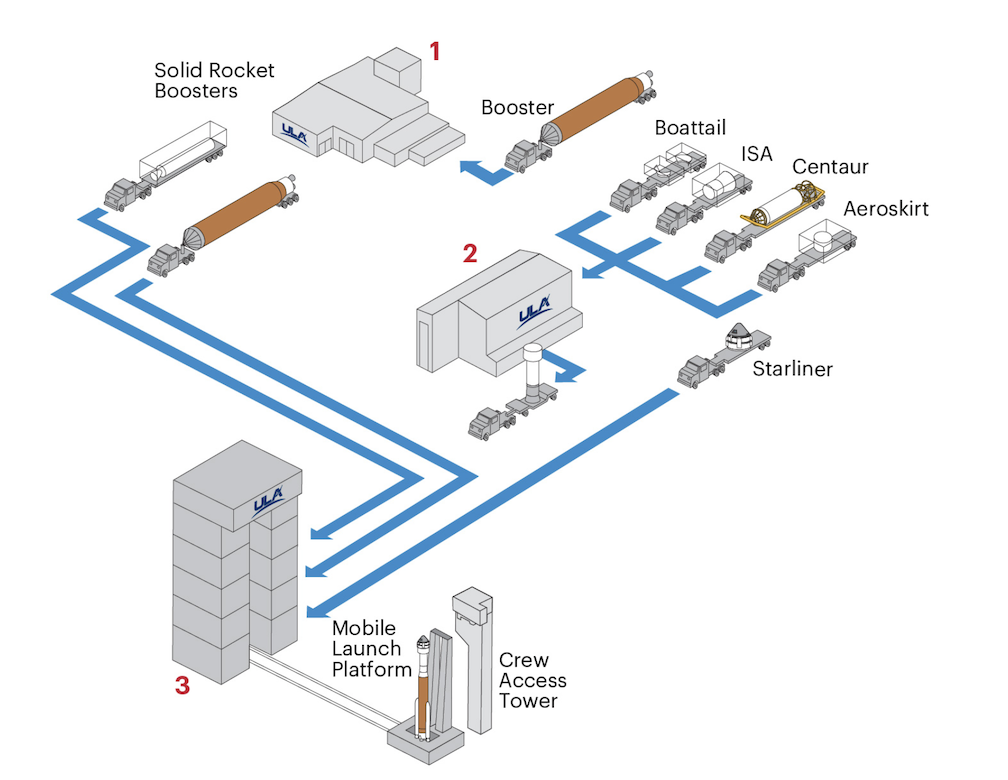
This image has an empty alt attribute; its file name is Screen-Shot-2024-04-29-at-6.48.11-PM.png

Space Launch Complex-41 (SLC-41), the East Coast home of the Atlas V rocket at Cape Canaveral Space Force Station in Florida, employs a “clean pad” concept of operations to ready launch vehicles and payloads for ascent into space. The rocket elements are assembled atop a Mobile Launch Platform inside the Vertical Integration Facility (VIF) located adjacent to the launch pad. The platform and fully stacked Atlas V then travel by rail approximately 1,800 feet northward from the VIF to the pad for the final countdown, fueling and liftoff. Complex 41 was constructed by the U.S. Air Force in the 1960s for the Titan rocket program. The site was rejuvenated in support of the Atlas V starting in the late 1990s.

1. Advanced Spaceflight Operations Center (ASOC)
    Launch Control Center 
    Mission Director’s Center, 
    Mission Support Teams,
    Launch Vehicle Horizontal Processing &
    Ordnance Installation
2. Delta Operations Center (DOC)
    ISA, Centaur, Boattail & Aeroskirt Vertical Integration
3. Vertical Integration Facility 
    Launch Vehicle Integration &
    Testing, Spacecraft Mate &
    Integrated Operations

Production
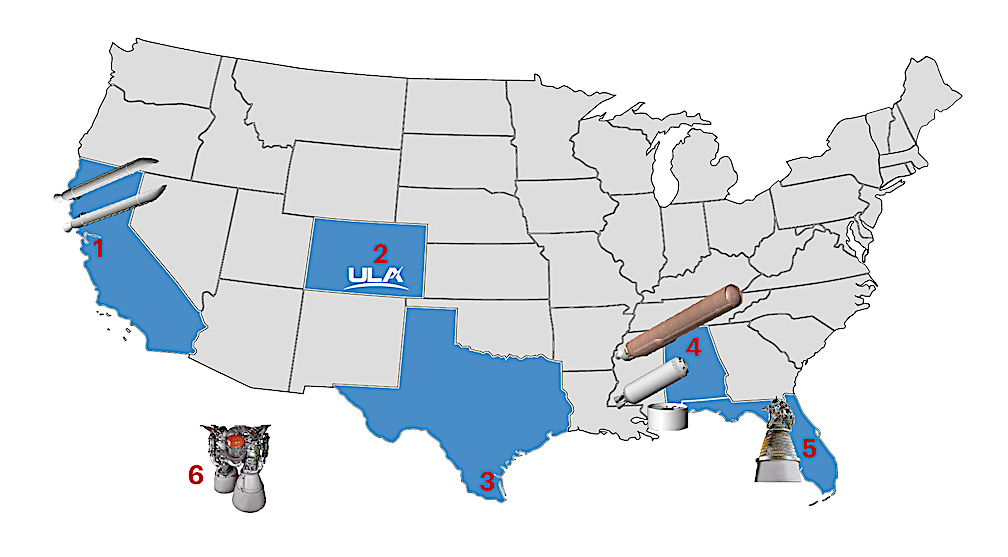
This image has an empty alt attribute; its file name is Screen-Shot-2024-04-29-at-6.49.41-PM.png

1. Sacramento, CA
    Solid Rocket Booster Fabrication
    at Aerojet Rocketdyne
2. Denver, CO
    ULA Headquarters &
    Design Center Engineering
3. Harlingen, TX
    Booster Adapter &
    Centaur Adapter Fabrication
4. Decatur, AL
    Booster Fabrication & Final Assembly,
    Centaur Tank Fabrication & Final Assembly
5. West Palm Beach, FL
    RL10A-4-2 Engine Fabrication at
    Aerojet Rocketdyne
6. Khimki, Russia

    RD-180 Engine Fabrication at
    NPO Energomash

  

Filed Under: Contracts & Commercial Deals, Exploration & Science Missions

Primary Sidebar

Coverage

  • Missions & Constellations
  • Business & Finance
  • Military & Defense
  • Launch
  • Software Automation & Ground Systems
  • Government & Regulation
  • Services & Applications

Most Read Stories

  • SpaceX Acquires Grain Management’s 800 MHz Spectrum Portfolio to Launch Standalone Starlink Mobile Carrier
  • FCC Grants SpaceX Approval for 15,000-Satellite Very Low Earth Orbit Direct-to-Device Constellation
  • Rocket Lab Challenges NASA’s $700M Mars Orbiter Award to Blue Origin While Scaling Vertical Integration via $8B Iridium Acquisition
  • Amazon Leo Plans Prime Subscription Bundling to Challenge Starlink in Consumer Satellite Broadband Market
  • SpaceX Restricts Military Starshield Speeds in Ukraine, Disrupting Pentagon-Funded Tactical Drone Operations

Secondary Sidebar

Footer


Satnews is a leading provider of satellite news, events, publications, research and other satellite industry information in both commercial and military enterprises worldwide.

Stories By Category

  • Business & Finance
  • Government & Regulation
  • Launch
  • Military & Defense
  • Missions & Constellations
  • Services & Applications
  • Software Automation & Ground Systems
  • Spectrum & Licensing
  • Startups & NewSpace Business

About Us

  • Leadership & Editorial Team
  • SatNews History
  • Free Satnews Subscription
  • SatNews Events
  • Magazines

Navigation

  • Latest Stories
  • Magazines
  • Events
  • Contact
  • Cookie & Privacy Policy for Satnews

We use cookies to ensure that we give you the best experience on our website. If you continue to use this site we will assume that you are happy with it.
x
Sign up Now (For Free)
Access daily or weekly satellite news updates covering all aspects of the commercial and military satellite industry.
Invalid email address
Notify Me Regarding ( At least one ):
We value your privacy and will not sell or share your email or other information with any other company. You may also unsubscribe at anytime.

Click Here to see our full privacy policy.
Thanks for subscribing!