


• Skip to primary navigation
  • Skip to main content
  • Skip to primary sidebar
  • Skip to secondary sidebar
  • Skip to footer
  • NEWS:
  • SatNews
  • SatMagazine
  • MilSatMagazine
  • SmallSat News
  • |     EVENTS:
  • SmallSat Symposium
  • Satellite Innovation
  • MilSat Symposium
  • SmallSat Europe

SatNews

Satellite Industry Intelligence Since 1983

Subscribe
  • LATEST
  • SatNews Events
  • Magazines
  • Calendar
  • Subscribe
  • Missions & Constellations
    • Exploration & Science Missions
    • In-Orbit Servicing & Orbital Operations
    • LEO Constellations
    • Mission Autonomy & Onboard Systems
    • Mission Deployments & Manifests
    • Navigation & PNT
    • SmallSat
    • Spacecraft & Payload Technology
    View All in Missions & Constellations →
    China Accelerates Orbital Internet Deployment with Successful Smart Dragon-3 Sea LaunchChina Accelerates Orbital Internet Deployment with Successful Smart Dragon-3 Sea Launch
    Smallsats Dominate 2025 Launch Landscape as Mass Efficiency PeaksSmallsats Dominate 2025 Launch Landscape as Mass Efficiency Peaks
    MIT STAR Lab Expands Scope from Lasercom Innovation to Space Policy ArchitectureMIT STAR Lab Expands Scope from Lasercom Innovation to Space Policy Architecture
    Northrop Grumman Contracted for Hungary’s HUGEO Sovereign Communications SatelliteNorthrop Grumman Contracted for Hungary’s HUGEO Sovereign Communications Satellite
  • Business
    • Contracts & Commercial Deals
    • Earnings & Financial Reporting
    • Events & Conferences
    • Funding & Venture Capital
    • Market Forecasts
    • Mergers & Acquisitions
    • Personnel Moves & Appointments
    View All in Business & Finance →
    “SpaceX and the biggest IPO in history”“SpaceX and the biggest IPO in history”
    SmallSat Europe Speaker Focus: Chiara Manfletti, NeuraspaceSmallSat Europe Speaker Focus: Chiara Manfletti, Neuraspace
    SmallSat Europe Speaker Focus: Daniel Bock, Morpheus SpaceSmallSat Europe Speaker Focus: Daniel Bock, Morpheus Space
    Lockheed Martin Outlines Strategic Space Technology Roadmap for 2026Lockheed Martin Outlines Strategic Space Technology Roadmap for 2026
  • Defense
    • Counterspace & ASAT
    • Defense Budgets & Procurement
    • ISR & Reconnaissance
    • MILSATCOM
    • Missile Warning & Defense
    • National Security Programs
    • Space Domain Awareness
    View All in Military & Defense →
    NRL to Showcase Sovereign Space Capabilities at 41st Space SymposiumNRL to Showcase Sovereign Space Capabilities at 41st Space Symposium
    Northrop Grumman Minotaur IV Lofted USSF Tech Demonstration Payloads to OrbitNorthrop Grumman Minotaur IV Lofted USSF Tech Demonstration Payloads to Orbit
    The End of the VSAT Parts BinThe End of the VSAT Parts Bin
    Procurement Lag vs. Conflict Speed: Can Defense Buying Cycles Keep Up with Space Innovation?Procurement Lag vs. Conflict Speed: Can Defense Buying Cycles Keep Up with Space Innovation?
  • Gov
    • Export Controls & Compliance
    • International Space Agreements
    • National Space Policy
    • Space Law & Treaties
    • Space Sustainability & Debris Policy
    • Space Traffic Management / Debris Removal
    View All in Government & Regulation →
    FCC Modernizes Satellite Spectrum Rules to Unleash Next-Generation BroadbandFCC Modernizes Satellite Spectrum Rules to Unleash Next-Generation Broadband
    SmallSat Europe Speaker Focus: Dr. Ane Aanesland, ThrustMeSmallSat Europe Speaker Focus: Dr. Ane Aanesland, ThrustMe
    Isaacman’s Budget Math: How NASA Plans to Reach the Moon With a Quarter Less MoneyIsaacman’s Budget Math: How NASA Plans to Reach the Moon With a Quarter Less Money
    FCC Seeks Comment on Expanding Spectrum Access for “Weird Space Stuff”FCC Seeks Comment on Expanding Spectrum Access for “Weird Space Stuff”
  • Launch
    • Launch Providers
    • Launch Schedule & Calendars
    • Launch Sites & Infrastructure
    • Rocket Technology & Vehicles
    View All in Launch →
    What the SpaceX IPO Changes for Every Satellite OperatorWhat the SpaceX IPO Changes for Every Satellite Operator
    €30 million Financing for PLD Space’s Small Satellite Launcher€30 million Financing for PLD Space’s Small Satellite Launcher
    Satellite Deployers to be Used on JAXA Small Satellite Mission by ExolaunchSatellite Deployers to be Used on JAXA Small Satellite Mission by Exolaunch
    CAS Space Successfully Launches Kinetica-2, Aiming for Global Cost LeadershipCAS Space Successfully Launches Kinetica-2, Aiming for Global Cost Leadership
  • Software
    • Autonomous Ground Operations
    • Data Processing & AI/ML
    • Digital Twins & Modeling
    • Ground Segment & Teleports
    • Mission Planning & Simulation
    • Space Systems Software Engineering
    • Spectrum & Licensing
    View All in Software Automation & Ground Systems →
    Archangel Lightworks Secures £10M Series A to Scale Optical Ground InfrastructureArchangel Lightworks Secures £10M Series A to Scale Optical Ground Infrastructure
    Keysight and Sateliot Win ESA and GSMA Foundry Challenge for 6G InnovationKeysight and Sateliot Win ESA and GSMA Foundry Challenge for 6G Innovation
    Automation and Agility: How SSC Space Go is Designed for the New Age of GroundAutomation and Agility: How SSC Space Go is Designed for the New Age of Ground
    Intellian Unveils Future Military and Aerospace Antenna Technologies at Satellite 2026Intellian Unveils Future Military and Aerospace Antenna Technologies at Satellite 2026
  • Services & Apps
    • Climate & Environmental Monitoring
    • Disaster Response & Security Mapping
    • Earth Observation & Imaging
    • Maritime & Aviation Satcom
    • Satellite Communications
    View All in Services & Applications →
    Kraken Robotics Integrates KATFISH Sonar on SEFINE RD-22 USV Following Multi-Naval DemonstrationsKraken Robotics Integrates KATFISH Sonar on SEFINE RD-22 USV Following Multi-Naval Demonstrations
    Astroscale Plans World-First Multi-Orbit Satellite Inspection MissionAstroscale Plans World-First Multi-Orbit Satellite Inspection Mission
    The Downlink Deficit: The Pentagon’s Optical Mesh Network and the Terrestrial BottleneckThe Downlink Deficit: The Pentagon’s Optical Mesh Network and the Terrestrial Bottleneck
    Cinemo Reimagines the Vehicle as a Software-Defined Entertainment HubCinemo Reimagines the Vehicle as a Software-Defined Entertainment Hub

NASA to launch sounding rockets into the Moon’s shadow during solar eclipse

March 26, 2024

NASA intends to launch three sounding rockets during the total solar eclipse on April 8, 2024, to study how Earth’s upper atmosphere is affected when sunlight momentarily dims over a portion of the planet.

The Atmospheric Perturbations around Eclipse Path (APEP) sounding rockets will launch from NASA’s Wallops Flight Facility in Virginia to study the disturbances in the ionosphere created when the Moon eclipses the Sun.

The sounding rockets had been previously launched and successfully recovered from White Sands Test Facility in New Mexico, during the October 2023 annular solar eclipse.
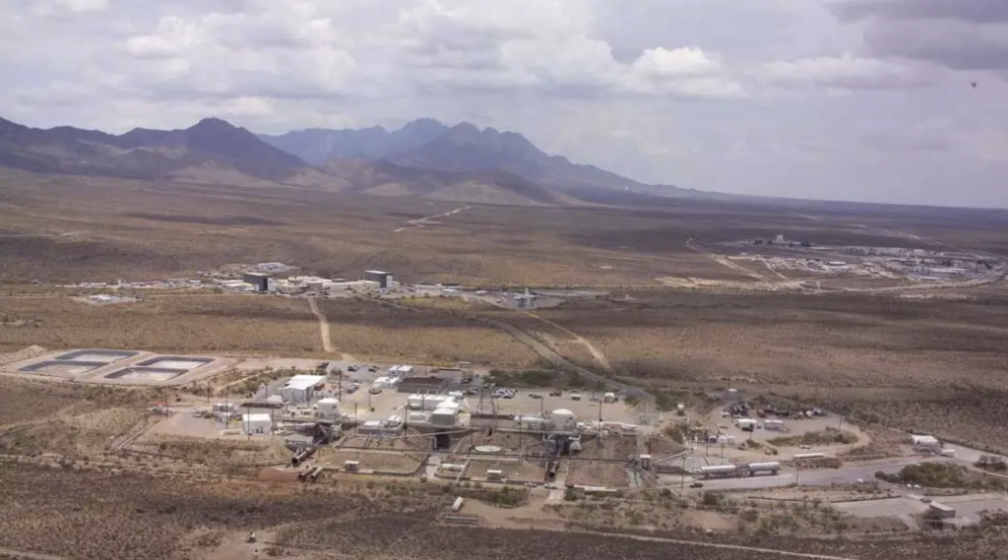
Aerial photo of NASA’s White Sands Test Facility in New Mexico.

They have been refurbished with new instrumentation and will be relaunched in April of 2024. The mission is led by Aroh Barjatya, a professor of engineering physics at Embry-Riddle Aeronautical University in Florida, where he directs the Space and Atmospheric Instrumentation Lab.
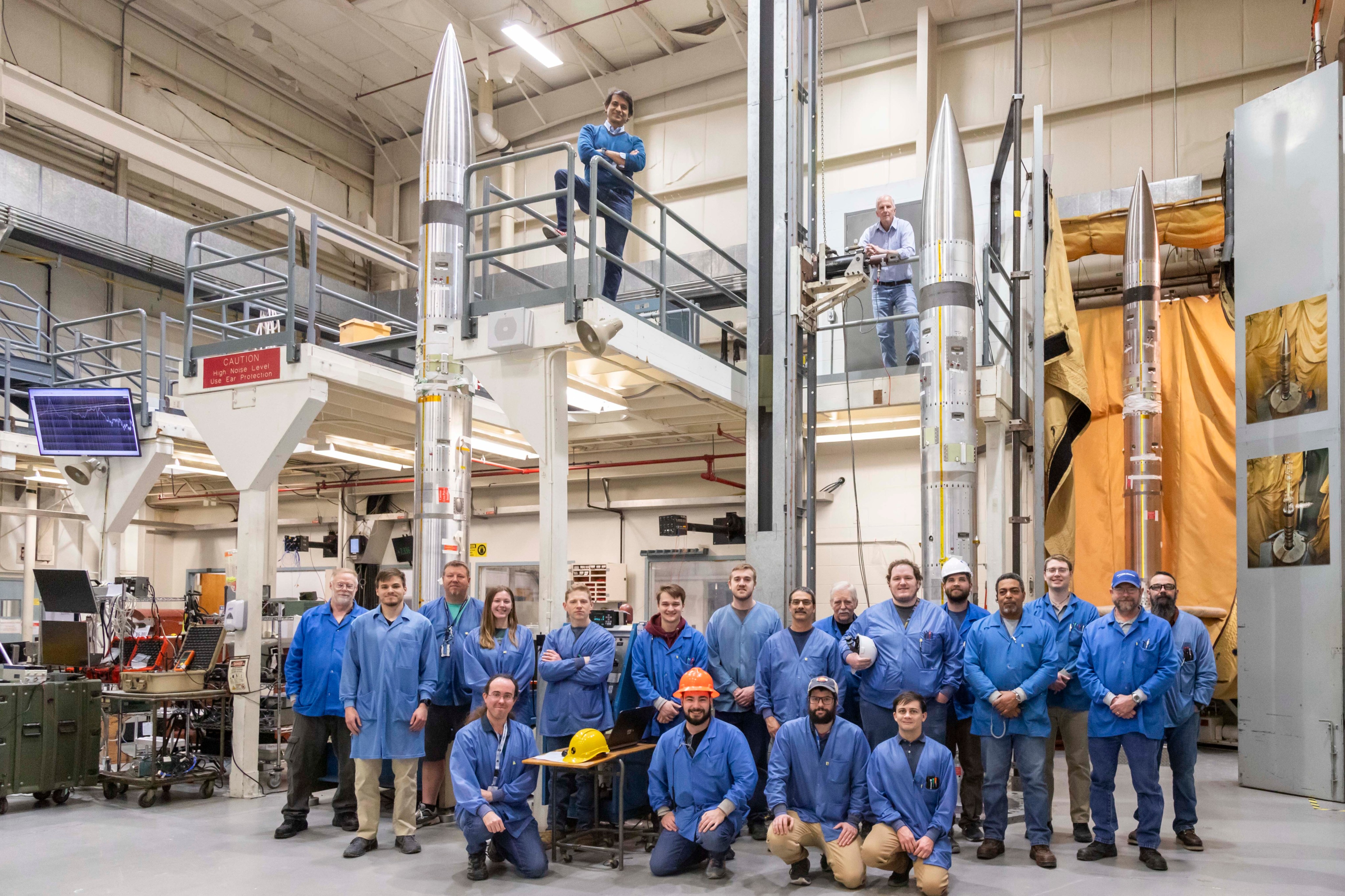
A group of people wearing blue jackets pose for the picture. They stand inside a tall, industrial room. Three silver rockets are behind them.
This photo shows the three APEP sounding rockets and the support team after successful assembly. The team lead, Aroh Barjatya, is at the top center, standing next to the guardrails on the second floor.
NASA/Berit Bland

The sounding rockets will launch at three different times: 45 minutes before, during, and 45 minutes after, the peak local eclipse. These intervals are important to collect data on how the Sun’s sudden disappearance affects the ionosphere, creating disturbances that have the potential to interfere with communications.

This conceptual animation is an example of what observers might expect to see during a total solar eclipse, like the one happening over the United States on April 8, 2024.

A cartoon Earth becomes shadowed as it turns from day to night, to day again. Red swirls sweep across the planet when it's daytime. Satellites orbit around the planet.
An animation depicting changes in the ionosphere over a 24-hour period. The red and yellow swaths represent high-density ionized particles during the day. The purple dots represent neutral, relaxed particles at night.
NASA/Krystofer Kim

The ionosphere is a region of Earth’s atmosphere that is between 55 to 310 miles (90 to 500 kilometers) above the ground.

“It’s an electrified region that reflects and refracts radio signals, and also impacts satellite communications as the signals pass through,” said Barjatya. “Understanding the ionosphere and developing models to help us predict disturbances is crucial to making sure our increasingly communication-dependent world operates smoothly.”

The ionosphere forms the boundary between Earth’s lower atmosphere – where we live and breathe – and the vacuum of space. It is made up of a sea of particles that become ionized, or electrically charged, from the Sun’s energy, or solar radiation. When night falls, the ionosphere thins out as previously ionized particles relax and recombine back into neutral particles. However, Earth’s terrestrial weather and space weather can impact these particles, making it a dynamic region and difficult to know what the ionosphere will be like at a given time. 

It’s often difficult to study short-term changes in the ionosphere during an eclipse with satellites because they may not be at the right place or time to cross the eclipse path. Since the exact date and times of the total solar eclipse are known, NASA can launch targeted sounding rockets to study the effects of the eclipse at the right time and at all altitudes of the ionosphere.

As the eclipse shadow races through the atmosphere, it creates a rapid, localized sunset that triggers large-scale atmospheric waves and small-scale disturbances, or perturbations. These perturbations affect different radio communication frequencies. Gathering the data on these perturbations will help scientists validate and improve current models that help predict potential disturbances to our communications, especially high frequency communication. 
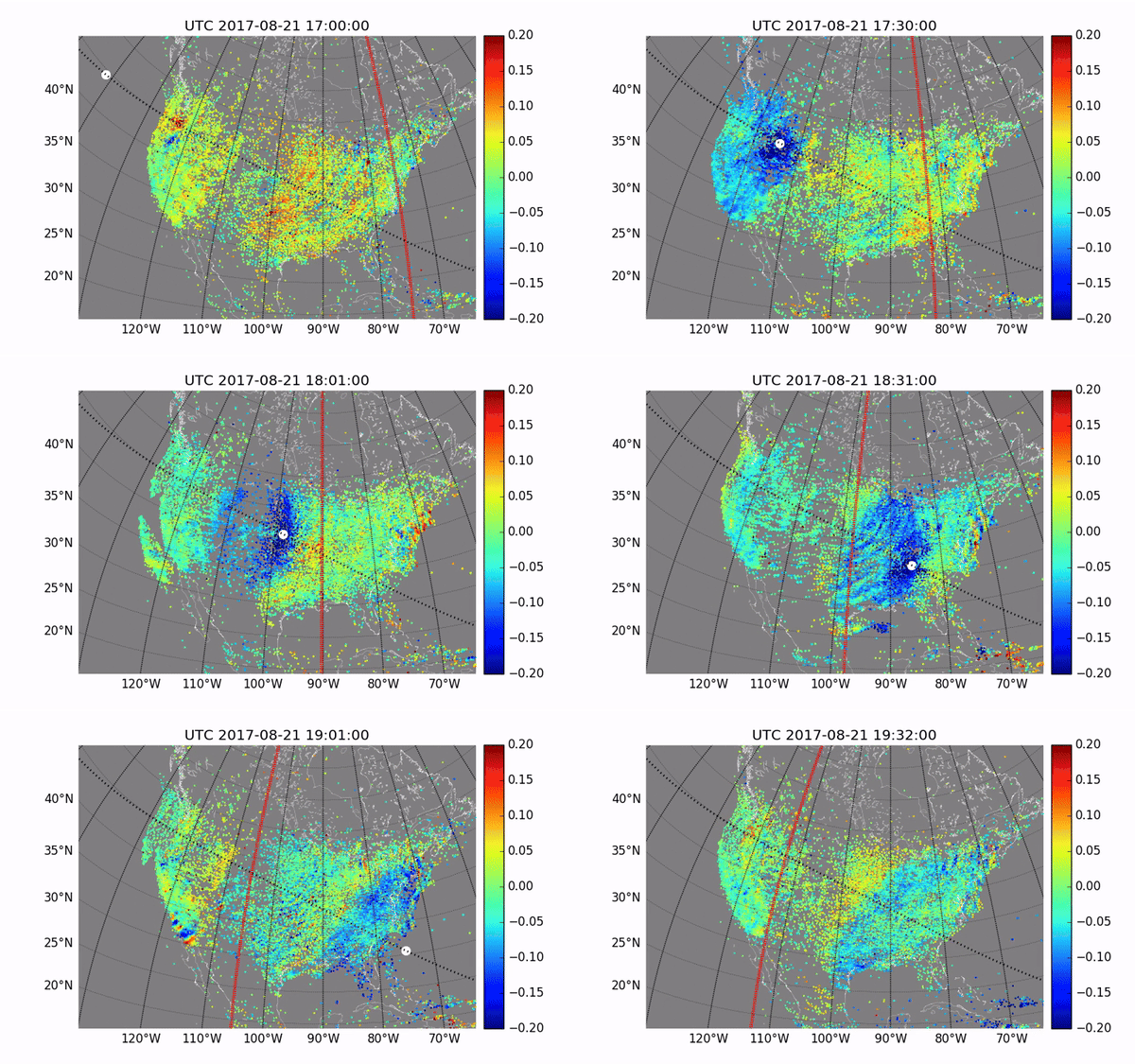
A map of the U.S. on a graph. The map is covered with light green, teal, and yellow dots. As the path of the Moon's shadow sweeps from the northwest US to the southeast US, the dots changed to a dark blue color.
The animation depicts the waves created by ionized particles during the 2017 total solar eclipse. MIT Haystack Observatory/Shun-rong Zhang. Zhang, S.-R., Erickson, P. J., Goncharenko, L. P., Coster, A. J., Rideout, W. & Vierinen, J. (2017). Ionospheric Bow Waves and Perturbations Induced by the 21 August 2017 Solar Eclipse. Geophysical Research Letters, 44(24), 12,067-12,073. https://doi.org/10.1002/2017GL076054.

The APEP rockets are expected to reach a maximum altitude of 260 miles (420 kilometers). Each rocket will measure charged and neutral particle density and surrounding electric and magnetic fields.

“Each rocket will eject four secondary instruments the size of a two-liter soda bottle that also measure the same data points, so it’s similar to results from fifteen rockets, while only launching three,” said Barjatya. Three secondary instruments on each rocket were built by Embry-Riddle, and the fourth one was built at Dartmouth College in New Hampshire.

In addition to the rockets, several teams across the U.S. will also be taking measurements of the ionosphere by various means. A team of students from Embry-Riddle will deploy a series of high-altitude balloons. Co-investigators from the Massachusetts Institute of Technology’s Haystack Observatory in Massachusetts, and the Air Force Research Laboratory in New Mexico, will operate a variety of ground-based radars taking measurements. Using this data, a team of scientists from Embry-Riddle and Johns Hopkins University Applied Physics Laboratory are refining existing models. Together, these various investigations will help provide the puzzle pieces needed to see the bigger picture of ionospheric dynamics.

[To watch this animation, select the graphic.] A sounding rocket is able to carry science instruments between 30 and 300 miles above Earth’s surface. These altitudes are typically too high for science balloons and too low for satellites to access safely, making sounding rockets the only platforms that can carry out direct measurements in these regions. NASA’s Goddard Space Flight Center.

When the APEP sounding rockets launched during the 2023 annular solar eclipse, scientists saw a sharp reduction in the density of charged particles as the annular eclipse shadow passed over the atmosphere.

“We saw the perturbations capable of affecting radio communications in the second and third rockets, but not during the first rocket that was before peak local eclipse,” said Barjatya. “We are super excited to relaunch them during the total eclipse, to see if the perturbations start at the same altitude and if their magnitude and scale remain the same.”

The next total solar eclipse over the contiguous U.S. is not until 2044, so these experiments are a rare opportunity for scientists to collect crucial data.

The APEP launches will be live streamed via NASA’s Wallops’ official YouTube page and featured in NASA’s official broadcast of the total solar eclipse. The public can also watch the launches in person from 1:00 until 4:00 p.m. at the NASA Wallops Flight Facility Visitor Center.

Article authored by Desiree Apodaca, NASA’s Goddard Space Flight Center, Greenbelt, Maryland.

Filed Under: Government & Regulation, Launch Schedule & Calendars

Primary Sidebar

Coverage

  • Missions & Constellations
  • Business & Finance
  • Military & Defense
  • Launch
  • Software Automation & Ground Systems
  • Government & Regulation
  • Services & Applications

Most Read Stories

  • L3Harris Unveils XL-300P: The First P25 Handheld with 5G and Satellite Direct-to-Device Connectivity
  • SpaceX Loses Contact With Starlink Satellite
  • Rheinmetall Walked Away. Germany Should Take the Hint.
  • Rocket Lab Emerging as Potential Bus Provider for 2,800-Satellite Equatys Constellation
  • SpaceX Accelerates Record-Breaking IPO Following Trillion-Dollar xAI Merger

Secondary Sidebar

Footer


Satnews is a leading provider of satellite news, events, publications, research and other satellite industry information in both commercial and military enterprises worldwide.

Stories By Category

  • Business & Finance
  • Government & Regulation
  • Launch
  • Military & Defense
  • Missions & Constellations
  • Services & Applications
  • Software Automation & Ground Systems
  • Spectrum & Licensing
  • Startups & NewSpace Business

About Us

  • Leadership & Editorial Team
  • SatNews History
  • Free Satnews Subscription
  • SatNews Events
  • Magazines

Navigation

  • Latest Stories
  • Magazines
  • Events
  • Contact
  • Cookie & Privacy Policy for Satnews

We use cookies to ensure that we give you the best experience on our website. If you continue to use this site we will assume that you are happy with it.
x
Sign up Now (For Free)
Access daily or weekly satellite news updates covering all aspects of the commercial and military satellite industry.
Invalid email address
Notify Me Regarding ( At least one ):
We value your privacy and will not sell or share your email or other information with any other company. You may also unsubscribe at anytime.

Click Here to see our full privacy policy.
Thanks for subscribing!