

• Skip to primary navigation
  • Skip to main content
  • Skip to primary sidebar
  • Skip to secondary sidebar
  • Skip to footer
  • NEWS:
  • SatNews
  • SatMagazine
  • MilSatMagazine
  • SmallSat News
  • |     EVENTS:
  • SmallSat Symposium
  • Satellite Innovation
  • MilSat Symposium
  • SmallSat Europe

SatNews

Satellite Industry Intelligence Since 1983

Subscribe
  • LATEST
  • SatNews Events
  • Magazines
  • Calendar
  • Subscribe
  • Missions & Constellations
    • Exploration & Science Missions
    • In-Orbit Servicing & Orbital Operations
    • LEO Constellations
    • Mission Autonomy & Onboard Systems
    • Mission Deployments & Manifests
    • Navigation & PNT
    • SmallSat
    • Spacecraft & Payload Technology
    View All in Missions & Constellations →
    NASA Shifts Focus to Permanent Lunar Base and Nuclear PropulsionNASA Shifts Focus to Permanent Lunar Base and Nuclear Propulsion
    Kepler and Astrolight Secure ESA Contract for HydRON Optical NetworkKepler and Astrolight Secure ESA Contract for HydRON Optical Network
    Amazon to Acquire Globalstar for $11.6 Billion to Fuel D2D ExpansionAmazon to Acquire Globalstar for $11.6 Billion to Fuel D2D Expansion
    SmallSat Europe Speaker Focus: Daniel Metzler, Isar AerospaceSmallSat Europe Speaker Focus: Daniel Metzler, Isar Aerospace
  • Business
    • Contracts & Commercial Deals
    • Earnings & Financial Reporting
    • Events & Conferences
    • Funding & Venture Capital
    • Market Forecasts
    • Mergers & Acquisitions
    • Personnel Moves & Appointments
    View All in Business & Finance →
    Saltzman Unveils 2040 Blueprint to Scale Space Force for Great Power CompetitionSaltzman Unveils 2040 Blueprint to Scale Space Force for Great Power Competition
    SmallSat Europe Speaker Focus: Col. Marcin Mazur, Polish Space AgencySmallSat Europe Speaker Focus: Col. Marcin Mazur, Polish Space Agency
    Oklahoma Positions as Commercial Space Manufacturing Hub at Space SymposiumOklahoma Positions as Commercial Space Manufacturing Hub at Space Symposium
    Global Defense Leaders Convene as Space Symposium 41 Addresses Orbital SecurityGlobal Defense Leaders Convene as Space Symposium 41 Addresses Orbital Security
  • Defense
    • Counterspace & ASAT
    • Defense Budgets & Procurement
    • ISR & Reconnaissance
    • MILSATCOM
    • Missile Warning & Defense
    • National Security Programs
    • Space Domain Awareness
    View All in Military & Defense →
    The Rise of Grey Zone Satellites: Ambiguity as a Tactical AdvantageThe Rise of Grey Zone Satellites: Ambiguity as a Tactical Advantage
    US Space Force Awards $68.6M Modification to Lockheed Martin for Next-Gen OPIRUS Space Force Awards $68.6M Modification to Lockheed Martin for Next-Gen OPIR
    General Atomics Completes Pre-Ship Review for Space Force Weather PayloadGeneral Atomics Completes Pre-Ship Review for Space Force Weather Payload
    NRL to Showcase Sovereign Space Capabilities at 41st Space SymposiumNRL to Showcase Sovereign Space Capabilities at 41st Space Symposium
  • Gov
    • Export Controls & Compliance
    • International Space Agreements
    • National Space Policy
    • Space Law & Treaties
    • Space Sustainability & Debris Policy
    • Space Traffic Management / Debris Removal
    View All in Government & Regulation →
    SmallSat Europe Speaker Focus: Chris Quilty, Quilty SpaceSmallSat Europe Speaker Focus: Chris Quilty, Quilty Space
    FCC Modernizes Satellite Spectrum Rules to Unleash Next-Generation BroadbandFCC Modernizes Satellite Spectrum Rules to Unleash Next-Generation Broadband
    SmallSat Europe Speaker Focus: Daniel Bock, Morpheus SpaceSmallSat Europe Speaker Focus: Daniel Bock, Morpheus Space
    SmallSat Europe Speaker Focus: Dr. Ane Aanesland, ThrustMeSmallSat Europe Speaker Focus: Dr. Ane Aanesland, ThrustMe
  • Launch
    • Launch Providers
    • Launch Schedule & Calendars
    • Launch Sites & Infrastructure
    • Rocket Technology & Vehicles
    View All in Launch →
    Ensign-Bickford Hardware Supports Successful Artemis II Lunar MissionEnsign-Bickford Hardware Supports Successful Artemis II Lunar Mission
    China Accelerates Orbital Internet Deployment with Successful Smart Dragon-3 Sea LaunchChina Accelerates Orbital Internet Deployment with Successful Smart Dragon-3 Sea Launch
    What the SpaceX IPO Changes for Every Satellite OperatorWhat the SpaceX IPO Changes for Every Satellite Operator
    €30 million Financing for PLD Space’s Small Satellite Launcher€30 million Financing for PLD Space’s Small Satellite Launcher
  • Software
    • Autonomous Ground Operations
    • Data Processing & AI/ML
    • Digital Twins & Modeling
    • Ground Segment & Teleports
    • Mission Planning & Simulation
    • Space Systems Software Engineering
    • Spectrum & Licensing
    View All in Software Automation & Ground Systems →
    Cloudcomputing Targets 1.5M Identities in Spain and Finalizes Innovate IT AcquisitionCloudcomputing Targets 1.5M Identities in Spain and Finalizes Innovate IT Acquisition
    Archangel Lightworks Secures £10M Series A to Scale Optical Ground InfrastructureArchangel Lightworks Secures £10M Series A to Scale Optical Ground Infrastructure
    Keysight and Sateliot Win ESA and GSMA Foundry Challenge for 6G InnovationKeysight and Sateliot Win ESA and GSMA Foundry Challenge for 6G Innovation
    Automation and Agility: How SSC Space Go is Designed for the New Age of GroundAutomation and Agility: How SSC Space Go is Designed for the New Age of Ground
  • Services & Apps
    • Climate & Environmental Monitoring
    • Disaster Response & Security Mapping
    • Earth Observation & Imaging
    • Maritime & Aviation Satcom
    • Satellite Communications
    View All in Services & Applications →
    Kraken Robotics Integrates KATFISH Sonar on SEFINE RD-22 USV Following Multi-Naval DemonstrationsKraken Robotics Integrates KATFISH Sonar on SEFINE RD-22 USV Following Multi-Naval Demonstrations
    Astroscale Plans World-First Multi-Orbit Satellite Inspection MissionAstroscale Plans World-First Multi-Orbit Satellite Inspection Mission
    The Downlink Deficit: The Pentagon’s Optical Mesh Network and the Terrestrial BottleneckThe Downlink Deficit: The Pentagon’s Optical Mesh Network and the Terrestrial Bottleneck
    Cinemo Reimagines the Vehicle as a Software-Defined Entertainment HubCinemo Reimagines the Vehicle as a Software-Defined Entertainment Hub

NASA’s Tiny BurstCube mission launched to study cosmic blasts

March 24, 2024

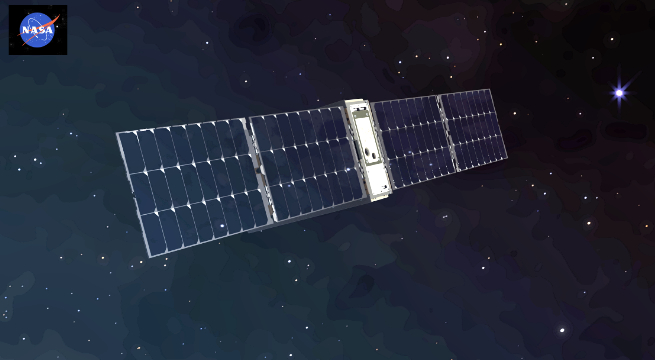
BurstCube, shown in this artist’s concept, will orbit Earth as it hunts for short gamma-ray bursts. Image is courtesy of NASA’s Goddard Space Flight Center Conceptual Image Lab.

NASA’s BurstCube, a shoebox-sized satellite designed to study the universe’s most powerful explosions, is on its way to the International Space Station.
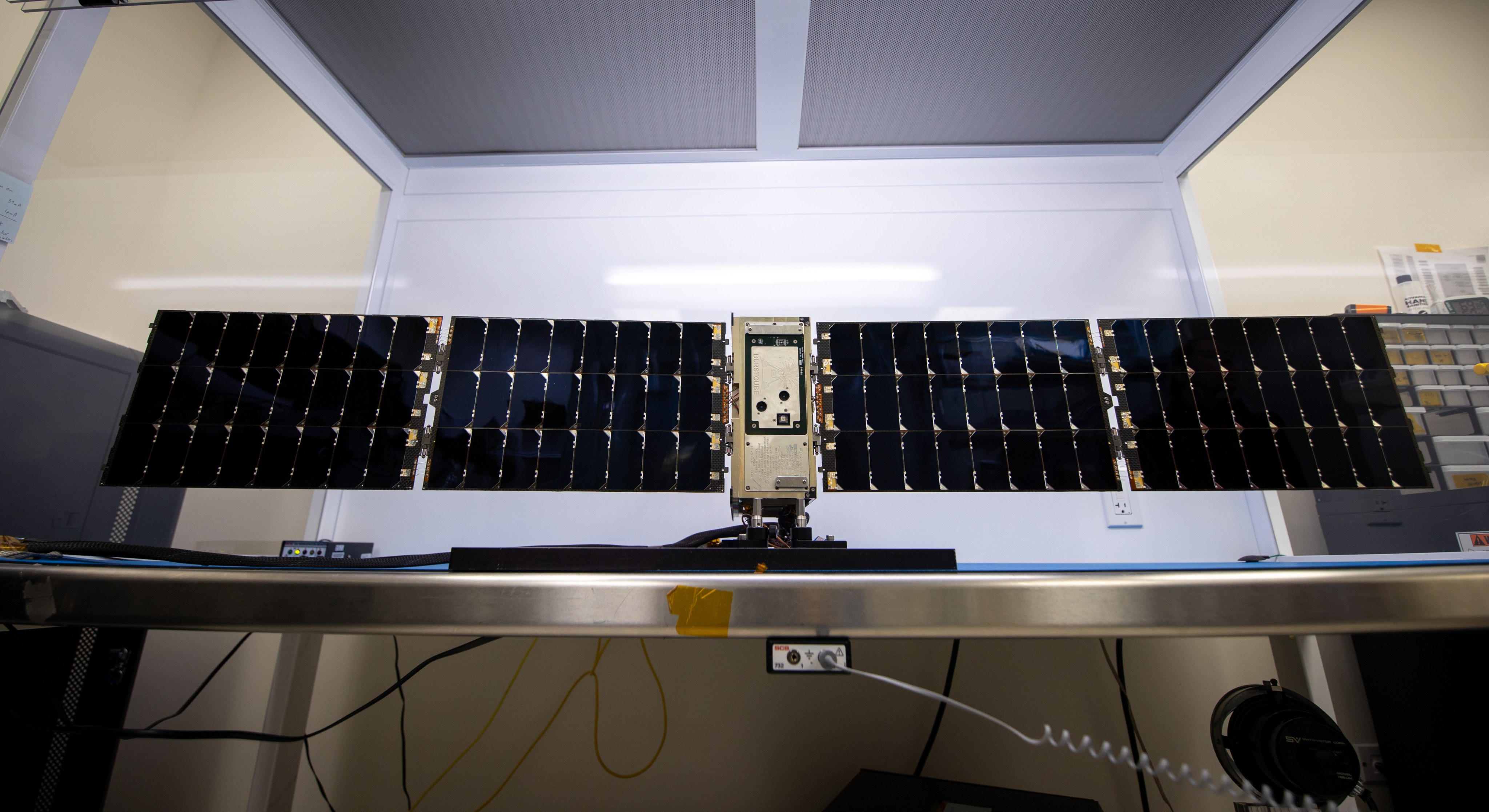
The BurstCube satellite sits on a table with its solar panels extended.
The BurstCube satellite sits in its flight configuration in this photo taken in the Goddard CubeSat Lab
in 2023.
Gama-ray burst image NASA—Sophia Roberts

The spacecraft traveled aboard SpaceX’s 30th Commercial Resupply Services mission, which lifted off at 4:55 p.m. EDT on Thursday, March 21, from Launch Complex 40 at Cape Canaveral Space Force Station in Florida. After arriving at the station, BurstCube will be unpacked and later released into orbit, where it will detect, locate, and study short gamma-ray bursts – brief flashes of high-energy light.

“BurstCube may be small, but in addition to investigating these extreme events, it’s testing new technology and providing important experience for early career astronomers and aerospace engineers,” said Jeremy Perkins, BurstCube’s principal investigator at NASA’s Goddard Space Flight Center in Greenbelt, Maryland.

Short gamma-ray bursts usually occur after the collisions of neutron stars, the superdense remnants of massive stars that exploded in supernovae. The neutron stars can also emit gravitational waves, ripples in the fabric of space-time, as they spiral together.Astronomers are interested in studying gamma-ray bursts using both light and gravitational waves because each can teach them about different aspects of the event. This approach is part of a new way of understanding the cosmos called multimessenger astronomy.

The collisions that create short gamma-ray bursts also produce heavy elements, such as gold and iodine, an essential ingredient for life as we know it.

Currently, the only joint observation of gravitational waves and light from the same event – called GW170817 – was in 2017. It was a watershed moment in multimessenger astronomy, and the scientific community has been hoping and preparing for additional concurrent discoveries since.

Swift’s Ultraviolet/Optical Telescope imaged the kilonova produced by merging neutron stars in the galaxy NGC 4993 (box) on Aug. 18, 2017, about 15 hours after gravitational waves and the gamma-ray burst were detected. The source was unexpectedly bright in ultraviolet light. It faded rapidly and was undetectable in UV when Swift looked again on Aug. 29. This false-color composite combines images taken through three ultraviolet filters. Inset: Magnified views of the galaxy. Credits: NASA/Swift

“BurstCube’s detectors are angled to allow us to detect and localize events over a wide area of the sky,” said Israel Martinez, research scientist and BurstCube team member at the University of Maryland, College Park and Goddard. “Our current gamma-ray missions can only see about 70% of the sky at any moment because Earth blocks their view. Increasing our coverage with satellites like BurstCube improves the odds we’ll catch more bursts coincident with gravitational wave detections.”

BurstCube’s main instrument detects gamma rays with energies ranging from 50,000 to 1 million electron volts. (For comparison, visible light ranges between 2 and 3 electron volts.)

When a gamma ray enters one of BurstCube’s four detectors, it encounters a cesium iodide layer called a scintillator, which converts it into visible light. The light then enters another layer, an array of 116 silicon photomultipliers, that converts it into a pulse of electrons, which is what BurstCube measures. For each gamma ray, the team sees one pulse in the instrument readout that provides the precise arrival time and energy. The angled detectors inform the team of the general direction of the event.
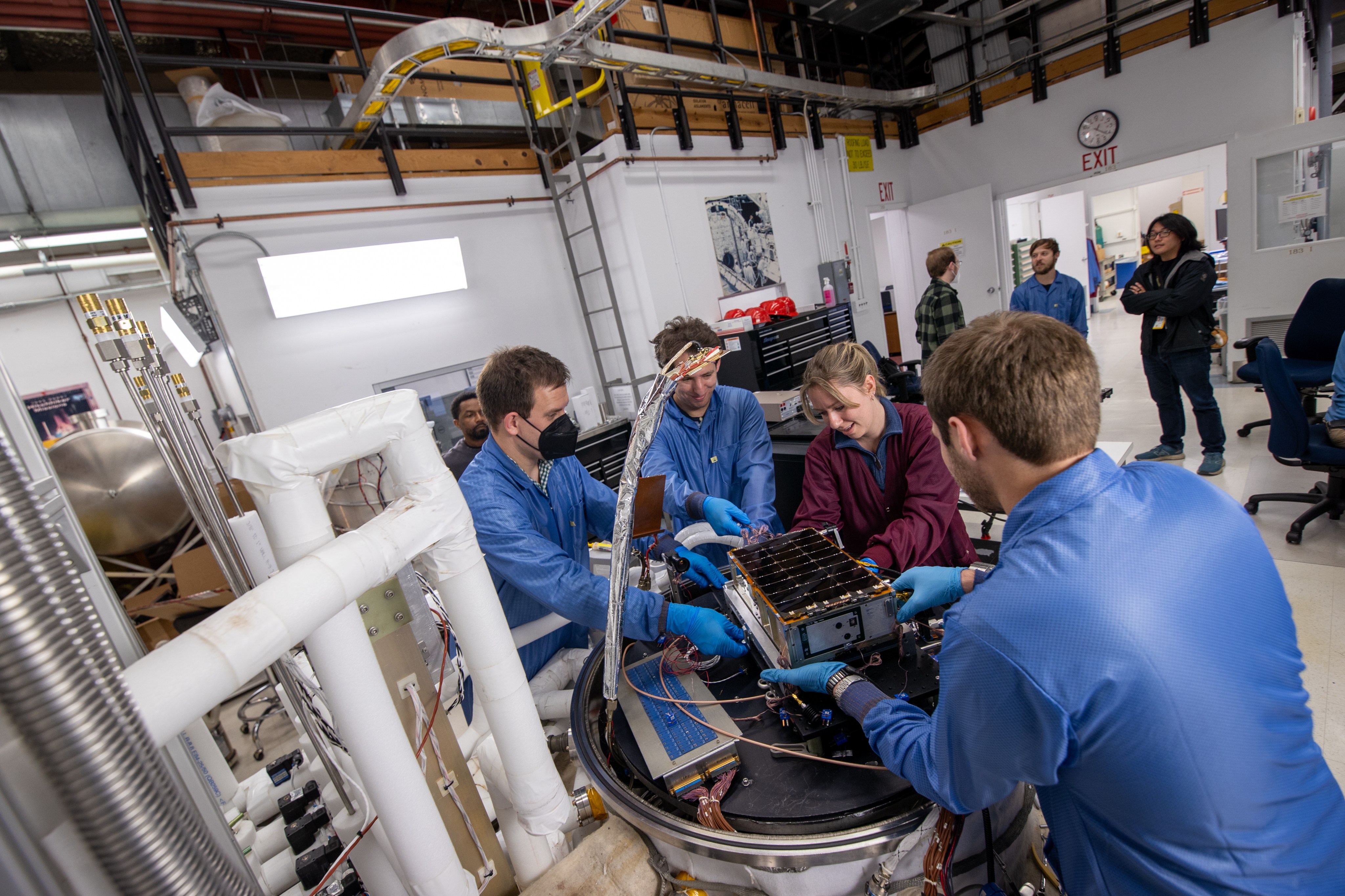
This photograph shows four people preparing the BurstCube satellite for thermal vacuum testing.
Engineers attach BurstCube to the platform of a thermal vacuum chamber at Goddard ahead of testing. Photo by NASA/Sophia Roberts

“We were able to order many of BurstCube’s parts, like solar panels and other off-the-shelf components, which are becoming standardized for CubeSats,” said Julie Cox, a BurstCube mechanical engineer at Goddard. “That allowed us to focus on the mission’s novel aspects, like the made-in-house components and the instrument, which will demonstrate how a new generation of miniaturized gamma-ray detectors work in space.”

BurstCube is led by NASA’s Goddard Space Flight Center in Greenbelt, Maryland. It’s funded by the Science Mission Directorate’s Astrophysics Division at NASA Headquarters. The BurstCube collaboration includes: the University of Alabama in Huntsville; the University of Maryland, College Park; the University of the Virgin Islands; the Universities Space Research Association in Washington; the Naval Research Laboratory in Washington; and NASA’s Marshall Space Flight Center in Huntsville.

Article is by Jeanette Kazmierczak, NASA’s Goddard Space Flight Center, Greenbelt, Maryland.

Filed Under: Government & Regulation, Launch Providers

Primary Sidebar

Coverage

  • Missions & Constellations
  • Business & Finance
  • Military & Defense
  • Launch
  • Software Automation & Ground Systems
  • Government & Regulation
  • Services & Applications

Most Read Stories

  • SpaceX Loses Contact With Starlink Satellite
  • Rocket Lab Emerging as Potential Bus Provider for 2,800-Satellite Equatys Constellation
  • SpaceX Accelerates Record-Breaking IPO Following Trillion-Dollar xAI Merger
  • Planet Labs Imposes Indefinite Blackout on Iran Satellite Imagery at U.S. Request
  • Amazon in Reported Talks to Acquire Globalstar in $9 Billion Move to Challenge Starlink

Secondary Sidebar

Footer


Satnews is a leading provider of satellite news, events, publications, research and other satellite industry information in both commercial and military enterprises worldwide.

Stories By Category

  • Business & Finance
  • Government & Regulation
  • Launch
  • Military & Defense
  • Missions & Constellations
  • Services & Applications
  • Software Automation & Ground Systems
  • Spectrum & Licensing
  • Startups & NewSpace Business

About Us

  • Leadership & Editorial Team
  • SatNews History
  • Free Satnews Subscription
  • SatNews Events
  • Magazines

Navigation

  • Latest Stories
  • Magazines
  • Events
  • Contact
  • Cookie & Privacy Policy for Satnews

We use cookies to ensure that we give you the best experience on our website. If you continue to use this site we will assume that you are happy with it.
x
Sign up Now (For Free)
Access daily or weekly satellite news updates covering all aspects of the commercial and military satellite industry.
Invalid email address
Notify Me Regarding ( At least one ):
We value your privacy and will not sell or share your email or other information with any other company. You may also unsubscribe at anytime.

Click Here to see our full privacy policy.
Thanks for subscribing!