

• Skip to primary navigation
  • Skip to main content
  • Skip to primary sidebar
  • Skip to secondary sidebar
  • Skip to footer
  • NEWS:
  • SatNews
  • SatMagazine
  • MilSatMagazine
  • SmallSat News
  • |     EVENTS:
  • SmallSat Symposium
  • Satellite Innovation
  • MilSat Symposium
  • SmallSat Europe

SatNews

Satellite Industry Intelligence Since 1983

Subscribe
  • LATEST
  • SatNews Events
  • Magazines
  • Calendar
  • Subscribe
  • Missions & Constellations
    • Exploration & Science Missions
    • In-Orbit Servicing & Orbital Operations
    • LEO Constellations
    • Mission Autonomy & Onboard Systems
    • Mission Deployments & Manifests
    • Navigation & PNT
    • SmallSat
    • Spacecraft & Payload Technology
    View All in Missions & Constellations →
    Iridium Unveils Core Role in Artemis II and Next-Gen PNT at Space Symposium 2026Iridium Unveils Core Role in Artemis II and Next-Gen PNT at Space Symposium 2026
    Boeing and Millennium Unveil Resolute Mid-Class Satellite PlatformBoeing and Millennium Unveil Resolute Mid-Class Satellite Platform
    NASA Shifts Focus to Permanent Lunar Base and Nuclear PropulsionNASA Shifts Focus to Permanent Lunar Base and Nuclear Propulsion
    Kepler and Astrolight Secure ESA Contract for HydRON Optical NetworkKepler and Astrolight Secure ESA Contract for HydRON Optical Network
  • Business
    • Contracts & Commercial Deals
    • Earnings & Financial Reporting
    • Events & Conferences
    • Funding & Venture Capital
    • Market Forecasts
    • Mergers & Acquisitions
    • Personnel Moves & Appointments
    View All in Business & Finance →
    SmallSat Europe Speaker Focus: Jaume Sanpera, SateliotSmallSat Europe Speaker Focus: Jaume Sanpera, Sateliot
    Ericsson Initiates SEK 15 Billion Share Buyback ProgramEricsson Initiates SEK 15 Billion Share Buyback Program
    Saltzman Unveils 2040 Blueprint to Scale Space Force for Great Power CompetitionSaltzman Unveils 2040 Blueprint to Scale Space Force for Great Power Competition
    SmallSat Europe Speaker Focus: Col. Marcin Mazur, Polish Space AgencySmallSat Europe Speaker Focus: Col. Marcin Mazur, Polish Space Agency
  • Defense
    • Counterspace & ASAT
    • Defense Budgets & Procurement
    • ISR & Reconnaissance
    • MILSATCOM
    • Missile Warning & Defense
    • National Security Programs
    • Space Domain Awareness
    View All in Military & Defense →
    The Rise of Grey Zone Satellites: Ambiguity as a Tactical AdvantageThe Rise of Grey Zone Satellites: Ambiguity as a Tactical Advantage
    US Space Force Awards $68.6M Modification to Lockheed Martin for Next-Gen OPIRUS Space Force Awards $68.6M Modification to Lockheed Martin for Next-Gen OPIR
    General Atomics Completes Pre-Ship Review for Space Force Weather PayloadGeneral Atomics Completes Pre-Ship Review for Space Force Weather Payload
    Global Defense Leaders Convene as Space Symposium 41 Addresses Orbital SecurityGlobal Defense Leaders Convene as Space Symposium 41 Addresses Orbital Security
  • Gov
    • Export Controls & Compliance
    • International Space Agreements
    • National Space Policy
    • Space Law & Treaties
    • Space Sustainability & Debris Policy
    • Space Traffic Management / Debris Removal
    View All in Government & Regulation →
    SmallSat Europe Speaker Focus: Chris Quilty, Quilty SpaceSmallSat Europe Speaker Focus: Chris Quilty, Quilty Space
    NRL to Showcase Sovereign Space Capabilities at 41st Space SymposiumNRL to Showcase Sovereign Space Capabilities at 41st Space Symposium
    FCC Modernizes Satellite Spectrum Rules to Unleash Next-Generation BroadbandFCC Modernizes Satellite Spectrum Rules to Unleash Next-Generation Broadband
    SmallSat Europe Speaker Focus: Daniel Bock, Morpheus SpaceSmallSat Europe Speaker Focus: Daniel Bock, Morpheus Space
  • Launch
    • Launch Providers
    • Launch Schedule & Calendars
    • Launch Sites & Infrastructure
    • Rocket Technology & Vehicles
    View All in Launch →
    Ensign-Bickford Hardware Supports Successful Artemis II Lunar MissionEnsign-Bickford Hardware Supports Successful Artemis II Lunar Mission
    China Accelerates Orbital Internet Deployment with Successful Smart Dragon-3 Sea LaunchChina Accelerates Orbital Internet Deployment with Successful Smart Dragon-3 Sea Launch
    What the SpaceX IPO Changes for Every Satellite OperatorWhat the SpaceX IPO Changes for Every Satellite Operator
    €30 million Financing for PLD Space’s Small Satellite Launcher€30 million Financing for PLD Space’s Small Satellite Launcher
  • Software
    • Autonomous Ground Operations
    • Data Processing & AI/ML
    • Digital Twins & Modeling
    • Ground Segment & Teleports
    • Mission Planning & Simulation
    • Space Systems Software Engineering
    • Spectrum & Licensing
    View All in Software Automation & Ground Systems →
    Cloudcomputing Targets 1.5M Identities in Spain and Finalizes Innovate IT AcquisitionCloudcomputing Targets 1.5M Identities in Spain and Finalizes Innovate IT Acquisition
    Archangel Lightworks Secures £10M Series A to Scale Optical Ground InfrastructureArchangel Lightworks Secures £10M Series A to Scale Optical Ground Infrastructure
    Keysight and Sateliot Win ESA and GSMA Foundry Challenge for 6G InnovationKeysight and Sateliot Win ESA and GSMA Foundry Challenge for 6G Innovation
    Automation and Agility: How SSC Space Go is Designed for the New Age of GroundAutomation and Agility: How SSC Space Go is Designed for the New Age of Ground
  • Services & Apps
    • Climate & Environmental Monitoring
    • Disaster Response & Security Mapping
    • Earth Observation & Imaging
    • Maritime & Aviation Satcom
    • Satellite Communications
    View All in Services & Applications →
    NASA Targets Commercial Relays to Replace Aging TDRSS InfrastructureNASA Targets Commercial Relays to Replace Aging TDRSS Infrastructure
    OQ Technology Awarded ESA Contract to Adapt 5G Beamforming for SpaceOQ Technology Awarded ESA Contract to Adapt 5G Beamforming for Space
    Kraken Robotics Integrates KATFISH Sonar on SEFINE RD-22 USV Following Multi-Naval DemonstrationsKraken Robotics Integrates KATFISH Sonar on SEFINE RD-22 USV Following Multi-Naval Demonstrations
    Astroscale Plans World-First Multi-Orbit Satellite Inspection MissionAstroscale Plans World-First Multi-Orbit Satellite Inspection Mission

NASA’s Swift Tracks Potential Magnetic Flip Of Monster Black Hole

May 10, 2022

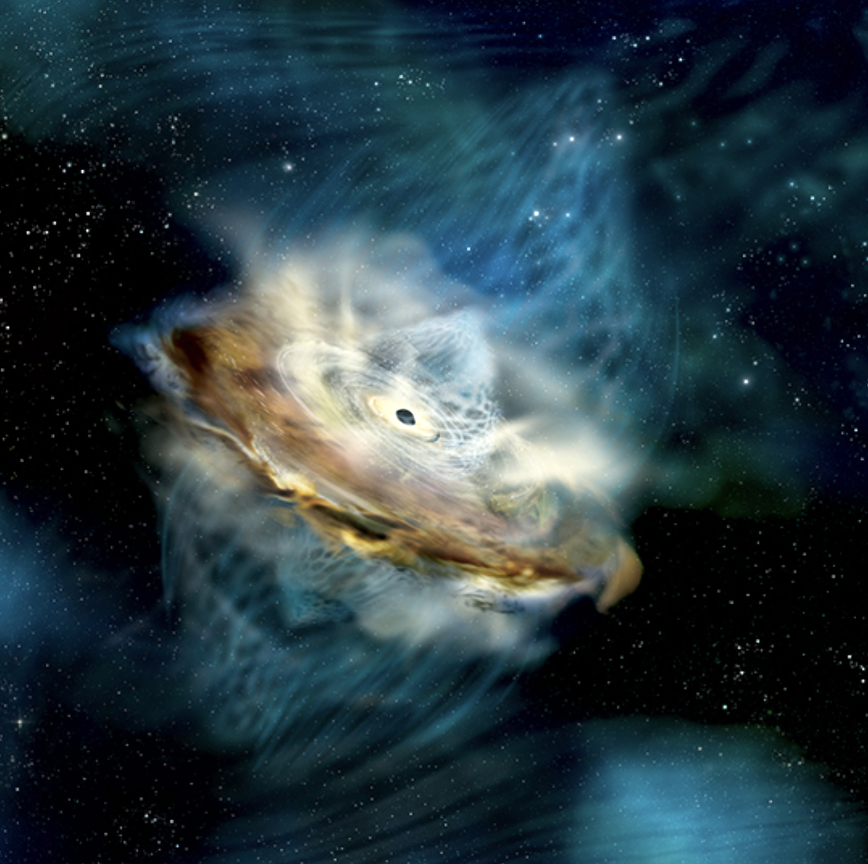
In a comprehensive new study, an international science team links an eruption’s unusual characteristics to changes in the black hole’s environment that likely would be triggered by such a magnetic switch. This illustration shows the accretion disk, corona (pale, conical swirls above the disk), and supermassive black hole of active galaxy 1ES 1927+654 before its recent flare-up. Credit: NASA/Swift

A rare and enigmatic outburst from a galaxy 236 million light-years away may have been sparked by a magnetic reversal, a spontaneous flip of the magnetic field surrounding its central black hole.
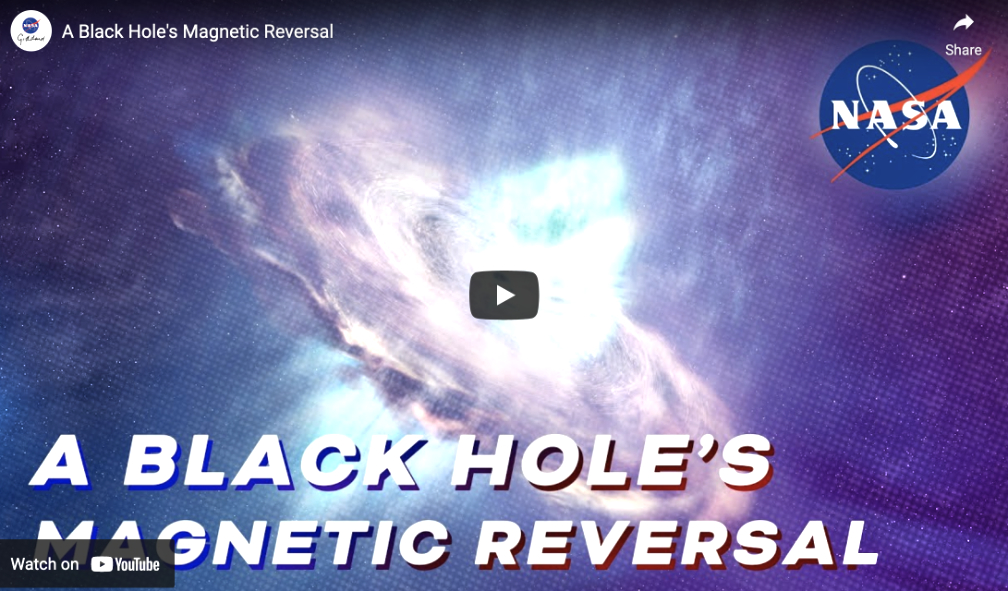
Explore the unusual eruption of 1ES 1927+654, a galaxy located 236 million light-years away in the constellation Draco. A sudden reversal of the magnetic field around its million-solar-mass black hole may have triggered the outburst. Credit: NASA’s Goddard Space Flight Center Download this video in HD formats from NASA’s Scientific Visualization Studio

“Rapid changes in visible and ultraviolet light have been seen in a few dozen galaxies similar to this one,” said Sibasish Laha, a research scientist at the University of Maryland, Baltimore County and NASA’s Goddard Space Flight Center in Greenbelt, Maryland. “But this event marks the first time we’ve seen X-rays dropping out completely while the other wavelengths brighten.”

A paper describing the findings, led by Laha, has been accepted for publication in The Astrophysical Journal.
The research team analyzed new and archival observations across the spectrum. NASA’s Neil Gehrels Swift Observatory and ESA’s (European Space Agency) XMM-Newton satellite provided UV and X-ray measurements.
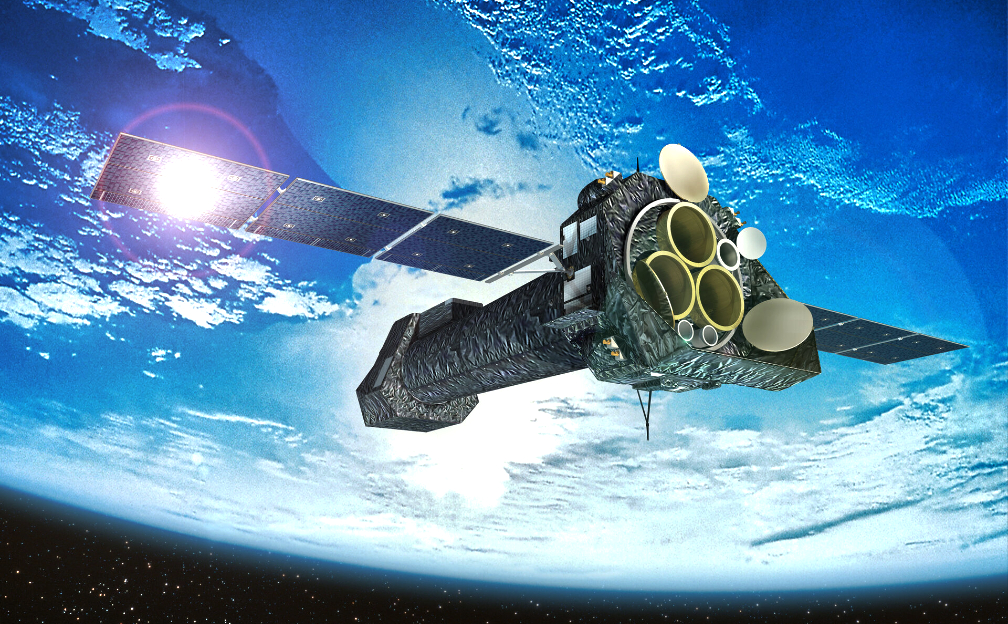
Artistic rendition of ESA’s XMM-Newton satellite on-orbit.

Visible light observations came from Italy’s 3.6-meter Galileo National Telescope and the 10.4-meter Gran Telescopio Canarias, both located on the island of La Palma in the Canary Islands, Spain. Radio measurements were acquired from the Very Long Baseline Array, a network of 10 radio telescopes located across the United States; the Very Large Array in New Mexico; and the European VLBI Network.

In early March 2018, the All-Sky Automated Survey for Supernovae alerted astronomers that a galaxy called 1ES 1927+654 had brightened by nearly 100 times in visible light. A search for earlier detections by the NASA-funded Asteroid Terrestrial-impact Last Alert System showed that the eruption had begun months earlier, at the end of 2017.

When Swift first examined the galaxy in May of 2018, its UV emission was elevated by 12 times but steadily declining, indicating an earlier unobserved peak. Then, in June, the galaxy’s higher-energy X-ray emission disappeared.
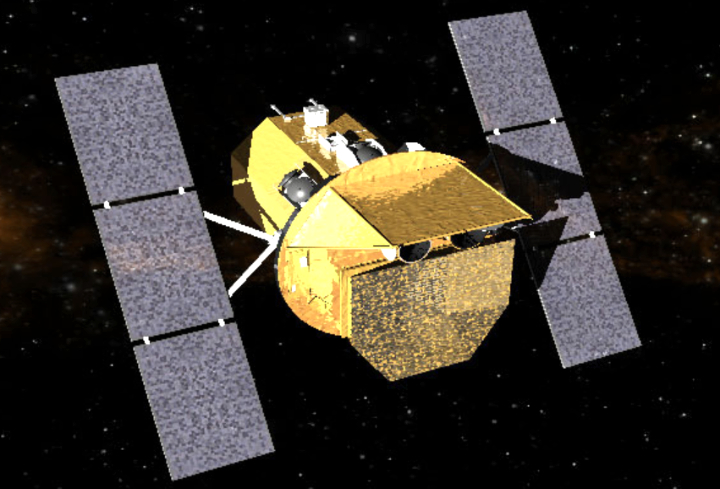
Artistic rendition of NASA’s Swift spacecraft.

“It was very exciting to delve into this galaxy’s strange explosive episode and try to understand the possible physical processes at work,” said José Acosta-Pulido, a co-author at the Canary Islands Institute of Astrophysics (IAC) on Tenerife.

Most big galaxies, including our own Milky Way, host a supermassive black hole weighing millions to billions of times the Sun’s mass. When matter falls toward one, it first collects into a vast, flattened structure called an accretion disk. As the material slowly swirls inward, it heats up and emits visible, UV, and lower-energy X-ray light. Near the black hole, a cloud of extremely hot particles – called the corona – produces higher-energy X-rays. The brightness of these emissions depends on how much material streams toward the black hole.

“An earlier interpretation of the eruption suggested that it was triggered by a star that passed so close to the black hole it was torn apart, disrupting the flow of gas,” said co-author Josefa Becerra González, also at the IAC. “We show that such an event would fade out more rapidly than this outburst.”

The unique disappearance of the X-ray emission provides astronomers with an important clue. They suspect the black hole’s magnetic field creates and sustains the corona, so any magnetic change could impact its X-ray properties.

“A magnetic reversal, where the north pole becomes south and vice versa, seems to best fit the observations,” said co-author Mitchell Begelman, a professor in the department of astrophysical and planetary sciences at the University of Colorado Boulder. He and his Boulder colleagues, post-doctoral researcher and co-author Nicolas Scepi and professor Jason Dexter, developed the magnetic model. “The field initially weakens at the outskirts of the accretion disk, leading to greater heating and brightening in visible and UV light,” he explained.

As the flip progresses, the field becomes so weak that it can no longer support the corona – the X-ray emission vanishes. The magnetic field then gradually strengthens in its new orientation. In October of 2018, about four months after they disappeared, the X-rays came back, indicating that the corona had been fully restored. By summer of 2021, the galaxy had completely returned to its pre-eruption state.

Magnetic reversals are likely to be common events in the cosmos. The geologic record shows that Earth’s field flips unpredictably, averaging a few reversals every million years in the recent past. The Sun, by contrast, undergoes a magnetic reversal as part of its normal cycle of activity, switching north and south poles roughly every 11 years.

Goddard manages the Swift mission in collaboration with Penn State, the Los Alamos National Laboratory in New Mexico, and Northrop Grumman Space Systems in Dulles, Virginia. Other partners include the University of Leicester and Mullard Space Science Laboratory in the United Kingdom, Brera Observatory in Italy, and the Italian Space Agency.

Authored by Francis Reddy, NASA’s Goddard Space Flight Center, Greenbelt, Maryland.

Filed Under: Exploration & Science Missions, Government & Regulation

Primary Sidebar

Coverage

  • Missions & Constellations
  • Business & Finance
  • Military & Defense
  • Launch
  • Software Automation & Ground Systems
  • Government & Regulation
  • Services & Applications

Most Read Stories

  • SpaceX Loses Contact With Starlink Satellite
  • Rocket Lab Emerging as Potential Bus Provider for 2,800-Satellite Equatys Constellation
  • SpaceX Accelerates Record-Breaking IPO Following Trillion-Dollar xAI Merger
  • Planet Labs Imposes Indefinite Blackout on Iran Satellite Imagery at U.S. Request
  • Amazon in Reported Talks to Acquire Globalstar in $9 Billion Move to Challenge Starlink

Secondary Sidebar

Footer


Satnews is a leading provider of satellite news, events, publications, research and other satellite industry information in both commercial and military enterprises worldwide.

Stories By Category

  • Business & Finance
  • Government & Regulation
  • Launch
  • Military & Defense
  • Missions & Constellations
  • Services & Applications
  • Software Automation & Ground Systems
  • Spectrum & Licensing
  • Startups & NewSpace Business

About Us

  • Leadership & Editorial Team
  • SatNews History
  • Free Satnews Subscription
  • SatNews Events
  • Magazines

Navigation

  • Latest Stories
  • Magazines
  • Events
  • Contact
  • Cookie & Privacy Policy for Satnews

We use cookies to ensure that we give you the best experience on our website. If you continue to use this site we will assume that you are happy with it.
x
Sign up Now (For Free)
Access daily or weekly satellite news updates covering all aspects of the commercial and military satellite industry.
Invalid email address
Notify Me Regarding ( At least one ):
We value your privacy and will not sell or share your email or other information with any other company. You may also unsubscribe at anytime.

Click Here to see our full privacy policy.
Thanks for subscribing!