Florence Tan is the Chief Technologist (Acting), Science Mission Directorate (SMD) Chair, Small Spacecraft Coordination Group at NASA. She presented the following regarding the work of NASA within the smallsat community…
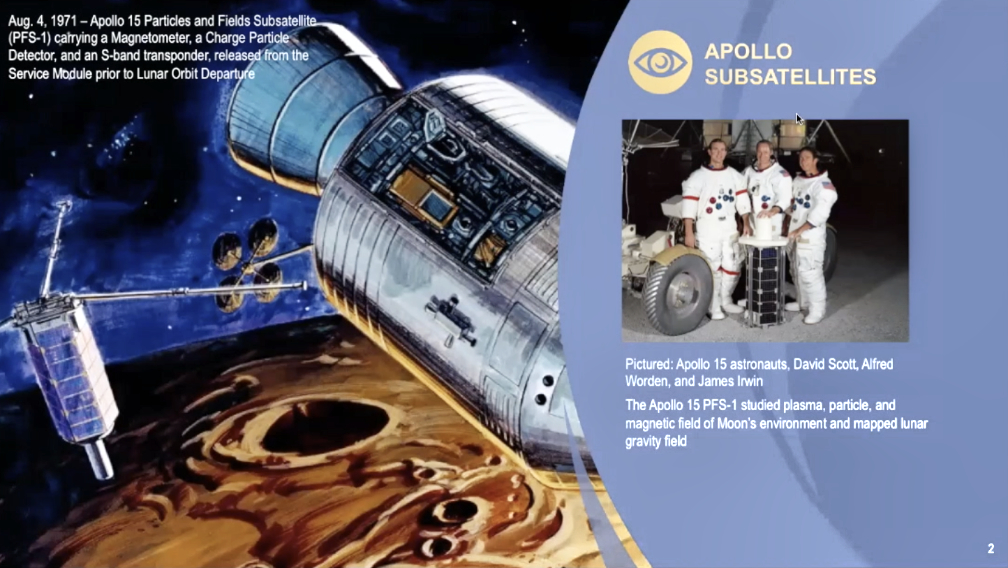
NASA is doing amazing science with smallsats. First, a little history. We are all aware of the Apollo missions to the moon in 1971. What is not so well known is that the Apollo 15 and 16 missions deployed smallsats at the command module as it left lunar orbit. Here (image below) you can see one of the satellites that flew. It carried three instruments: a magnetometer, a charged particle detector and an S-band transponder. It made a number of important measurements… plasma, particle and magnetic field of the Moon’s environment and mapped the lunar gravity field.
Traditionally, NASA uses legacy-class flight ship missions… think Hubble, Cassini or the Perseverance rover that’s landing in a few days on Mars. We use these missions to achieve our goals of extraordinary science and supporting explorations through innovative technology. There is a place for flight ship missions; however, we recognize the value and impact of smallsats, from cubesats to Esper-class spacecraft. The concepts we are able to use to perform targeted science to prove out new technologies and innovations and train and educate our future workforce.
To this end, NASA stood up the Small Spacecraft Coordination Group (SSCG), whose goal is to improve coordination among our mission directorates, to place more emphasis on the overarching, integrated, smallsat strategy to advance our agency’s objectives.
In August 2019, the SSCG released a NASA Small Spacecraft strategic plan. Our strategies are influenced by NASA’s Achieving Sciences Report Recommendations and adds guidance to those recommendations to account for the future capabilities and growth in launch systems and Esper class spacecraft.
In late 2018, SMD released a policy and established this policy, NASA STD-32. This policy enables rideshare or launch accommodation opportunities using an Esper-class ring as part of the launch service procured for an SMD (Science Mission Directorate) primary payload. In early 2020, during the Access to Space workshop, we announced the establishment of the Rideshare Office, headed by Aly Mendoza-Hill, to maximize science, exploration and technology returns by enabling accommodation opportunities for secondary payloads on SMD primary mission launches.
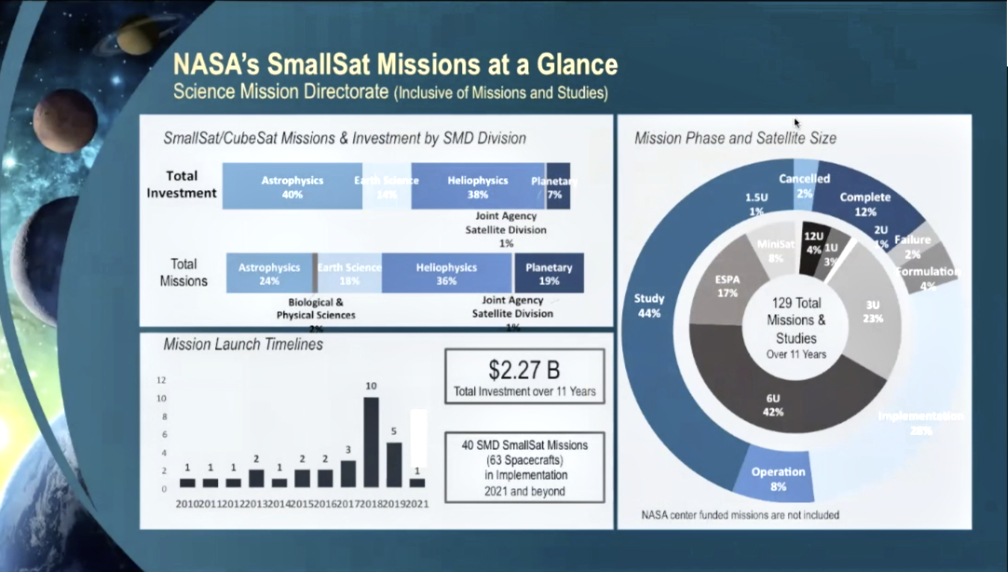
Shown above is NASA’s smallsat science mission fleet chart. Across the six divisions of SMD, we have funded 72 cubesat and smallsat missions and 57 studies to date. Currently, we have 40 small spacecraft missions, or 63 spacecraft, in implementation or formulation. The funding for smallsat missions and studies over 11 years is greater than $2 billion. Two-thirds of our missions are 6U or larger. We are shifting toward constellations, as well.
The next two charts are going to be a synopsis of some of our science missions. As our Associate Administrator for Science said, “These missions do big science but they are special because they come in small packages, which means you can launch them together and get more research for the price of a single launch.”
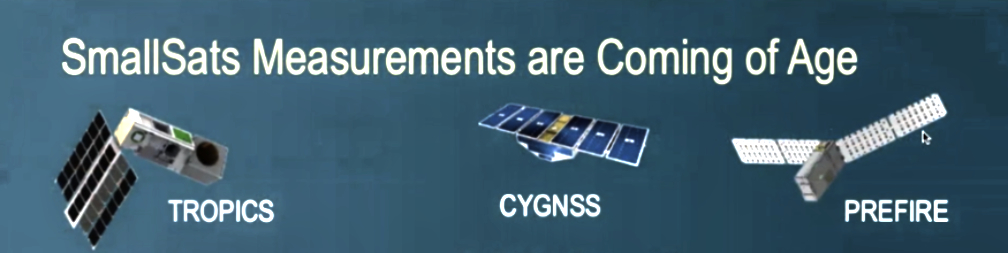
TROPICS, CYGNSS and PREFIRE are EO missions. CYGNSS is a cyclone, global navigation satellite system. It was launched in December of 2016 and is comprised of eight smallsats. CYGNSS measures the strength of GPS signals reflected by the Earth’s surface to divide the properties of the surface. In its four years of operation, CYGNSS has been able to make measurements of global oceans, surface winds such as tropical cyclones to help understand meteorological processes and improve numerical weather forecasts. Over land, CYGNSS has made measurements of flood inundation. CYGNSS also produces daily soil moisture data products and these are used in hydrological process studies and for disaster monitoring. Recently, CYGNSS was approved for another three years of operation.
TROPICS (Time-Resolved Observations of Precipitation structure and storm Intensity with a Constellation of Smallsats). TROPICS is a constellation of six, 3U cubesats in three orbital planes and carries scanning microwave radiometers to measure temperature, humidity, precipitation and cloud properties and offers a combination of horizontal and temporal resolutions to measure the violent conditions and inner core conditions of tropical cyclones at a near global scale. This is a profound leap forward for detailed studies of high impact meteorological events.
Next is PREFIRE (Polar Radiant Energy in the Far-Infrared Experiment). This experiment offers a new window to polar observation and polar climate predictions. It’s going to fly two, 6U cubesats and will systematically map the Earth’s far-infrared emissions spectrum in polar or near-polar orbit for the first time. Thanks to the investments we’ve made to ambient temperature detection and miniaturized optics, we are able to fly the thermal infrared spectrometer that weighs less than 3 kg, uses less than 5 watts of power and sits within a 3U form factor. PREFIRE will fly in two, distinct orbits, separated by a few hours, and able to quantify with spectral fingerprints of atmospheric and surface cloud and ice melt. We can use these observations to integrate them with models so that we are able to ensure these measurements toward the improvement in polar climate predictions.
NASA recently announced three, exciting, selections of smallsat missions for further concept studies. Pandora is a mission to study the atmosphere features of exoplanets in our solar neighborhood. StarBurst seeks to understand the nature of neutron star mergers with LIGO (Laser Interferometer Gravitational-Wave Observatory) is a facility dedicated to the detection of cosmic gravitational waves and the measurement of these waves for scientific research. It consists of two widely separated installations within the United States, operated in unison as a single observatory. And Aspera is a small telescope that will map the gas of galaxies near our own Milky Way so that we can understand the evolution of galaxies over cosmic time. Everyone of these missions will be addressing compelling astrophysics.
Around planetary science, we just launched last month a Q-PACE (CubeSat Particle Aggregation and Collision Experiment) mission. We will be introducing particles in the low gravity of LEO to understand and look at the formation process of our own solar system and the genesis of planetary ring systems.
Lunar Polar Hydrogen Mapper, called LunaH-Map, is an exciting instrument that will launch on the Artemis I mission (September 2021) and will feature a miniaturized neutron spectrometer that will study and map hydrogen abundance within the permanently shadowed regions (PSRs) of the Moon’s south pole. These PSRs may contain enough water to change our view of the formation and evolution of the Moon or may contain enough water to support human and robotic exploration of the solar system.
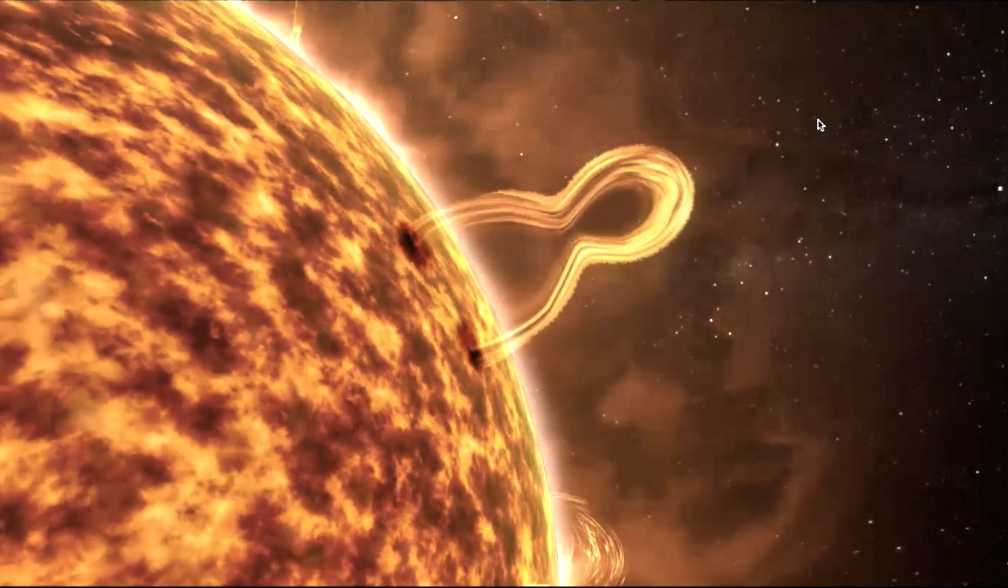
Then we have the SunRISE (Sun Radio Interferometer Space Experiment) mission, which will study the sun’s coronal mass ejections (CMEs). CMEs can accelerate particles that produce radio emissions and we’re interested in how solar particles are accelerated and released into interplanetary space and we are very interested in this from the fundamental point of view as well as the effect on space and on Earth and our space assets. SunRISE is a combination of new 6U cubesats operating as a radio interferometer to produce an aperture with a diameter of around 10 km. The idea is to take a picture of the CME that is erupting and we know where the space stuff is because the smallsats also pickup the GPS signals. We take the data and collect it and transmit it down to the ground for processing so we can see a picture of where these particles are accelerated.
Today, NASA is leveraging the capabilities of the commercial space industry for science and smallsats. NASA has a wider diversity of options for access to space. We have new capabilities that play an important role for launching large numbers of sallsats, including constellations, as well as global telecom and data services, buses for smallsats, and NASA has a contract for commercial data buys as well as rideshares to GEO. We are working with NASA’s Space Communications and Navigation group to provide comm requirements for our Near Earth Orbit assets in order to transition to one hundred percent commercial telecom service in the years to come.
The future is bright. We see a shift toward small, mini-sats for sustained, decadal-class observations. For this, there is a need for miniaturization of instrumentation, materials and hardware that can withstand environmental space, data assimilation and simulation tools. As our sensors mature, the data products from large and small missions will become indistinguishable. We will gain new insights from multi-instrument constellation data fusion and analytics. And we will require the tools to understand the data. We will have cooperative synergies among small and large missions and internal cooperation on key, community, science measurements. Commercial services such as comms, and ground station operations, could be used for our goals.
In turn, we must re-think how we look at reliable cost risks of small spacecraft, especially in constellations. We may not have the same risk requirements profile as with a large, multi-million dollar mission. We can take advantage of affordable and more frequent access to space that allows high replenishment rates of satellite fleets. The last 10 years have seen a flowering of the domestic and international space industry, the commercial utility of LEO in all sectors.
For the more than 30 years I have worked at NASA, I take great pride and delight to see the maturation of the American space sector. It is with great satisfaction that we can leverage the U.S. space industry’s innovative technologies and services for our science missions and take advantage of the kinds of scale offered by industries and tax payer dollars. I thank you for your time.