

• Skip to primary navigation
  • Skip to main content
  • Skip to primary sidebar
  • Skip to secondary sidebar
  • Skip to footer
  • NEWS:
  • SatNews
  • SatMagazine
  • MilSatMagazine
  • SmallSat News
  • |     EVENTS:
  • SmallSat Symposium
  • Satellite Innovation
  • MilSat Symposium
  • SmallSat Europe

SatNews

Satellite Industry Intelligence Since 1983

Subscribe
  • LATEST
  • SatNews Events
  • Magazines
  • Calendar
  • Subscribe
  • Missions & Constellations
    • Exploration & Science Missions
    • In-Orbit Servicing & Orbital Operations
    • LEO Constellations
    • Mission Autonomy & Onboard Systems
    • Mission Deployments & Manifests
    • Navigation & PNT
    • SmallSat
    • Spacecraft & Payload Technology
    View All in Missions & Constellations →
    Analyst Projects Massive Subscription Growth for Starlink Ahead of Imminent SpaceX IPOAnalyst Projects Massive Subscription Growth for Starlink Ahead of Imminent SpaceX IPO
    KSAT and iQPS Expand Strategic Alliance to Accelerate High-Frequency SAR ConstellationKSAT and iQPS Expand Strategic Alliance to Accelerate High-Frequency SAR Constellation
    Kaman Precision Products Deploys Advanced Magnetic Sensors for Next-Generation Launch PropulsionKaman Precision Products Deploys Advanced Magnetic Sensors for Next-Generation Launch Propulsion
    Beyond Gravity Launches Advanced Propulsion Pointing Mechanism for LEO ConstellationsBeyond Gravity Launches Advanced Propulsion Pointing Mechanism for LEO Constellations
  • Business
    • Contracts & Commercial Deals
    • Earnings & Financial Reporting
    • Events & Conferences
    • Funding & Venture Capital
    • Market Forecasts
    • Mergers & Acquisitions
    • Personnel Moves & Appointments
    View All in Business & Finance →
    Pilot Photonics Secures €1M ESA Contract to Advance Space PhotonicsPilot Photonics Secures €1M ESA Contract to Advance Space Photonics
    Space Stocks in Focus: Zacks Investment Ideas Highlights Gilat, Satellogic, and EchoStarSpace Stocks in Focus: Zacks Investment Ideas Highlights Gilat, Satellogic, and EchoStar
    Lockheed Martin UK Announces Major Workforce Expansion with Up to 2,000 New Space JobsLockheed Martin UK Announces Major Workforce Expansion with Up to 2,000 New Space Jobs
    Voyager Technologies Acquires Astrobotic for $300 MillionVoyager Technologies Acquires Astrobotic for $300 Million
  • Defense
    • Counterspace & ASAT
    • Defense Budgets & Procurement
    • ISR & Reconnaissance
    • MILSATCOM
    • Missile Warning & Defense
    • National Security Programs
    • Space Domain Awareness
    View All in Military & Defense →
    American military space closed around one company in seven daysAmerican military space closed around one company in seven days
    MDA Space Selected by BAE Systems for U.S. Space Force Missile Warning ConstellationMDA Space Selected by BAE Systems for U.S. Space Force Missile Warning Constellation
    ParaZero Secures First DefendAir Order from U.S. Tier-1 Defense CorporationParaZero Secures First DefendAir Order from U.S. Tier-1 Defense Corporation
    Northrop Grumman Partners with Apex for Space-Based Interceptors Targeting 2027 DeliveryNorthrop Grumman Partners with Apex for Space-Based Interceptors Targeting 2027 Delivery
  • Gov
    • Export Controls & Compliance
    • International Space Agreements
    • National Space Policy
    • Space Law & Treaties
    • Space Sustainability & Debris Policy
    • Space Traffic Management / Debris Removal
    View All in Government & Regulation →
    Major opportunities for 2 GHz over EuropeMajor opportunities for 2 GHz over Europe
    “Dual-use” is the funding word. It’s also the label operators want off.“Dual-use” is the funding word. It’s also the label operators want off.
    Sovereignty got an answer on Day 3. Two answers, actually, and a commercial veto.Sovereignty got an answer on Day 3. Two answers, actually, and a commercial veto.
    Dependency killed the old debate. Sovereignty is the new one, and Europe hasn’t agreed what it means.Dependency killed the old debate. Sovereignty is the new one, and Europe hasn’t agreed what it means.
  • Launch
    • Launch Providers
    • Launch Schedule & Calendars
    • Launch Sites & Infrastructure
    • Rocket Technology & Vehicles
    View All in Launch →
    Twelve Scientific Payloads Experience Microgravity Aboard SubOrbital Express-5Twelve Scientific Payloads Experience Microgravity Aboard SubOrbital Express-5
    Amazon Leo Constellation Surpasses 330 Satellites Following Latest Atlas V LaunchAmazon Leo Constellation Surpasses 330 Satellites Following Latest Atlas V Launch
    If You Thought Space Was Hard Try to Get Your Satellite On a RocketIf You Thought Space Was Hard Try to Get Your Satellite On a Rocket
    Blue Origin Suffers Major Setback as New Glenn Rocket Explodes During Static Fire TestBlue Origin Suffers Major Setback as New Glenn Rocket Explodes During Static Fire Test
  • Software
    • Autonomous Ground Operations
    • Data Processing & AI/ML
    • Digital Twins & Modeling
    • Ground Segment & Teleports
    • Mission Planning & Simulation
    • Space Systems Software Engineering
    • Spectrum & Licensing
    View All in Software Automation & Ground Systems →
    KSAT and Axelspace Expand Strategic Partnership to Accelerate Earth ObservationKSAT and Axelspace Expand Strategic Partnership to Accelerate Earth Observation
    Europe has ships. SmallSat Europe said it doesn’t have ports.Europe has ships. SmallSat Europe said it doesn’t have ports.
    The orbital data center thesis just became an economics question.The orbital data center thesis just became an economics question.
    AI just reached production in European space. The trust problem is what comes next.AI just reached production in European space. The trust problem is what comes next.
  • Services & Apps
    • Climate & Environmental Monitoring
    • Disaster Response & Security Mapping
    • Earth Observation & Imaging
    • Maritime & Aviation Satcom
    • Satellite Communications
    View All in Services & Applications →
    Viasat Secures Lockheed Martin Contract for NOAA’s Next-Generation AircraftViasat Secures Lockheed Martin Contract for NOAA’s Next-Generation Aircraft
    SES Partners with Viva to Launch Multi-Orbit In-Flight ConnectivitySES Partners with Viva to Launch Multi-Orbit In-Flight Connectivity
    Resolve Optics Delivers Radiation-Resistant Lenses for LEO SatellitesResolve Optics Delivers Radiation-Resistant Lenses for LEO Satellites
    SITAEL Unveils €200 Million Growth Strategy and ESA Mission Contract at SmallSat EuropeSITAEL Unveils €200 Million Growth Strategy and ESA Mission Contract at SmallSat Europe

The Testing of a New, NASA International Satellite is Completed by Airbus

June 14, 2020


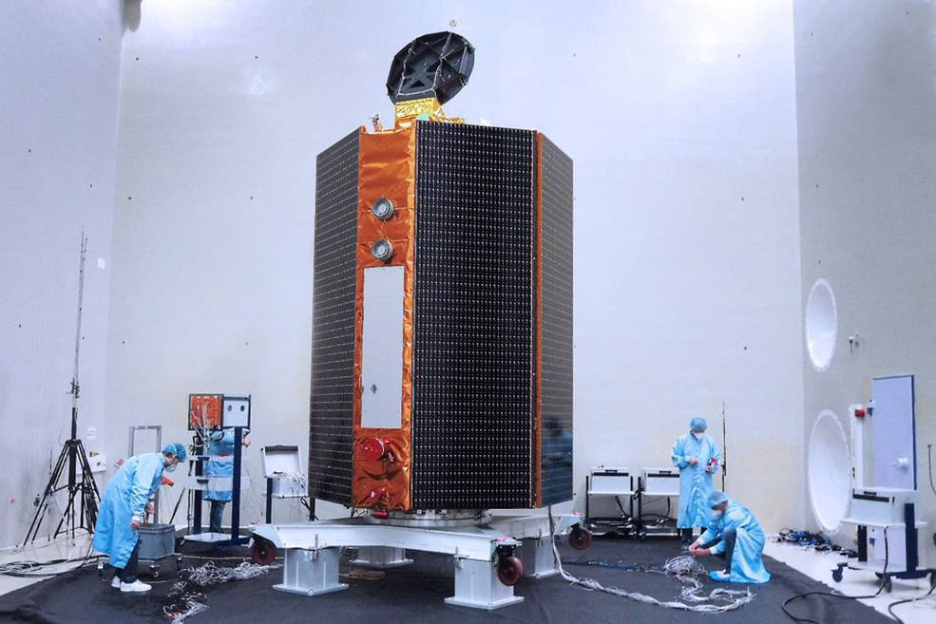
Mission team members perform acoustic tests of the Sentinel-6 Michael Freilich satellite in a chamber outfitted with giant speakers that blast the spacecraft with sound. This is to ensure that the high decibels associated with liftoff won't damage the spacecraft.
Photo is courtesy of Airbus.

A team of engineers in the U.S. and Europe subjected the Sentinel-6 Michael Freilich spacecraft to a battery of trials to ready it for liftoff later this year.

Once the state-of-the-art Sentinel-6 Michael Freilich satellite launches in November, it will collect the most accurate data yet on sea level — a key indicator of how Earth's warming climate is affecting the oceans, weather and coastlines. But first, engineers need to ensure that the spacecraft can survive the rigors of launch and of operating in the harsh environment of space. That's where meticulous testing comes in.

At the end of May, engineers finished putting the spacecraft — which is being built in Germany — through a battery of tests that began in November 2019. "If it can survive all the abuse we deliberately put it through on the ground, then it's ready for space," said John Oswald, the mission's deputy project manager at NASA's Jet Propulsion Laboratory in Southern California.

The Sentinel-6 Michael Freilich spacecraft is a part of the Copernicus Sentinel-6/Jason-CS (Continuity of Service) mission, a joint U.S.-European effort in which two identical satellites will be launched five years apart. The spacecraft will join the Copernicus constellation of satellites that constitutes the European Union's Earth Observation Program.

Once on-orbit, each satellite will collect sea level measurements down to the centimeter for 90% of the world's oceans. The data will add to almost 30 years of information gathered by an uninterrupted series of joint U.S.-European satellites, creating an unprecedented — and unbroken — 40 year sea level dataset. The spacecraft will also measure the temperature and humidity of Earth's atmosphere, which can be used to help improve weather forecasts and hurricane predictions.
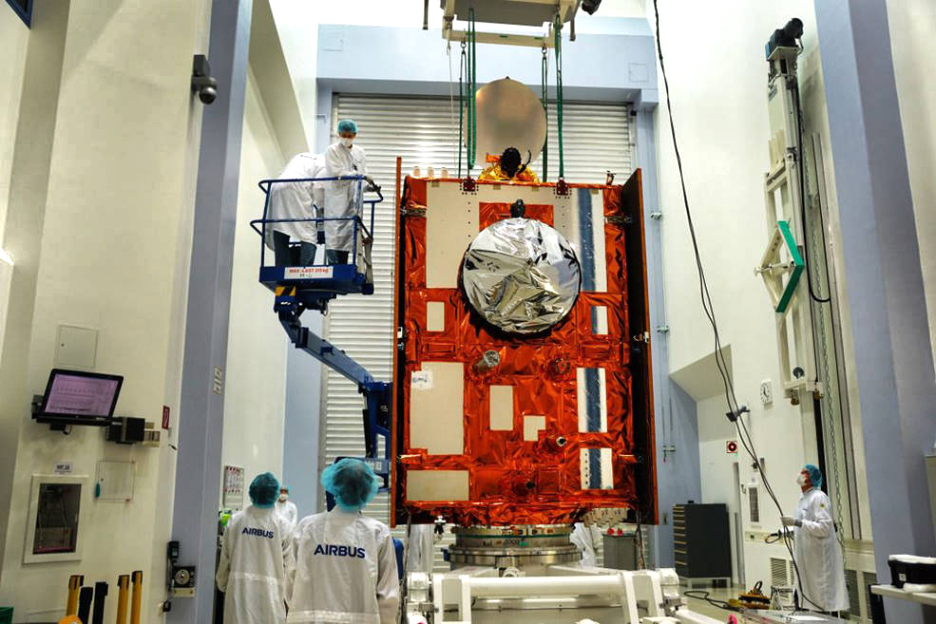

The Sentinel-6 Michael Freilich satellite sits in front of a testing chamber where mission team members tested whether the spacecraft could endure the loud sounds it will encounter during launch.
Photo is courtesy of Airbus.

These measurements are important because the oceans and atmosphere are tightly connected. "We're changing our climate, and the clearest signal of that is the rising oceans," said Josh Willis, the mission's project scientist at JPL. "More than 90% of the heat trapped by greenhouse gases is going into the ocean." That heat causes seawater to expand, accounting for about one-third of the global average of modern-day sea level rise. Meltwater from glaciers and ice sheets account for the rest. Sentinel-6 Michael Freilich satellite sits in front of a testing chamber The Sentinel-6 Michael Freilich satellite sits in front of a testing chamber where mission team members tested whether the spacecraft could endure the loud sounds it will encounter during launch. Credits: Airbus

"For climate science, what we need to know is not just sea level today, but sea level compared to 20 years ago. We need long records to do climate science," said Willis.

Six scientific instruments are key to that task. Two of them will work in concert to measure the distance from the satellite to the ocean's surface. That information — combined with data from three other instruments that precisely establish the satellite's position in orbit and a sixth that will measure vertical slices of the atmosphere for temperature and humidity — will help determine sea levels around the world.

Put Through Their Paces
To ensure that the scientific instruments will work once they get into space, engineers sent the Sentinel-6 Michael Freilich to a testing facility near Munich and ran the satellite through a gauntlet starting in November 2019.

First up: the vibration test, where the engineers subjected the Sentinel-6 Michael Freilich satellite to the kinds of shaking it will experience while attached to a SpaceX Falcon 9 rocket blasting into orbit. Then in December, engineers tested the spacecraft in a big vacuum chamber and exposed it to the extreme temperatures that it will encounter in space, ranging from 149 to minus 292 degrees Fahrenheit (65 to minus 180 degrees Celsius).

The next two trials took place in late April and May. The acoustics test, performed in April, made sure the satellite could withstand the loud noises that occur during launch. Engineers placed the spacecraft in a roughly 1,000-square-foot (100-square-meter) chamber outfitted with enormous speakers. Then they blasted the satellite with four 60-second bursts of sound, with the loudest peaking around 140 decibels. That's like standing next to a jet's engine as the plane takes off.

Finally, in the last week of May, engineers performed an electromagnetic compatibility test to ensure that the sensors and electronics on the satellite wouldn't interfere with one another, or with the data collection. The mission uses state-of-the-art instruments to make precise measurements, so the smallest interference could compromise that data.

Normally, JPL engineers would help to conduct these tests in person, but two of the trials took place after social-distancing safety measures had been established due to the coronavirus pandemic. So team members worked out a system to support their counterparts in Germany remotely.

To account for the nine-hour time-zone difference, engineers in California pulled shifts from midnight to 10 a.m. for several weeks, consulting with colleagues in Germany through phone calls, video conferences, chat rooms and text messages.

Oswald said it was confusing sometimes, keeping all the channels and groups going at the same time in the middle of the night, but he was impressed with the team. The tests are complete and the preliminary results look good.

Team members will spend the next several weeks completing the analysis of the test results and then preparing the satellite for shipment to Vandenberg Air Force Base in California for launch this fall.

About the Mission
Copernicus Sentinel-6/Jason-CS is being jointly developed by the European Space Agency (ESA), the European Organisation for the Exploitation of Meteorological Satellites (EUMETSAT), NASA and the National Oceanic and Atmospheric Administration (NOAA), with funding support from the European Commission and support from France's National Centre for Space Studies (CNES).

The first Sentinel-6/Jason-CS satellite that will launch was named after the former director of NASA's Earth Science Division, Michael Freilich. It will follow the most recent U.S.-European sea level observation satellite, Jason-3, which launched in 2016 and is currently providing data.

NASA's contributions to the Sentinel-6 mission are three of the science instrument payloads for each of the two Sentinel-6 satellites, including the Advanced Microwave Radiometer, the Global Navigation Satellite System – Radio Occultation, and the Laser Reflector Array. NASA is also contributing launch services for those satellites, ground systems supporting operation of the JPL-provided science instruments, the science data processors for two of these instruments, and support for the international Ocean Surface Topography Science Team.

To learn more about NASA's study of sea level rise, visit: sealevel.nasa.gov


Photo is courtesy of NASA.

 

Filed Under: Exploration & Science Missions, Spacecraft & Payload Technology

Primary Sidebar

Coverage

  • Missions & Constellations
  • Business & Finance
  • Military & Defense
  • Launch
  • Software Automation & Ground Systems
  • Government & Regulation
  • Services & Applications

Most Read Stories

  • AST SpaceMobile Pivots to SpaceX for Mid-June Launch of Three BlueBird Satellites
  • SmallSat Europe Speaker Focus: Frank M. Salzgeber, Nadir Space Venture
  • SpaceX Debuts Starship V3: Redefining Heavy-Lift Launch Capability
  • SpaceX Accelerates Transition from Falcon 9 to Next-Generation Starship Fleet
  • SpaceX Is Worth $1.75 Trillion. Only 7% of That Is Real.

Secondary Sidebar

Footer


Satnews is a leading provider of satellite news, events, publications, research and other satellite industry information in both commercial and military enterprises worldwide.

Stories By Category

  • Business & Finance
  • Government & Regulation
  • Launch
  • Military & Defense
  • Missions & Constellations
  • Services & Applications
  • Software Automation & Ground Systems
  • Spectrum & Licensing
  • Startups & NewSpace Business

About Us

  • Leadership & Editorial Team
  • SatNews History
  • Free Satnews Subscription
  • SatNews Events
  • Magazines

Navigation

  • Latest Stories
  • Magazines
  • Events
  • Contact
  • Cookie & Privacy Policy for Satnews

We use cookies to ensure that we give you the best experience on our website. If you continue to use this site we will assume that you are happy with it.
x
Sign up Now (For Free)
Access daily or weekly satellite news updates covering all aspects of the commercial and military satellite industry.
Invalid email address
Notify Me Regarding ( At least one ):
We value your privacy and will not sell or share your email or other information with any other company. You may also unsubscribe at anytime.

Click Here to see our full privacy policy.
Thanks for subscribing!