

The Directorate General of the Spanish Guardia Civil has awarded GMV the contract for the supply and installation of the Regional Maritime Surveillance Center (Centro Regional para Vigilancia Marítima: CRVM) of the Mediterranean in Valencia.
The Guardia Civil is the Spanish gendarmerie: it is a police force that has both military and civilian functions. It has foreign peace-keeping missions and maintains military status and is the equivalent of a federal paramilitary police. As a police force, the Guardia Civil is comparable today to the French Gendarmerie, the Italian Carabinieri and the Dutch Royal Marechaussee as it is part of the European Gendarmerie.
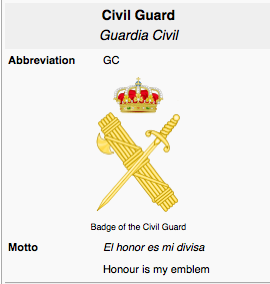
The Guardia Civil uses as its leading emblem the motto “El honor es mi divisa” (Honor is my emblem) stressing its esprit de corps and pointing out the importance of honor. Their precincts are called “casa cuartel” (army house) and, like other military garrisons in Spain, they appear under the motto “Todo por la patria” (All in the service of the Mother/Fatherland).
The remit of the Regional Mediterranean Center is to keep watch over coasts and borders, coordinating the Guardia Civil’s resources and specialties within its territorial jurisdiction.
This new center will provide real time information on the various systems used by the Guardia Civil in its maritime surveillance of the coasts and borders of Spain. It will also phase in information from other international scenarios in which the Guardia Civil participates as part of its border protection missions.
This center will display in unified and integrated form information from the radar tracks and video signals of the sensor stations of the Integrated Exterior Surveillance System (Sistema Integrado de Vigilancia Exterior: SIVE) of the Mediterranean.
But CRVM’s information trawl goes well beyond its subordinated SIVE deployments; through the National Coordination Center (NCC), it will also receive information from external sources such as AIS (Automatic Identification System) networks and AVL (Automatic Vehicle Location) systems, satellite information plus information from other countries that might be involved in any particular operation underway at that time. It is this merging of so many different information sources and cooperation with other systems that makes CRVM so unique.
CVRM will therefore have the following capabilities:
—The capability of merging information from SIVE’s various sensor stations and also information from the NCC. This will give a complete overview of the maritime border situation.
—The capability of carrying out interoperable incident management in keeping with the cooperation and information-swapping guidelines laid down by the European Commission’s European Border Surveillance System (EUROSUR).
—Capability of assessing information with decision-taking aid to ensure the best and swiftest decisions are taken in each case.
—Capability of broadcasting orders and controlling the ongoing situations in response to actions taken.
Winning this contract represents yet another GMV milestone in the area of border surveillance and security. In this area GMV is already playing a key role in the EUROSUR project, creating a permanent connection between the whole set of National Coordination Centers (NCCs) and the European Agency for the Management of Operational Cooperation at the External Borders of the Member States of the European Union (FRONTEX, shortened from the French Frontières extérieures), using an extensible system to share information
