

• Skip to primary navigation
  • Skip to main content
  • Skip to primary sidebar
  • Skip to secondary sidebar
  • Skip to footer
  • NEWS:
  • SatNews
  • SatMagazine
  • MilSatMagazine
  • SmallSat News
  • |     EVENTS:
  • SmallSat Symposium
  • Satellite Innovation
  • MilSat Symposium
  • SmallSat Europe

SatNews

Satellite Industry Intelligence Since 1983

Subscribe
  • LATEST
  • SatNews Events
  • Magazines
  • Calendar
  • Subscribe
  • Missions & Constellations
    • Exploration & Science Missions
    • In-Orbit Servicing & Orbital Operations
    • LEO Constellations
    • Mission Autonomy & Onboard Systems
    • Mission Deployments & Manifests
    • Navigation & PNT
    • SmallSat
    • Spacecraft & Payload Technology
    View All in Missions & Constellations →
    SpaceX’s Secret ‘Starfall’ Capsule Wins FAA Approval for Pacific Reentry TestsSpaceX’s Secret ‘Starfall’ Capsule Wins FAA Approval for Pacific Reentry Tests
    NOAA Activates First Dedicated U.S. Space Weather Satellite One Million Miles from EarthNOAA Activates First Dedicated U.S. Space Weather Satellite One Million Miles from Earth
    Thales Alenia Space to coordinate EROSS SC On-Orbit Servicing projectThales Alenia Space to coordinate EROSS SC On-Orbit Servicing project
    Astroscale Launches Industry Initiative to Study Atmospheric Impact of Spacecraft ReentryAstroscale Launches Industry Initiative to Study Atmospheric Impact of Spacecraft Reentry
  • Business
    • Contracts & Commercial Deals
    • Earnings & Financial Reporting
    • Events & Conferences
    • Funding & Venture Capital
    • Market Forecasts
    • Mergers & Acquisitions
    • Personnel Moves & Appointments
    View All in Business & Finance →
    SpaceX: The targets might be toughSpaceX: The targets might be tough
    SOMA Satellite Factory: Planet Labs Expands San Francisco HQ to Supercharge Production PipelineSOMA Satellite Factory: Planet Labs Expands San Francisco HQ to Supercharge Production Pipeline
    Riding the Starship: The SpaceX IPO Is Set to Rocket Seattle’s Aerospace EcosystemRiding the Starship: The SpaceX IPO Is Set to Rocket Seattle’s Aerospace Ecosystem
    Space Race Moves to Wall Street: China’s Private Rocket Makers Target IPOs as Historic SpaceX Flotation NearsSpace Race Moves to Wall Street: China’s Private Rocket Makers Target IPOs as Historic SpaceX Flotation Nears
  • Defense
    • Counterspace & ASAT
    • Defense Budgets & Procurement
    • ISR & Reconnaissance
    • MILSATCOM
    • Missile Warning & Defense
    • National Security Programs
    • Space Domain Awareness
    View All in Military & Defense →
    Space-Based Shield: Spire Global and Diehl Defence Partner to Build European Missile Warning NetworkSpace-Based Shield: Spire Global and Diehl Defence Partner to Build European Missile Warning Network
    Qorvo Unveils Compact X-Band Radar Module to Enhance Defense System PerformanceQorvo Unveils Compact X-Band Radar Module to Enhance Defense System Performance
    Energration and Atombeam Partner on DARPA Proposal to Revolutionize Tactical Data Movement at the Defense EdgeEnergration and Atombeam Partner on DARPA Proposal to Revolutionize Tactical Data Movement at the Defense Edge
    American military space closed around one company in seven daysAmerican military space closed around one company in seven days
  • Gov
    • Export Controls & Compliance
    • International Space Agreements
    • National Space Policy
    • Space Law & Treaties
    • Space Sustainability & Debris Policy
    • Space Traffic Management / Debris Removal
    View All in Government & Regulation →
    Major opportunities for 2 GHz over EuropeMajor opportunities for 2 GHz over Europe
    “Dual-use” is the funding word. It’s also the label operators want off.“Dual-use” is the funding word. It’s also the label operators want off.
    Sovereignty got an answer on Day 3. Two answers, actually, and a commercial veto.Sovereignty got an answer on Day 3. Two answers, actually, and a commercial veto.
    Dependency killed the old debate. Sovereignty is the new one, and Europe hasn’t agreed what it means.Dependency killed the old debate. Sovereignty is the new one, and Europe hasn’t agreed what it means.
  • Launch
    • Launch Providers
    • Launch Schedule & Calendars
    • Launch Sites & Infrastructure
    • Rocket Technology & Vehicles
    View All in Launch →
    Breaking the TRL Bottleneck: Space Phoenix Systems Debuts Cost-Effective Space Test-and-Return ServiceBreaking the TRL Bottleneck: Space Phoenix Systems Debuts Cost-Effective Space Test-and-Return Service
    Twelve Scientific Payloads Experience Microgravity Aboard SubOrbital Express-5Twelve Scientific Payloads Experience Microgravity Aboard SubOrbital Express-5
    Amazon Leo Constellation Surpasses 330 Satellites Following Latest Atlas V LaunchAmazon Leo Constellation Surpasses 330 Satellites Following Latest Atlas V Launch
    If You Thought Space Was Hard Try to Get Your Satellite On a RocketIf You Thought Space Was Hard Try to Get Your Satellite On a Rocket
  • Software
    • Autonomous Ground Operations
    • Data Processing & AI/ML
    • Digital Twins & Modeling
    • Ground Segment & Teleports
    • Mission Planning & Simulation
    • Space Systems Software Engineering
    • Spectrum & Licensing
    View All in Software Automation & Ground Systems →
    Software Over the Air: FatPipe Launches Acceleration Tool to Unclog Starlink and Amazon LEO LinksSoftware Over the Air: FatPipe Launches Acceleration Tool to Unclog Starlink and Amazon LEO Links
    Three LEO Operators Bet 2026 on a Supply Chain Built for 2027Three LEO Operators Bet 2026 on a Supply Chain Built for 2027
    NASA Advances Interoperable Space Networks with Successful PExT DemonstrationNASA Advances Interoperable Space Networks with Successful PExT Demonstration
    KSAT and iQPS Expand Strategic Alliance to Accelerate High-Frequency SAR ConstellationKSAT and iQPS Expand Strategic Alliance to Accelerate High-Frequency SAR Constellation
  • Services & Apps
    • Climate & Environmental Monitoring
    • Disaster Response & Security Mapping
    • Earth Observation & Imaging
    • Maritime & Aviation Satcom
    • Satellite Communications
    View All in Services & Applications →
    Eutelsat and Tototheo Global Forge Partnership to Deliver LEO Connectivity Across Maritime and Government SectorsEutelsat and Tototheo Global Forge Partnership to Deliver LEO Connectivity Across Maritime and Government Sectors
    Marlink Equips Groupama-FDJ Cycling Team with Hybrid Starlink and LTE NetworkMarlink Equips Groupama-FDJ Cycling Team with Hybrid Starlink and LTE Network
    Viasat Secures Lockheed Martin Contract for NOAA’s Next-Generation AircraftViasat Secures Lockheed Martin Contract for NOAA’s Next-Generation Aircraft
    SES Partners with Viva to Launch Multi-Orbit In-Flight ConnectivitySES Partners with Viva to Launch Multi-Orbit In-Flight Connectivity

NASA… Milky Way’s Globular Cluster Provides Sweet Insight For Hubble

July 22, 2013

[SatNews] “These data are so good, we can actually see the individual motions of the stars in the cluster.

Astronomers using NASA’s Hubble Space Telescope have determined the orbital motion of two distinct populations of stars in an ancient globular star cluster, offering proof they formed at different times and providing a rare look back into the Milky Way galaxy’s early days.
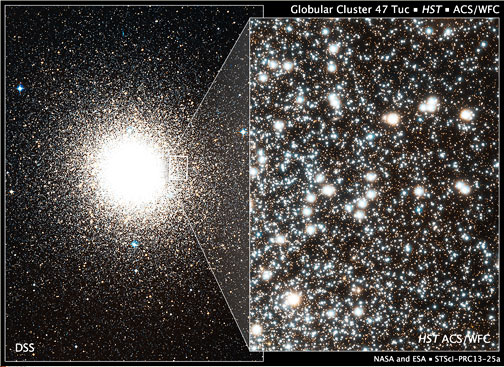

These images showcase the ancient globular cluster 47 Tucanae, a dense swarm of up to a million stars.

The image at left shows the entire cluster, which measures about 120 light-years across. Located in the southern constellation Tucana, the cluster is about 16,700 light-years away. The image is part of the Digitized Sky Survey (DSS) and was taken by the UK Schmidt Telescope at Siding Spring Observatory in New South Wales, Australia. The white rectangular box outlines the view taken by NASA’s Hubble Space Telescope. That image, shown at right, captures close-up views of thousands of cluster stars. The large, bright stars in the image are red giants. These stars have puffed up to several times their normal size because they have exhausted their nuclear fuel and are near the end of their lives. The image was taken by Hubble’s Advanced Camera for Surveys. Astronomers used these Hubble observations, along with archival Hubble data, of 47 Tucanae to accurately measure changes in positions of more than 30,000 cluster stars. Based on those measurements, the astronomers pieced together the stars’ histories, finding two populations of stars that have different chemical composition and that have different motions. Understanding the dynamics of the 47 Tucanae stars can yield insights into how this cluster formed its stars. The Hubble image was taken between January and October 2010. The Schmidt telescope image was taken Oct. 12, 1977, and Sept. 9, 1989. Object Names: 47 Tuc, 47 Tucanae, NGC 104 Image Type: Astronomical/Annotated Credit: NASA, ESA, Digitized Sky Survey (DSS; STScI/AURA/UKSTU/AAO), H. Richer and J. Heyl (University of British Columbia), and J. Anderson and J. Kalirai (STScI)

Researchers led by Harvey Richer of the University of British Columbia in Vancouver combined recent Hubble observations with eight years’ worth of data from the telescope’s archive to determine the motions of the stars in the globular cluster 47 Tucanae, which is located about 16,700 light-years away in the southern constellation Tucana.

The analysis enabled researchers, for the first time, to link the movement of stars in the clusters with the stars’ ages. The two populations in 47 Tucanae differ in age by less than 100 million years.

“When analyzing the motions of stars, the longer the time baseline for observations, the more accurately we can measure their motion,” said Richer. “These data are so good, we can actually see the individual motions of the stars in the cluster. The data offer detailed evidence to help us understand how various stellar populations formed in such clusters.”

The Milky Way’s globular clusters are the surviving relics from our galaxy’s formation. They offer insights into the early history of our galaxy. 47 Tucanae is 10.5 billion years old and one of the brightest of our galaxy’s more than 150 globular clusters. The cluster measures about 120 light-years wide.

Previous spectroscopic studies revealed  many globular clusters contain stars of varying chemical compositions, suggesting multiple episodes of star birth. This Hubble analysis supports those studies, but adds the stars’ orbital motion to the analysis.

Richer and his team used Hubble’s Advanced Camera for Surveys to observe the cluster in 2010. They combined those observations with 754 archival images to measure the change in position of more than 30,000 stars. Using these data, they could discern how fast the stars move. The team also measured the stars’ brightness and temperatures.

This stellar archaeology identified the two distinct populations of stars. The first population consists of redder stars, which are older, less chemically enriched, and orbiting in random circles. The second population consists of bluer stars, which are younger, more chemically enhanced, and moving in more elliptical orbits.

The lack of heavier elements in the redder stars reflects the initial composition of the gas that formed the cluster. After the most massive of these stars completed their stellar evolution, they expelled gas enriched with heavier elements back into the cluster. This gas collided with other gas and formed a second, more chemically enriched generation of stars that was concentrated toward the cluster center. Over time these stars moved slowly outward into more elliptical orbits.

This is not the first time Hubble has revealed multiple generations of stars in globular clusters. In 2007, Hubble researchers found three generations of stars in the massive globular cluster NGC 2808. But Richer’s team is the first to link stellar dynamics to separate populations. The team’s results appeared July 1 in The Astrophysical Journal Letters.

The Hubble Space Telescope is a cooperative project between NASA and the European Space Agency. NASA’s Goddard Space Flight Center in Greenbelt, Md., manages the telescope. The Space Telescope Science Institute (STScI) in Baltimore, Md., conducts Hubble science operations. STScI is operated by the Association of Universities for Research in Astronomy Inc. in Washington.

Learn more about 47 Tucanae here.

Filed Under: Exploration & Science Missions

Primary Sidebar

Coverage

  • Missions & Constellations
  • Business & Finance
  • Military & Defense
  • Launch
  • Software Automation & Ground Systems
  • Government & Regulation
  • Services & Applications

Most Read Stories

  • SpaceX Debuts Starship V3: Redefining Heavy-Lift Launch Capability
  • SpaceX Is Worth $1.75 Trillion. Only 7% of That Is Real.
  • SpaceX: 10,000 Launches Annually
  • American military space closed around one company in seven days
  • The end of GEO?

Secondary Sidebar

Footer


Satnews is a leading provider of satellite news, events, publications, research and other satellite industry information in both commercial and military enterprises worldwide.

Stories By Category

  • Business & Finance
  • Government & Regulation
  • Launch
  • Military & Defense
  • Missions & Constellations
  • Services & Applications
  • Software Automation & Ground Systems
  • Spectrum & Licensing
  • Startups & NewSpace Business

About Us

  • Leadership & Editorial Team
  • SatNews History
  • Free Satnews Subscription
  • SatNews Events
  • Magazines

Navigation

  • Latest Stories
  • Magazines
  • Events
  • Contact
  • Cookie & Privacy Policy for Satnews

We use cookies to ensure that we give you the best experience on our website. If you continue to use this site we will assume that you are happy with it.
x
Sign up Now (For Free)
Access daily or weekly satellite news updates covering all aspects of the commercial and military satellite industry.
Invalid email address
Notify Me Regarding ( At least one ):
We value your privacy and will not sell or share your email or other information with any other company. You may also unsubscribe at anytime.

Click Here to see our full privacy policy.
Thanks for subscribing!