


Kirchner highlighted the need to modernize the way NOAA and other federal agencies obtain satellite weather data, placing new emphasis on purchasing data from low-cost commercial suppliers. “The U.S. government should articulate and implement procurement reform by creating new performance-based, pay-on-delivery, data-purchase procurement approaches that enable federal agencies to immediately contract for services to help close the observational weather data gap looming in the next few years,” Kirchner told the committee in his testimony.
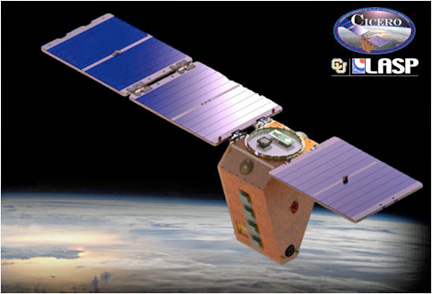
Artist’s rendering of the LASP design for the
CICERO Pathfinder spacecraft.
GeoOptics will launch an array of powerful GPS radio occultation (RO) sensors on its Phase 1 “CICERO” constellation of six low Earth orbiting satellites. CICERO will be expanded to 24 satellites carrying complementary sensors as demand grows. GPS-RO measures atmospheric temperature, moisture and pressure with a precision unrivalled by other space-based techniques. The RO sensor recovers this information by precisely observing perturbations imposed on ubiquitous GPS radio signals as they pass through the atmosphere. Today more than 2,500 orgnizations in 75 countries use RO data in Numerical Weather Prediction (NWP) and research. NOAA’s own studies show that more accurate mid-to-long term forecasts can be made up to 15 hours sooner using the data collected from the current limited set of experimental GPS-RO sensors. CICERO Phase 1 will increase the available RO data supply at least three-fold.
“GeoOptics will advance a small satellite observing model that starts with GPS radio occultation,” Kirchner testified. “We believe an integrated private company like ours can deploy such systems for a fraction of current costs to the government.”
Kirchner went on to characterize the value proposition that commercial companies, such as GeoOptics, will represent to the U.S. weather enterprise community. He said GeoOptics believes that by adopting procurement options for purchasing earth observational data, the government could foster a vibrant global market in innovative satellite weather data. This will dramatically advance forecasting, particularly for severe storms, and will save lives, protect property and promote a robust U.S. economy.
