

…part of a satellite mission that NASA has selected to move forward into development (Phase B), with launch expected in 2017. The NRL Space Science Division (SSD) developed Michelson Interferometer for Global High-resolution Thermospheric Imaging (MIGHTI) satellite instrument is part of NASA’s Ionospheric Connection Explorer (ICON) mission.
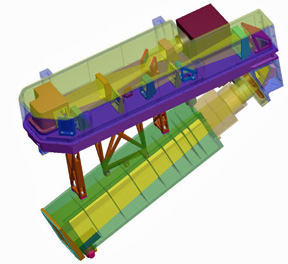
Conceptual design of NRL’s Michelson Interferometer for Global High-resolution Thermospheric Imaging (MIGHTI), that is part of NASA’s ICON mission.
(Photo: U.S. Naval Research Laboratory)

NRL’s Dr. Christoph Englert leads the MIGHTI research. (Photo: U.S. Naval Research Laboratory)
NRL’s MIGHTI instrument onboard the ICON satellite will contribute to reaching the mission goals by measuring the neutral winds and temperatures in the Earth’s low latitude thermosphere. The MIGHTI instrument uses the DASH (Doppler Asymmetric Spatial Heterodyne spectroscopy) technique, which was co-invented and pioneered by NRL. The payload consists of two identical units that will observe the Earth’s thermosphere with perpendicular viewing directions. As ICON travels eastward and continuously images the thermosphere and ionosphere, MIGHTI will measure the vector components of the vertical wind profile.
NRL’s MIGHTI is named for Albert Michelson, a physicist known for his research on the measurement of the speed of light using a related interferometer type. More directly, MIGHTI builds on technology previously used in NRL’s SHIMMER (Spatial Heterodyne Imager for Mesospheric Radicals), a payload aboard STPSat-1. The NRL MIGHTI team is led by Dr. Christoph Englert, head of the Geospace Science and Technology Branch in NRL’s Space Science Division.
In addition to SSD leading the MIGHTI instrument, NRL scientists Dr. Joe Huba from the Plasma Physics Division and Dr. Andrew Stephan from the SSD will provide ICON scientific data analysis and interpretation. ICON is part of NASA’s Heliophysics Explorer Program. The Explorer program, which has launched more than 90 missions since 1958, is managed by NASA’s Goddard Space Flight Center for the Science Mission Directorate.
