

…concluded its mission after serving the organization for more than 17 years— that’s 12 years longer than its mission life. Radarsat-1 launched in 1995 for an expected five-year mission. It was Canada’s first and oldest Earth monitoring satellite and conducted the first complete radar survey of Antarctica. Ball Aerospace built the spacecraft bus and a portion of the ground station for the advanced operational synthetic aperture for Spar Aerospace and the Canadian Space Agency. Ball also provided technical services to Spar (MacDonald Dettwiler), including system engineering and system integration planning. Radarsat-1 represented several firsts for Ball Aerospace:
- First fixed price and commercial spacecraft bus, introducing a cost-effective solution for Earth observation and remote-sensing missions
- First Ball Aerospace international spacecraft, which expanded the company’s profile into new markets
- Inaugural satellite bus for the company’s successful Ball Configurable Platform (BCP) line of spacecraft
“Radarsat-1 set the bar high,” said Cary Ludtke, vice president and general manager for Ball’s Operational Space business unit. “It was a great learning experience in principal areas of the company’s evolving business approach, particularly in developing the know-how to execute on commercial, fixed-price programs.”
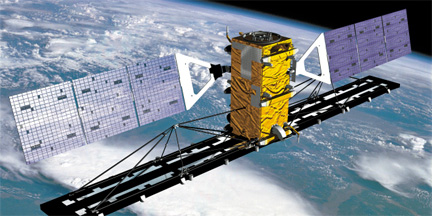
Artistic rendition of the Radarsat-1 satellite.
Ball built the Radarsat-1 spacecraft bus based on technical experience gained developing the Earth Radiation Budget Experiment for NASA and the Relay Mirror Experiment satellite for the U.S. Air Force. More recently, Ball continues its contributions to NASA’s Earth science program with the launch of the Operational Land Imager aboard the Landsat Data Continuity Mission to extend the 40-year record of continuous land surface observations.
