

• Skip to primary navigation
  • Skip to main content
  • Skip to primary sidebar
  • Skip to secondary sidebar
  • Skip to footer
  • NEWS:
  • SatNews
  • SatMagazine
  • MilSatMagazine
  • SmallSat News
  • |     EVENTS:
  • SmallSat Symposium
  • Satellite Innovation
  • MilSat Symposium
  • SmallSat Europe

SatNews

Satellite Industry Intelligence Since 1983

Subscribe
  • LATEST
  • SatNews Events
  • Magazines
  • Calendar
  • Subscribe
  • Missions & Constellations
    • Exploration & Science Missions
    • In-Orbit Servicing & Orbital Operations
    • LEO Constellations
    • Mission Autonomy & Onboard Systems
    • Mission Deployments & Manifests
    • Navigation & PNT
    • SmallSat
    • Spacecraft & Payload Technology
    View All in Missions & Constellations →
    Starlink Outages Disrupt Navy Drone Tests as Pentagon Dependency GrowsStarlink Outages Disrupt Navy Drone Tests as Pentagon Dependency Grows
    Iridium Unveils Core Role in Artemis II and Next-Gen PNT at Space Symposium 2026Iridium Unveils Core Role in Artemis II and Next-Gen PNT at Space Symposium 2026
    Boeing and Millennium Unveil Resolute Mid-Class Satellite PlatformBoeing and Millennium Unveil Resolute Mid-Class Satellite Platform
    NASA Shifts Focus to Permanent Lunar Base and Nuclear PropulsionNASA Shifts Focus to Permanent Lunar Base and Nuclear Propulsion
  • Business
    • Contracts & Commercial Deals
    • Earnings & Financial Reporting
    • Events & Conferences
    • Funding & Venture Capital
    • Market Forecasts
    • Mergers & Acquisitions
    • Personnel Moves & Appointments
    View All in Business & Finance →
    Amazon+Globalstar. Turbocharging the industryAmazon+Globalstar. Turbocharging the industry
    Geographic Hotspots: Where Demand Is AcceleratingGeographic Hotspots: Where Demand Is Accelerating
    SmallSat Europe Speaker Focus: Martin Langer, OroraTechSmallSat Europe Speaker Focus: Martin Langer, OroraTech
    SmallSat Europe Speaker Focus: Jaume Sanpera, SateliotSmallSat Europe Speaker Focus: Jaume Sanpera, Sateliot
  • Defense
    • Counterspace & ASAT
    • Defense Budgets & Procurement
    • ISR & Reconnaissance
    • MILSATCOM
    • Missile Warning & Defense
    • National Security Programs
    • Space Domain Awareness
    View All in Military & Defense →
    Saltzman Unveils 2040 Blueprint to Scale Space Force for Great Power CompetitionSaltzman Unveils 2040 Blueprint to Scale Space Force for Great Power Competition
    The Rise of Grey Zone Satellites: Ambiguity as a Tactical AdvantageThe Rise of Grey Zone Satellites: Ambiguity as a Tactical Advantage
    SmallSat Europe Speaker Focus: Col. Marcin Mazur, Polish Space AgencySmallSat Europe Speaker Focus: Col. Marcin Mazur, Polish Space Agency
    US Space Force Awards $68.6M Modification to Lockheed Martin for Next-Gen OPIRUS Space Force Awards $68.6M Modification to Lockheed Martin for Next-Gen OPIR
  • Gov
    • Export Controls & Compliance
    • International Space Agreements
    • National Space Policy
    • Space Law & Treaties
    • Space Sustainability & Debris Policy
    • Space Traffic Management / Debris Removal
    View All in Government & Regulation →
    SmallSat Europe Speaker Focus: Chris Quilty, Quilty SpaceSmallSat Europe Speaker Focus: Chris Quilty, Quilty Space
    NRL to Showcase Sovereign Space Capabilities at 41st Space SymposiumNRL to Showcase Sovereign Space Capabilities at 41st Space Symposium
    FCC Modernizes Satellite Spectrum Rules to Unleash Next-Generation BroadbandFCC Modernizes Satellite Spectrum Rules to Unleash Next-Generation Broadband
    SmallSat Europe Speaker Focus: Daniel Bock, Morpheus SpaceSmallSat Europe Speaker Focus: Daniel Bock, Morpheus Space
  • Launch
    • Launch Providers
    • Launch Schedule & Calendars
    • Launch Sites & Infrastructure
    • Rocket Technology & Vehicles
    View All in Launch →
    Ensign-Bickford Hardware Supports Successful Artemis II Lunar MissionEnsign-Bickford Hardware Supports Successful Artemis II Lunar Mission
    China Accelerates Orbital Internet Deployment with Successful Smart Dragon-3 Sea LaunchChina Accelerates Orbital Internet Deployment with Successful Smart Dragon-3 Sea Launch
    What the SpaceX IPO Changes for Every Satellite OperatorWhat the SpaceX IPO Changes for Every Satellite Operator
    €30 million Financing for PLD Space’s Small Satellite Launcher€30 million Financing for PLD Space’s Small Satellite Launcher
  • Software
    • Autonomous Ground Operations
    • Data Processing & AI/ML
    • Digital Twins & Modeling
    • Ground Segment & Teleports
    • Mission Planning & Simulation
    • Space Systems Software Engineering
    • Spectrum & Licensing
    View All in Software Automation & Ground Systems →
    Blue Origin Unveils Project Quartz Global Ground Station NetworkBlue Origin Unveils Project Quartz Global Ground Station Network
    Cloudcomputing Targets 1.5M Identities in Spain and Finalizes Innovate IT AcquisitionCloudcomputing Targets 1.5M Identities in Spain and Finalizes Innovate IT Acquisition
    Archangel Lightworks Secures £10M Series A to Scale Optical Ground InfrastructureArchangel Lightworks Secures £10M Series A to Scale Optical Ground Infrastructure
    Keysight and Sateliot Win ESA and GSMA Foundry Challenge for 6G InnovationKeysight and Sateliot Win ESA and GSMA Foundry Challenge for 6G Innovation
  • Services & Apps
    • Climate & Environmental Monitoring
    • Disaster Response & Security Mapping
    • Earth Observation & Imaging
    • Maritime & Aviation Satcom
    • Satellite Communications
    View All in Services & Applications →
    NASA Targets Commercial Relays to Replace Aging TDRSS InfrastructureNASA Targets Commercial Relays to Replace Aging TDRSS Infrastructure
    OQ Technology Awarded ESA Contract to Adapt 5G Beamforming for SpaceOQ Technology Awarded ESA Contract to Adapt 5G Beamforming for Space
    Kraken Robotics Integrates KATFISH Sonar on SEFINE RD-22 USV Following Multi-Naval DemonstrationsKraken Robotics Integrates KATFISH Sonar on SEFINE RD-22 USV Following Multi-Naval Demonstrations
    Astroscale Plans World-First Multi-Orbit Satellite Inspection MissionAstroscale Plans World-First Multi-Orbit Satellite Inspection Mission

NASA’s IRIS Is 20/20 In Preparation For Launch

April 22, 2013


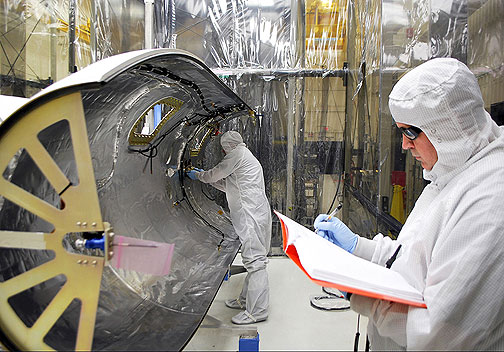
VANDENBERG AFB, Calif. – Technicians work on the payload fairing that will protect NASA’s Interface Region Imaging Spectrograph (IRIS) spacecraft during launch aboard an Orbital Sciences Pegasus XL rocket. Launch is currently scheduled no earlier than May 28, 2013. The IRIS satellite will improve our understanding of how heat and energy move through the deepest levels of the sun’s atmosphere, thereby increasing our ability to forecast space weather. On launch day, deployment of the Pegasus from Orbital’s L-1011 carrier aircraft will occur at a location over the Pacific Ocean about 100 miles northwest of Vandenberg off the central coast of California south of Big Sur. Image Credit: VAFB/Randy Beaudoin
[SatNews] Both these phenomena can add to the turbulence of the region and IRIS’s high-resolution spectra and images will be able to tease apart just which forms of energy cause which effects.

Understanding the interface between the photosphere and corona remains a fundamental challenge in solar and heliospheric science. The Interface Region Imaging Spectrograph (IRIS) mission opens a window of discovery into this crucial region by tracing the flow of energy and plasma through the chromosphere and transition region into the corona using spectrometry and imaging.

IRIS is designed to provide significant new information to increase the understanding of energy transport into the corona and solar wind and provide an archetype for all stellar atmospheres.

The unique instrument capabilities, coupled with state of the art 3-D modeling, will fill a large gap in our knowledge of this dynamic region of the solar atmosphere. The mission will extend the scientific output of existing heliophysics spacecraft that follow the effects of energy release processes from the sun to Earth.

The IRIS satellite design is derived from several previous NASA/LMSAL spacecraft. By re-using prior designs Lockheed Martin was able to reduce technical, scheduling and cost risks. Solar arrays omitted for clarity. Credit: LMSAL

IRIS is NASA’s Interface Region Imaging Spectrograph. Its primary goal is to understand how heat and energy move through the lower levels of the solar atmosphere.

IRIS is a class of spacecraft called a Small Explorer, which NASA defines as costing less than $120 million.

Lockheed Martin (LM) Solar and Astrophysics Laboratory in LM’s Advanced Technology Center is the principle investigator institution and has overall responsibility for the mission, with major contributions from Lockheed Martin Civil Space, NASA Ames, Smithsonian Astrophysical Laboratory, Montana State University, Stanford University and the University of Oslo.
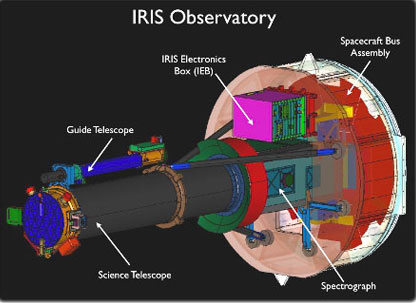
IRIS weighs 440 pounds. It is approximately 7 feet (2.1 meters) long and, with its solar panels extended, is a little over 12 feet (3.7 meters) across.

IRIS will make use of high-resolution images, data and advanced computer models to unravel how matter, light, and energy move from the sun’s 6000 K surface to its million K outer atmosphere or corona. A fundamentally mysterious region that helps drive heat into the corona, this area has been notoriously hard to study. IRIS will be able to tease apart what’s happening there better than has ever been done before.

To do this, IRIS will observe the lowest part of the sun’s atmosphere: the chromosphere, an expanse of ionized gas or plasma lying just above the sun’s surface, and the transition region, where the chromosphere transitions into the even hotter corona above. This interface region lies at the core of many outstanding questions about the sun’s atmosphere, such as how the sun creates giant explosions like solar flares or coronal mass ejections (CMEs), or how solar material in the corona reaches millions of degrees, several thousand times hotter than the surface of the sun itself.

Much of this coronal heating begins in the chromosphere and transition region. These highly dynamic regions are constantly in motion, so it isn’t simple to profile temperatures with respect to position. Indeed, a wide range of temperatures can occur at similar heights, with different swaths of material propelled upward and downward in response to the release of magnetic energy, as well as various types of plasma waves. This moving interface region covers a wide range of heights above the sun’s surface, extending over several thousand miles. Throughout this height range, not only do the temperatures vary dramatically from 5000 Kelvin to almost a million degrees, but there are also enormous density contrasts, with certain areas up to a million times more dense than others.
This turbulent interface region contains more mass than does all the rest of the corona and heliosphere, which extends to the very edge of the solar system. Given how much material is there, the chromosphere requires a heating rate at least ten times greater than that of the corona itself.

One of IRIS’s main science objectives will be to study how this foundational region of the heliosphere contributes mass and energy to the atmosphere above it, depositing so much heat into the corona. IRIS observations will mesh with those from NASA’s Solar Dynamics Observatory (SDO), which launched in 2010. SDO observes the sun’s surface and the corona, while IRIS will observe the crucial region in between the photosphere and corona at much higher resolution than ever before captured. IRIS is what’s called an imaging spectrograph, which means it will provide both images and what are called spectra, which splits light into its various colors. Each line of light carries information about different materials of the sun and how they move, thus they can be used to probe physical characteristics in the solar atmosphere such as density, temperature and velocity.

IRIS will attempt to distinguish between two mechanisms that may be responsible for powering this region: magnetic field reconnection and dissipation of waves that travel through the solar atmosphere. Both these phenomena can add to the turbulence of the region and IRIS’s high-resolution spectra and images will be able to tease apart just which forms of energy cause which effects.

Such information will also help scientists examine how the solar material and its attendant magnetic fields contribute to eruptions on the sun such as solar flares and CMEs. This may increase our ability to forecast such space weather, which can disable satellites, cause power grid failures, and disrupt GPS services.

Lastly, understanding our own star better will help deepen our insight into atmospheres at distant stars as well.

Filed Under: Exploration & Science Missions

Primary Sidebar

Coverage

  • Missions & Constellations
  • Business & Finance
  • Military & Defense
  • Launch
  • Software Automation & Ground Systems
  • Government & Regulation
  • Services & Applications

Most Read Stories

  • SpaceX Loses Contact With Starlink Satellite
  • Rocket Lab Emerging as Potential Bus Provider for 2,800-Satellite Equatys Constellation
  • SpaceX Accelerates Record-Breaking IPO Following Trillion-Dollar xAI Merger
  • Planet Labs Imposes Indefinite Blackout on Iran Satellite Imagery at U.S. Request
  • Amazon in Reported Talks to Acquire Globalstar in $9 Billion Move to Challenge Starlink

Secondary Sidebar

Footer


Satnews is a leading provider of satellite news, events, publications, research and other satellite industry information in both commercial and military enterprises worldwide.

Stories By Category

  • Business & Finance
  • Government & Regulation
  • Launch
  • Military & Defense
  • Missions & Constellations
  • Services & Applications
  • Software Automation & Ground Systems
  • Spectrum & Licensing
  • Startups & NewSpace Business

About Us

  • Leadership & Editorial Team
  • SatNews History
  • Free Satnews Subscription
  • SatNews Events
  • Magazines

Navigation

  • Latest Stories
  • Magazines
  • Events
  • Contact
  • Cookie & Privacy Policy for Satnews

We use cookies to ensure that we give you the best experience on our website. If you continue to use this site we will assume that you are happy with it.
x
Sign up Now (For Free)
Access daily or weekly satellite news updates covering all aspects of the commercial and military satellite industry.
Invalid email address
Notify Me Regarding ( At least one ):
We value your privacy and will not sell or share your email or other information with any other company. You may also unsubscribe at anytime.

Click Here to see our full privacy policy.
Thanks for subscribing!