

• Skip to primary navigation
  • Skip to main content
  • Skip to primary sidebar
  • Skip to secondary sidebar
  • Skip to footer
  • NEWS:
  • SatNews
  • SatMagazine
  • MilSatMagazine
  • SmallSat News
  • |     EVENTS:
  • SmallSat Symposium
  • Satellite Innovation
  • MilSat Symposium
  • SmallSat Europe

SatNews

Satellite Industry Intelligence Since 1983

Subscribe
  • LATEST
  • SatNews Events
  • Magazines
  • Calendar
  • Subscribe
  • Missions & Constellations
    • Exploration & Science Missions
    • In-Orbit Servicing & Orbital Operations
    • LEO Constellations
    • Mission Autonomy & Onboard Systems
    • Mission Deployments & Manifests
    • Navigation & PNT
    • SmallSat
    • Spacecraft & Payload Technology
    View All in Missions & Constellations →
    NASA’s Shift to CLPS 2.0 Signals Structural Transformation of Lunar Logistics MarketNASA’s Shift to CLPS 2.0 Signals Structural Transformation of Lunar Logistics Market
    Teledyne to Showcase Integrated Sensing Ecosystem and New Low-Light Module at SPIE 2026Teledyne to Showcase Integrated Sensing Ecosystem and New Low-Light Module at SPIE 2026
    NASA Shuts Off Instrument on Voyager 1 to Extend Interstellar MissionNASA Shuts Off Instrument on Voyager 1 to Extend Interstellar Mission
    Starlink Outages Disrupt Navy Drone Tests as Pentagon Dependency GrowsStarlink Outages Disrupt Navy Drone Tests as Pentagon Dependency Grows
  • Business
    • Contracts & Commercial Deals
    • Earnings & Financial Reporting
    • Events & Conferences
    • Funding & Venture Capital
    • Market Forecasts
    • Mergers & Acquisitions
    • Personnel Moves & Appointments
    View All in Business & Finance →
    Market Dynamics and Non-Terrestrial Network (NTN) ChipsetsMarket Dynamics and Non-Terrestrial Network (NTN) Chipsets
    SmallSat Europe Speaker Focus: Alexander Greenberg, Loft OrbitalSmallSat Europe Speaker Focus: Alexander Greenberg, Loft Orbital
    SmallSat Europe Speaker Focus: Carsten Drachmann, GomSpaceSmallSat Europe Speaker Focus: Carsten Drachmann, GomSpace
    Meink: Space Force Programs Ready to Execute Once FY27 Budget LandsMeink: Space Force Programs Ready to Execute Once FY27 Budget Lands
  • Defense
    • Counterspace & ASAT
    • Defense Budgets & Procurement
    • ISR & Reconnaissance
    • MILSATCOM
    • Missile Warning & Defense
    • National Security Programs
    • Space Domain Awareness
    View All in Military & Defense →
    USSF Finalizes GPS III Constellation with Successful SV-10 DeploymentUSSF Finalizes GPS III Constellation with Successful SV-10 Deployment
    SDA’s Sandhoo: Tranche 1 Launches Resume in May or JuneSDA’s Sandhoo: Tranche 1 Launches Resume in May or June
    Gen. Stephen Whiting: First USSPACECOM Operational Staff Arrive at Redstone This WeekGen. Stephen Whiting: First USSPACECOM Operational Staff Arrive at Redstone This Week
    Saltzman Rolls Out Space Force Objective Force, Flags CR as Top RiskSaltzman Rolls Out Space Force Objective Force, Flags CR as Top Risk
  • Gov
    • Export Controls & Compliance
    • International Space Agreements
    • National Space Policy
    • Space Law & Treaties
    • Space Sustainability & Debris Policy
    • Space Traffic Management / Debris Removal
    View All in Government & Regulation →
    FCC Grants AST SpaceMobile Authority for 248-Satellite Constellation and Direct-to-Cell ServiceFCC Grants AST SpaceMobile Authority for 248-Satellite Constellation and Direct-to-Cell Service
    SmallSat Europe Speaker Focus: Col. Marcin Mazur, Polish Space AgencySmallSat Europe Speaker Focus: Col. Marcin Mazur, Polish Space Agency
    SmallSat Europe Speaker Focus: Chris Quilty, Quilty SpaceSmallSat Europe Speaker Focus: Chris Quilty, Quilty Space
    NRL to Showcase Sovereign Space Capabilities at 41st Space SymposiumNRL to Showcase Sovereign Space Capabilities at 41st Space Symposium
  • Launch
    • Launch Providers
    • Launch Schedule & Calendars
    • Launch Sites & Infrastructure
    • Rocket Technology & Vehicles
    View All in Launch →
    Blue Origin Achieves First Booster Reuse but Satellite Enters Off-Nominal OrbitBlue Origin Achieves First Booster Reuse but Satellite Enters Off-Nominal Orbit
    Ensign-Bickford Hardware Supports Successful Artemis II Lunar MissionEnsign-Bickford Hardware Supports Successful Artemis II Lunar Mission
    China Accelerates Orbital Internet Deployment with Successful Smart Dragon-3 Sea LaunchChina Accelerates Orbital Internet Deployment with Successful Smart Dragon-3 Sea Launch
    What the SpaceX IPO Changes for Every Satellite OperatorWhat the SpaceX IPO Changes for Every Satellite Operator
  • Software
    • Autonomous Ground Operations
    • Data Processing & AI/ML
    • Digital Twins & Modeling
    • Ground Segment & Teleports
    • Mission Planning & Simulation
    • Space Systems Software Engineering
    • Spectrum & Licensing
    View All in Software Automation & Ground Systems →
    RF-Design Launches FiberLink CompactLine FCLR1811S4 for Ground Segment OptimizationRF-Design Launches FiberLink CompactLine FCLR1811S4 for Ground Segment Optimization
    Sat-Lite Technologies adds  Richard Rader to Spearhead Sales ExpansionSat-Lite Technologies adds Richard Rader to Spearhead Sales Expansion
    Blue Origin Unveils Project Quartz Global Ground Station NetworkBlue Origin Unveils Project Quartz Global Ground Station Network
    Cloudcomputing Targets 1.5M Identities in Spain and Finalizes Innovate IT AcquisitionCloudcomputing Targets 1.5M Identities in Spain and Finalizes Innovate IT Acquisition
  • Services & Apps
    • Climate & Environmental Monitoring
    • Disaster Response & Security Mapping
    • Earth Observation & Imaging
    • Maritime & Aviation Satcom
    • Satellite Communications
    View All in Services & Applications →
    IEC Telecom Unveils Voucher-Based Connectivity Solution at Singapore Maritime Week 2026IEC Telecom Unveils Voucher-Based Connectivity Solution at Singapore Maritime Week 2026
    GomSpace and STETMAN Establish UASAT Joint Venture for Ukrainian Sovereign CommunicationsGomSpace and STETMAN Establish UASAT Joint Venture for Ukrainian Sovereign Communications
    ISS National Lab Launches 2026 Orbital Edge Accelerator to Scale Space-Based R&DISS National Lab Launches 2026 Orbital Edge Accelerator to Scale Space-Based R&D
    Kymeta Chief Scientist Discusses Metamaterial Antenna Evolution and Orbital SustainabilityKymeta Chief Scientist Discusses Metamaterial Antenna Evolution and Orbital Sustainability

NASA’s Hubble Reveals Rogue Debris Disk Near Star Fomalhaut

January 14, 2013

[SatNews] “We are shocked. This is not what we expected…”

Newly released NASA Hubble Space Telescope images of a vast debris disk encircling the nearby star Fomalhaut and a mysterious planet circling it may provide forensic evidence of a titanic planetary disruption in the system.

Astronomers are surprised to find the debris belt is wider than previously known, spanning a section of space from 14 to nearly 20 billion miles from the star. Even more surprisingly, the latest Hubble images have allowed a team of astronomers to calculate the planet follows an unusual elliptical orbit that carries it on a potentially destructive path through the vast dust ring.
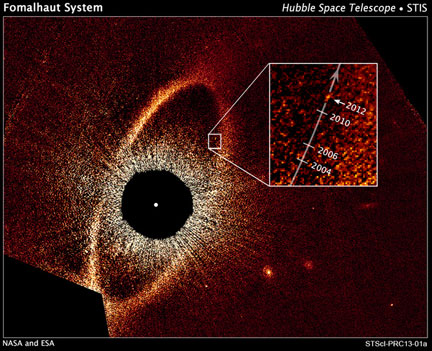

This false-color composite image, taken with the Hubble Space Telescope, reveals the orbital motion of the planet Fomalhaut b. Based on these observations, astronomers calculated that the planet is in a 2,000-year-long, highly elliptical orbit. The planet will appear to cross a vast belt of debris around the star roughly 20 years from now. If the planet’s orbit lies in the same plane with the belt, icy and rocky debris in the belt could crash into the planet’s atmosphere and produce various phenomena. The black circle at the center of the image blocks out the light from the bright star, allowing reflected light from the belt and planet to be photographed. The Hubble images were taken with the Space Telescope Imaging Spectrograph in 2010 and 2012. Credit: NASA, ESA, and P. Kalas (University of California, Berkeley and SETI Institute)

The planet, called Fomalhaut b, swings as close to its star as 4.6 billion miles, and the outermost point of its orbit is 27 billion miles away from the star. The orbit was recalculated from the newest Hubble observation made last year.

“We are shocked. This is not what we expected,” said Paul Kalas of the University of California at Berkeley and the SETI Institute in Mountain View, Calif.

The Fomalhaut team led by Kalas considers this circumstantial evidence there may be other planet-like bodies in the system that gravitationally disturbed Fomalhaut b to place it in such a highly eccentric orbit. The team presented its finding Tuesday at the 221st meeting of the American Astronomical Society in Long Beach, California.

Among several scenarios to explain Fomalhaut b’s 2,000-year-long orbit is the hypothesis that an as yet undiscovered planet gravitationally ejected Fomalhaut b from a position closer to the star, and sent it flying in an orbit that extends beyond the dust belt.

“Hot Jupiters get tossed through scattering events, where one planet goes in and one gets thrown out,” said co-investigator Mark Clampin of NASA’s Goddard Space Flight Center in Greenbelt, Md. “This could be the planet that gets thrown out.”

Hubble also found the dust and ice belt encircling the star Fomalhaut has an apparent gap slicing across the belt. This might have been carved by another undetected planet. Hubble’s exquisite view of the dust belt shows irregularities that strongly motivate a search for other planets in the system.

If its orbit lies in the same plane with the dust belt, then Fomalhaut b will intersect the belt around 2032 on the outbound leg of its orbit. During the crossing, icy and rocky debris in the belt could crash into the planet’s atmosphere and create the type of cosmic fireworks seen when Comet Shoemaker-Levy 9 crashed into Jupiter. Most of the fireworks from collisions will be seen in infrared light. However, if Fomalhaut b is not co-planar with the belt, the only thing to be seen will be a gradual dimming of Fomalhaut b as it travels farther from the star.

Kalas hypothesized that Fomalhaut b’s extreme orbit is a major clue in explaining why the planet is unusually bright in visible light, but very dim in infrared light. It is possible the planet’s optical brightness originates from a ring or shroud of dust around the planet, which reflects starlight. The dust would be rapidly produced by satellites orbiting the planet, which would suffer extreme erosion by impacts and gravitational stirring when Fomalhaut b enters into the planetary system after a millennium of deep freeze beyond the main belt. An analogy can be found by looking at Saturn, which has a tenuous, but very large dust ring produced when meteoroids hit the outer moon Phoebe.

The team has also considered a different scenario where a hypothetical second dwarf planet suffered a catastrophic collision with Fomalhaut b. The collision scenario would explain why the star Fomalhaut has a narrow outer belt linked to an extreme planet. But in this case the belt is young, less than 10,000 years old, and it is difficult to produce energetic collisions far from the star in such young systems.

Fomalhaut is a special system because it looks like scientists may have a snapshot of what our solar system was doing 4 billion years ago. The planetary architecture is being redrawn, the comet belts are evolving, and planets may be gaining and losing their moons. Astronomers will continue monitoring Fomalhaut b for decades to come because they may have a chance to observe a planet entering an icy debris belt that is like the Kuiper Belt at the fringe of our own solar system.

For more information please visit.

Filed Under: Exploration & Science Missions

Primary Sidebar

Coverage

  • Missions & Constellations
  • Business & Finance
  • Military & Defense
  • Launch
  • Software Automation & Ground Systems
  • Government & Regulation
  • Services & Applications

Most Read Stories

  • SpaceX Loses Contact With Starlink Satellite
  • Rocket Lab Emerging as Potential Bus Provider for 2,800-Satellite Equatys Constellation
  • SpaceX Accelerates Record-Breaking IPO Following Trillion-Dollar xAI Merger
  • Planet Labs Imposes Indefinite Blackout on Iran Satellite Imagery at U.S. Request
  • Amazon in Reported Talks to Acquire Globalstar in $9 Billion Move to Challenge Starlink

Secondary Sidebar

Footer


Satnews is a leading provider of satellite news, events, publications, research and other satellite industry information in both commercial and military enterprises worldwide.

Stories By Category

  • Business & Finance
  • Government & Regulation
  • Launch
  • Military & Defense
  • Missions & Constellations
  • Services & Applications
  • Software Automation & Ground Systems
  • Spectrum & Licensing
  • Startups & NewSpace Business

About Us

  • Leadership & Editorial Team
  • SatNews History
  • Free Satnews Subscription
  • SatNews Events
  • Magazines

Navigation

  • Latest Stories
  • Magazines
  • Events
  • Contact
  • Cookie & Privacy Policy for Satnews

We use cookies to ensure that we give you the best experience on our website. If you continue to use this site we will assume that you are happy with it.
x
Sign up Now (For Free)
Access daily or weekly satellite news updates covering all aspects of the commercial and military satellite industry.
Invalid email address
Notify Me Regarding ( At least one ):
We value your privacy and will not sell or share your email or other information with any other company. You may also unsubscribe at anytime.

Click Here to see our full privacy policy.
Thanks for subscribing!