

…NASA James Webb Space Telescope mirrors to Goddard Space Flight Center, Greenbelt, Maryland, on Friday, September 14, 2012. Ball Aerospace, under contract to Northrop Grumman, is responsible for the Webb’s optical technology and lightweight mirror system. Two of the 18 beryllium primary mirror segments that comprise NASA’s sophisticated Webb Telescope were shipped from Boulder in custom containers designed specifically for the multiple trips the mirrors made through eight U.S. states while completing their manufacturing. The remaining 16 mirrors will make their way from Boulder to Goddard over the next 12 months as they await telescope integration in 2015. The Webb is on track for an October 2018 liftoff.
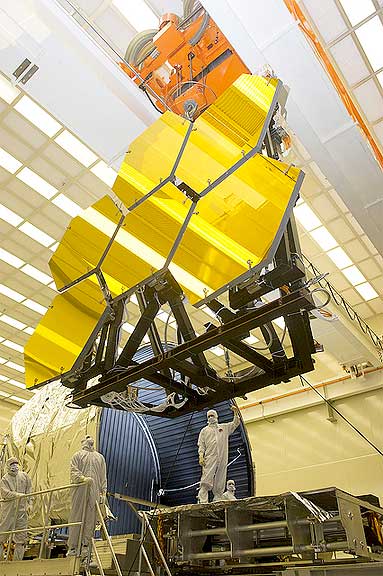
The James Webb Space Telescope mirrors have completed deep-freeze tests and are removed from the X-ray and Cryogenic test Facility at Marshall Space Flight Center.
Photo credit: Emmett Given, NASA Marshall
The Webb Telescope will be the first civilian space-based observatory to use an actively controlled, segmented mirror architecture. Each of the 18 hexagonal-shaped mirror assemblies that make up the 21.3-foot (6.5m) primary mirror measures more than 1.3 meters across, and weighs approximately 40kg, or 88 pounds, after light-weighting. The Webb telescope is critical for future infrared observations. The Webb will be the premier observatory of the next decade. It will study every phase in the history of our universe, ranging from the first luminous glows after the Big Bang, to the formation of stellar systems capable of supporting life on planets like Earth, to the evolution of our own Solar System.
The custom shipping containers for the mirrors are designed to maintain a consistent environment during travel between facilities. Each container is hermetically sealed to handle atmospheric pressure changes when the mirrors are shipped from high elevations like Boulder to other locations at or near sea level such as Greenbelt, Maryland. In addition to the Webb Telescope, Ball Aerospace has played a significant role in astrophysics and planetary missions including Kepler, the Hubble Space Telescope, the Wide-field Infrared Survey Explorer, the Spitzer Space Telescope, the Infrared Astronomical Satellite, the Cosmic Background Explorer, the Chandra X-ray Observatory, and the upcoming Sentinel Mission.
