

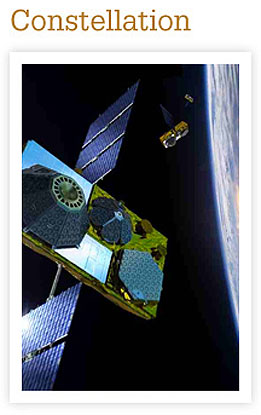
Second-Generation Satellite Constellation The Globalstar second-generation constellation will consist of 32 Low Earth Orbiting (LEO) satellites.
[SatNews] Shake hands, settle up and then—get that puppy launched!
Globalstar, Inc. (Nasdaq:GSAT), and launch services provider Arianespace have entered into an agreement regarding the additional amounts that Globalstar will pay to cover costs associated with the delays experienced during three prior launch campaigns. This resolution permits Globalstar and Arianespace to complete the fourth launch campaign under their current Launch Services Agreement.
Globalstar anticipates that satellite manufacturer Thales Alenia Space will complete the Pre-Shipment Reviews of the final six spacecraft purchased under the terms of the 2009 contract in the upcoming weeks in Rome. Once completed, the fourth launch campaign can begin. Due to available launch windows and the upcoming end-of-year holiday season, the fourth launch is now anticipated in early 2013. Globalstar will provide additional information regarding the specific launch date in the near future once its plans are confirmed with the launch participants.
“We are only months away from completing the fourth launch of our second-generation satellites to re-establish Globalstar’s preeminent position within the Mobile Satellite Industry,” said Jay Monroe, Chairman and Chief Executive Officer of Globalstar. “With our landline quality voice service, industry leading handset data speeds, high quality innovative M2M data solutions and low cost pricing plans, we are ready to mix it up in the MSS marketplace.”
The Globalstar satellite is simple; Each consists of a communications system of both S and L-band antennas, a trapezoidal body, two solar arrays and each satellite operates at an altitude of 1,414km (approximately 876 miles). The second-generation satellites are manufactured by Thales Alenia Space.
The satellites utilize “bent-pipe” architecture. On any given call, several satellites transmit a caller’s signal via CDMA technology to a satellite dish at the appropriate gateway where the call is then routed locally through the terrestrial telecommunications system.
