

• Skip to primary navigation
  • Skip to main content
  • Skip to primary sidebar
  • Skip to secondary sidebar
  • Skip to footer
  • NEWS:
  • SatNews
  • SatMagazine
  • MilSatMagazine
  • SmallSat News
  • |     EVENTS:
  • SmallSat Symposium
  • Satellite Innovation
  • MilSat Symposium
  • SmallSat Europe

SatNews

Satellite Industry Intelligence Since 1983

Subscribe
  • LATEST
  • SatNews Events
  • Magazines
  • Calendar
  • Subscribe
  • Missions & Constellations
    • Exploration & Science Missions
    • In-Orbit Servicing & Orbital Operations
    • LEO Constellations
    • Mission Autonomy & Onboard Systems
    • Mission Deployments & Manifests
    • Navigation & PNT
    • SmallSat
    • Spacecraft & Payload Technology
    View All in Missions & Constellations →
    Pittsburgh’s Moonshot: Astrobotic Unveils Griffin-1 Lander Ahead of Historic NASA ‘Moon Base II’ MissionPittsburgh’s Moonshot: Astrobotic Unveils Griffin-1 Lander Ahead of Historic NASA ‘Moon Base II’ Mission
    Rapid Deployment: ZeroUSV Streamlines Uncrewed Vessel Portability for Defense and Survey MissionsRapid Deployment: ZeroUSV Streamlines Uncrewed Vessel Portability for Defense and Survey Missions
    High-Stakes Rescue: Commercial Satellite Servicer Encapsulated for Swift Telescope Orbital BoostHigh-Stakes Rescue: Commercial Satellite Servicer Encapsulated for Swift Telescope Orbital Boost
    SpaceX’s Secret ‘Starfall’ Capsule Wins FAA Approval for Pacific Reentry TestsSpaceX’s Secret ‘Starfall’ Capsule Wins FAA Approval for Pacific Reentry Tests
  • Business
    • Contracts & Commercial Deals
    • Earnings & Financial Reporting
    • Events & Conferences
    • Funding & Venture Capital
    • Market Forecasts
    • Mergers & Acquisitions
    • Personnel Moves & Appointments
    View All in Business & Finance →
    Monetizing the Airwaves: EchoStar’s Massive Spectrum Offloads to SpaceX and AT&T Fuel Satellite Sector RallyMonetizing the Airwaves: EchoStar’s Massive Spectrum Offloads to SpaceX and AT&T Fuel Satellite Sector Rally
    North American Expansion: ATEK MIDAS and Vino Waves Launch Joint Venture to Support High-Frequency Chip DesignsNorth American Expansion: ATEK MIDAS and Vino Waves Launch Joint Venture to Support High-Frequency Chip Designs
    Global Convergence: Viasat and India’s WiSig Networks Begin Live Testing of 5G Satellite IoT ChipsetGlobal Convergence: Viasat and India’s WiSig Networks Begin Live Testing of 5G Satellite IoT Chipset
    Ground Segment Shakeup: Gilat to Acquire Comtech’s Satellite & Space Division for $157.5 MillionGround Segment Shakeup: Gilat to Acquire Comtech’s Satellite & Space Division for $157.5 Million
  • Defense
    • Counterspace & ASAT
    • Defense Budgets & Procurement
    • ISR & Reconnaissance
    • MILSATCOM
    • Missile Warning & Defense
    • National Security Programs
    • Space Domain Awareness
    View All in Military & Defense →
    Space Force Awards Lockheed Martin $514M to Build Resilient GPS IIIF SatellitesSpace Force Awards Lockheed Martin $514M to Build Resilient GPS IIIF Satellites
    Sovereign Electronic Warfare: Eviden and Hexadrone Partner to Integrate Tactical SIGINT onto Modular Drone FleetSovereign Electronic Warfare: Eviden and Hexadrone Partner to Integrate Tactical SIGINT onto Modular Drone Fleet
    Space Logistics Pivot: USSF Launches Challenge to Develop Multi-Orbit ‘Warehouses’ and Fuel DepotsSpace Logistics Pivot: USSF Launches Challenge to Develop Multi-Orbit ‘Warehouses’ and Fuel Depots
    Savox Communications Unveils ‘MissionCore’ to Unify Disconnected Battlefield Data LinksSavox Communications Unveils ‘MissionCore’ to Unify Disconnected Battlefield Data Links
  • Gov
    • Export Controls & Compliance
    • International Space Agreements
    • National Space Policy
    • Space Law & Treaties
    • Space Sustainability & Debris Policy
    • Space Traffic Management / Debris Removal
    View All in Government & Regulation →
    Orbital Paperwork War: China’s Spectrum Squatting Reserves 244,000 Satellite Slots to Combat SpaceX’s LEO MonopolyOrbital Paperwork War: China’s Spectrum Squatting Reserves 244,000 Satellite Slots to Combat SpaceX’s LEO Monopoly
    The Next Arena: Why the WRC-27 Summit in Shanghai is the New Space Tech FrontlineThe Next Arena: Why the WRC-27 Summit in Shanghai is the New Space Tech Frontline
    American military space closed around one company in seven daysAmerican military space closed around one company in seven days
    Major opportunities for 2 GHz over EuropeMajor opportunities for 2 GHz over Europe
  • Launch
    • Launch Providers
    • Launch Schedule & Calendars
    • Launch Sites & Infrastructure
    • Rocket Technology & Vehicles
    View All in Launch →
    Breaking the TRL Bottleneck: Space Phoenix Systems Debuts Cost-Effective Space Test-and-Return ServiceBreaking the TRL Bottleneck: Space Phoenix Systems Debuts Cost-Effective Space Test-and-Return Service
    Twelve Scientific Payloads Experience Microgravity Aboard SubOrbital Express-5Twelve Scientific Payloads Experience Microgravity Aboard SubOrbital Express-5
    Amazon Leo Constellation Surpasses 330 Satellites Following Latest Atlas V LaunchAmazon Leo Constellation Surpasses 330 Satellites Following Latest Atlas V Launch
    If You Thought Space Was Hard Try to Get Your Satellite On a RocketIf You Thought Space Was Hard Try to Get Your Satellite On a Rocket
  • Software
    • Autonomous Ground Operations
    • Data Processing & AI/ML
    • Digital Twins & Modeling
    • Ground Segment & Teleports
    • Mission Planning & Simulation
    • Space Systems Software Engineering
    • Spectrum & Licensing
    View All in Software Automation & Ground Systems →
    Poland Sovereignty: GMV to Develop Core Ground Control Platform for CAMILA ConstellationPoland Sovereignty: GMV to Develop Core Ground Control Platform for CAMILA Constellation
    Software Over the Air: FatPipe Launches Acceleration Tool to Unclog Starlink and Amazon LEO LinksSoftware Over the Air: FatPipe Launches Acceleration Tool to Unclog Starlink and Amazon LEO Links
    Three LEO Operators Bet 2026 on a Supply Chain Built for 2027Three LEO Operators Bet 2026 on a Supply Chain Built for 2027
    NASA Advances Interoperable Space Networks with Successful PExT DemonstrationNASA Advances Interoperable Space Networks with Successful PExT Demonstration
  • Services & Apps
    • Climate & Environmental Monitoring
    • Disaster Response & Security Mapping
    • Earth Observation & Imaging
    • Maritime & Aviation Satcom
    • Satellite Communications
    View All in Services & Applications →
    Space-Based Underwriting: Liberty and ICEYE Launch Satellite-Powered Parametric Wildfire InsuranceSpace-Based Underwriting: Liberty and ICEYE Launch Satellite-Powered Parametric Wildfire Insurance
    Eutelsat and Tototheo Global Forge Partnership to Deliver LEO Connectivity Across Maritime and Government SectorsEutelsat and Tototheo Global Forge Partnership to Deliver LEO Connectivity Across Maritime and Government Sectors
    Marlink Equips Groupama-FDJ Cycling Team with Hybrid Starlink and LTE NetworkMarlink Equips Groupama-FDJ Cycling Team with Hybrid Starlink and LTE Network
    Viasat Secures Lockheed Martin Contract for NOAA’s Next-Generation AircraftViasat Secures Lockheed Martin Contract for NOAA’s Next-Generation Aircraft

Wise Wonderments… A Chunk Of The Milky Way (Imagery)

January 12, 2012

[SatNews] A new, large mosaic from NASA’s Wide-Field Infrared Survey Explorer (WISE) showcases….

….a vast stretch of cosmic clouds bubbling with new star birth. The region — a 1,000-square-degree chunk of our Milky Way galaxy — is home to numerous star-forming clouds, where massive stars have blown out bubbles in the gas and dust. “Massive stars sweep up and destroy their natal clouds, but they continuously spark new stars to form along the way,” said WISE Mission Scientist Dave Leisawitz of NASA Goddard Space Flight Center, Greenbelt, Md. Leisawitz is co-author of a new paper reporting the results in the Astrophysical Journal. “Occasionally a new, massive star forms, perpetuating the sequence of events and giving rise to the dazzling fireworks display seen in this WISE mosaic.”

The WISE space telescope mapped the entire sky two times in infrared light, completing its survey in February of 2011. Astronomers studying how stars form took advantage of WISE’s all-encompassing view by studying several star-forming clouds, or nebulae, including 10 pictured in this new view. The observations provide new evidence for a process called triggered star formation, in which the winds and sizzling radiation from massive stars compress gas and dust, inducing a second generation of stars. The same winds and radiation carve out the cavities, or bubbles, seen throughout the image.

Finding evidence for triggered star formation has proved more difficult than some might think. Astronomers are not able to watch the stars grow and evolve like biologists watching zebras in the wild. Instead, they piece together a history of star formation by looking at distinct stages in the process. It’s the equivalent of observing only baby, middle-aged and elderly zebras with crude indicators of their ages. WISE is helping to fill in these gaps by providing more and more “specimens” for study.

“Each region we looked at gave us a single snapshot of star formation in progress,” said Xavier Koenig, lead author of the new study at Goddard, who presented the results in Austin, Texas, at the 219th meeting of the American Astronomical Society. “But when we look at a whole collection of regions, we can piece together the chain of events.” After looking at several of the star-forming nebulae, Koenig and his colleagues noticed a pattern in the spatial arrangement of newborn stars. Some were found lining the blown-out cavities, a phenomenon that had been seen before, but other new stars were seen sprinkled throughout the cavity interiors.

The results suggest that stars are born in a successive fashion, one after the other, starting from a core cluster of massive stars and moving steadily outward. This lends support to the triggered star formation theory, and offers new clues about the physics of the process. The astronomers also found evidence that the bubbles seen in the star-forming clouds can spawn new bubbles. In this scenario, a massive star blasts away surrounding material, eventually triggering the birth of another star massive enough to carve out its own bubble. A few examples of what may be first- and second-generation bubbles can be seen in the new WISE image. “I can almost hear the stars pop and crackle,” said Leisawitz.

The complete WISE catalogue will be released to the public astronomy community in the spring of 2012.
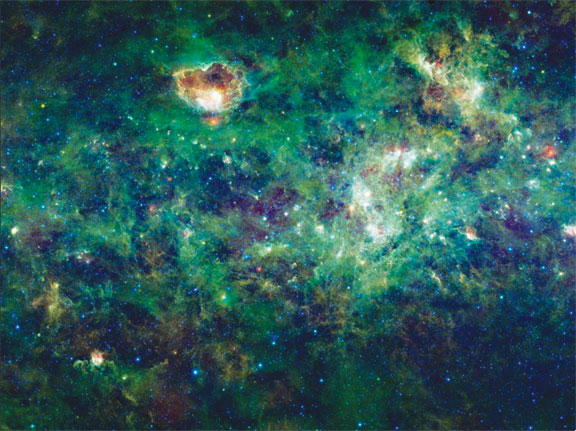

This enormous section of the Milky Way galaxy is a mosaic of images from NASA’s Wide-field Infrared Survey Explorer, or WISE. The constellations Cassiopeia and Cepheus are featured in this 1,000-square degree expanse. These constellations, named after an ancient Queen and King of Ethiopia in Greek mythology, are visible in the northern sky every night of the year as seen from most of the United States.

To the unaided human eye, Cassiopeia is easily recognizable by the five bright stars that make up its “W” shape. However, WISE observed infrared light, where the sky takes on a very different appearance. The bright stars of the constellations fade into obscurity amongst the backdrop of millions of other stars revealed by WISE. Cool clouds of dust that fill the space between the stars in the Milky Way glow in infrared light and tell us more about the story of how stars are born, and how they die.

Within this image are dozens of dense clouds, called nebulae. Many of the nebulae seen here are places where new stars are forming, creating bubble like structures that can be dozens to hundreds of light-years in size. The process of star formation within these giant clouds has been likened to fireworks, celebrating the birth of new generations of stars. But the death of stars is also seen in the remnants of a supernova explosion that was witnessed by the astronomer Tycho Brahe in 1572 AD. This remnant is located about one-fifth of the way from left of center, and about one-sixth of the way up from the middle of the image.

The colors used in this image represent specific wavelengths of infrared light. Blue and cyan (blue-green) represent light emitted at wavelengths of 3.4 and 4.6 microns, which is predominantly from stars. Green and red represent light from 12 and 22 microns, respectively, which is mostly emitted by dust. This image is a mosaic of thousands of individual frames from WISE, combined first into 442 interlocking tiles before re-projecting and stitching them into the final picture. This was done for each of the four WISE wavelengths, totaling nearly 30 billion pixels in the interlocking tiles. Image credit: NASA/JPL-Caltech/UCLA

Filed Under: Exploration & Science Missions

Primary Sidebar

Coverage

  • Missions & Constellations
  • Business & Finance
  • Military & Defense
  • Launch
  • Software Automation & Ground Systems
  • Government & Regulation
  • Services & Applications

Most Read Stories

  • SpaceX Is Worth $1.75 Trillion. Only 7% of That Is Real.
  • SpaceX: 10,000 Launches Annually
  • American military space closed around one company in seven days
  • Analyst Projects Massive Subscription Growth for Starlink Ahead of Imminent SpaceX IPO
  • Public Capital for Multi-Planetary Infrastructure: SpaceX Unveils Record $75 Billion IPO

Secondary Sidebar

Footer


Satnews is a leading provider of satellite news, events, publications, research and other satellite industry information in both commercial and military enterprises worldwide.

Stories By Category

  • Business & Finance
  • Government & Regulation
  • Launch
  • Military & Defense
  • Missions & Constellations
  • Services & Applications
  • Software Automation & Ground Systems
  • Spectrum & Licensing
  • Startups & NewSpace Business

About Us

  • Leadership & Editorial Team
  • SatNews History
  • Free Satnews Subscription
  • SatNews Events
  • Magazines

Navigation

  • Latest Stories
  • Magazines
  • Events
  • Contact
  • Cookie & Privacy Policy for Satnews

We use cookies to ensure that we give you the best experience on our website. If you continue to use this site we will assume that you are happy with it.
x
Sign up Now (For Free)
Access daily or weekly satellite news updates covering all aspects of the commercial and military satellite industry.
Invalid email address
Notify Me Regarding ( At least one ):
We value your privacy and will not sell or share your email or other information with any other company. You may also unsubscribe at anytime.

Click Here to see our full privacy policy.
Thanks for subscribing!