

• Skip to primary navigation
  • Skip to main content
  • Skip to primary sidebar
  • Skip to secondary sidebar
  • Skip to footer
  • NEWS:
  • SatNews
  • SatMagazine
  • MilSatMagazine
  • SmallSat News
  • |     EVENTS:
  • SmallSat Symposium
  • Satellite Innovation
  • MilSat Symposium
  • SmallSat Europe

SatNews

Satellite Industry Intelligence Since 1983

Subscribe
  • LATEST
  • SatNews Events
  • Magazines
  • Calendar
  • Subscribe
  • Missions & Constellations
    • Exploration & Science Missions
    • In-Orbit Servicing & Orbital Operations
    • LEO Constellations
    • Mission Autonomy & Onboard Systems
    • Mission Deployments & Manifests
    • Navigation & PNT
    • SmallSat
    • Spacecraft & Payload Technology
    View All in Missions & Constellations →
    The Astronaut Wears Prada. Axiom Space and the Inner Layer of Next-Generation Lunar SpacesuitThe Astronaut Wears Prada. Axiom Space and the Inner Layer of Next-Generation Lunar Spacesuit
    Analyst Projects Massive Subscription Growth for Starlink Ahead of Imminent SpaceX IPOAnalyst Projects Massive Subscription Growth for Starlink Ahead of Imminent SpaceX IPO
    Emergency Alert on the ISS: NASA Orders Safe Haven Amid Russian Module Leak RepairsEmergency Alert on the ISS: NASA Orders Safe Haven Amid Russian Module Leak Repairs
    KSAT and iQPS Expand Strategic Alliance to Accelerate High-Frequency SAR ConstellationKSAT and iQPS Expand Strategic Alliance to Accelerate High-Frequency SAR Constellation
  • Business
    • Contracts & Commercial Deals
    • Earnings & Financial Reporting
    • Events & Conferences
    • Funding & Venture Capital
    • Market Forecasts
    • Mergers & Acquisitions
    • Personnel Moves & Appointments
    View All in Business & Finance →
    Brian Hughes Appointed as New Director of NASA’s Kennedy Space Center to Oversee Surging Launch DemandBrian Hughes Appointed as New Director of NASA’s Kennedy Space Center to Oversee Surging Launch Demand
    Beyond Mega-Constellations: Iridium and Globalstar Emerge as Prime Defense and IoT Investment PlaysBeyond Mega-Constellations: Iridium and Globalstar Emerge as Prime Defense and IoT Investment Plays
    SpaceX IPO: Will all that glitters turn to…….?SpaceX IPO: Will all that glitters turn to…….?
    Pilot Photonics Secures €1M ESA Contract to Advance Space PhotonicsPilot Photonics Secures €1M ESA Contract to Advance Space Photonics
  • Defense
    • Counterspace & ASAT
    • Defense Budgets & Procurement
    • ISR & Reconnaissance
    • MILSATCOM
    • Missile Warning & Defense
    • National Security Programs
    • Space Domain Awareness
    View All in Military & Defense →
    American military space closed around one company in seven daysAmerican military space closed around one company in seven days
    MDA Space Selected by BAE Systems for U.S. Space Force Missile Warning ConstellationMDA Space Selected by BAE Systems for U.S. Space Force Missile Warning Constellation
    ParaZero Secures First DefendAir Order from U.S. Tier-1 Defense CorporationParaZero Secures First DefendAir Order from U.S. Tier-1 Defense Corporation
    Northrop Grumman Partners with Apex for Space-Based Interceptors Targeting 2027 DeliveryNorthrop Grumman Partners with Apex for Space-Based Interceptors Targeting 2027 Delivery
  • Gov
    • Export Controls & Compliance
    • International Space Agreements
    • National Space Policy
    • Space Law & Treaties
    • Space Sustainability & Debris Policy
    • Space Traffic Management / Debris Removal
    View All in Government & Regulation →
    Major opportunities for 2 GHz over EuropeMajor opportunities for 2 GHz over Europe
    “Dual-use” is the funding word. It’s also the label operators want off.“Dual-use” is the funding word. It’s also the label operators want off.
    Sovereignty got an answer on Day 3. Two answers, actually, and a commercial veto.Sovereignty got an answer on Day 3. Two answers, actually, and a commercial veto.
    Dependency killed the old debate. Sovereignty is the new one, and Europe hasn’t agreed what it means.Dependency killed the old debate. Sovereignty is the new one, and Europe hasn’t agreed what it means.
  • Launch
    • Launch Providers
    • Launch Schedule & Calendars
    • Launch Sites & Infrastructure
    • Rocket Technology & Vehicles
    View All in Launch →
    Twelve Scientific Payloads Experience Microgravity Aboard SubOrbital Express-5Twelve Scientific Payloads Experience Microgravity Aboard SubOrbital Express-5
    Amazon Leo Constellation Surpasses 330 Satellites Following Latest Atlas V LaunchAmazon Leo Constellation Surpasses 330 Satellites Following Latest Atlas V Launch
    If You Thought Space Was Hard Try to Get Your Satellite On a RocketIf You Thought Space Was Hard Try to Get Your Satellite On a Rocket
    Blue Origin Suffers Major Setback as New Glenn Rocket Explodes During Static Fire TestBlue Origin Suffers Major Setback as New Glenn Rocket Explodes During Static Fire Test
  • Software
    • Autonomous Ground Operations
    • Data Processing & AI/ML
    • Digital Twins & Modeling
    • Ground Segment & Teleports
    • Mission Planning & Simulation
    • Space Systems Software Engineering
    • Spectrum & Licensing
    View All in Software Automation & Ground Systems →
    KSAT and Axelspace Expand Strategic Partnership to Accelerate Earth ObservationKSAT and Axelspace Expand Strategic Partnership to Accelerate Earth Observation
    Europe has ships. SmallSat Europe said it doesn’t have ports.Europe has ships. SmallSat Europe said it doesn’t have ports.
    The orbital data center thesis just became an economics question.The orbital data center thesis just became an economics question.
    AI just reached production in European space. The trust problem is what comes next.AI just reached production in European space. The trust problem is what comes next.
  • Services & Apps
    • Climate & Environmental Monitoring
    • Disaster Response & Security Mapping
    • Earth Observation & Imaging
    • Maritime & Aviation Satcom
    • Satellite Communications
    View All in Services & Applications →
    Viasat Secures Lockheed Martin Contract for NOAA’s Next-Generation AircraftViasat Secures Lockheed Martin Contract for NOAA’s Next-Generation Aircraft
    SES Partners with Viva to Launch Multi-Orbit In-Flight ConnectivitySES Partners with Viva to Launch Multi-Orbit In-Flight Connectivity
    Resolve Optics Delivers Radiation-Resistant Lenses for LEO SatellitesResolve Optics Delivers Radiation-Resistant Lenses for LEO Satellites
    SITAEL Unveils €200 Million Growth Strategy and ESA Mission Contract at SmallSat EuropeSITAEL Unveils €200 Million Growth Strategy and ESA Mission Contract at SmallSat Europe

NASA… STEREO Sees Space Storm (Imagery)

August 18, 2011


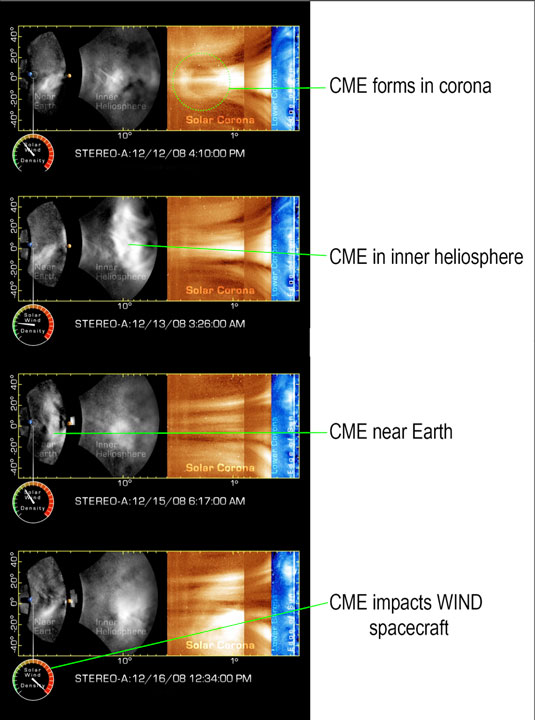
These four panels illustrate the path taken by the CME as witnessed by STEREO: in the corona; in the inner heliosphere; near Earth; impacting Wind spacecraft. Credit: SwRI
[SatNews] For the first time, a spacecraft far from Earth has turned and watched a solar storm engulf our planet.

The movie (see the last paragraph of this story for more info…), released during a NASA press conference, has galvanized solar physicists, who say it could lead to important advances in space weather forecasting. NASA’s STEREO spacecraft and new data processing techniques have succeeded in tracking space weather events from their origin in the sun’s corona to impact with the Earth, resolving a 40-year mystery about the structure of the structures that cause space weather: how the structures that impact the Earth relate to the corresponding structures in the solar corona.

“The movie sent chills down my spine,” says Craig DeForest of the Southwest Researcher Institute in Boulder, Colorado. “It shows a CME swelling into an enormous wall of plasma and then washing over the tiny blue speck of Earth where we live. I felt very small.” CMEs are billion-ton clouds of solar plasma launched by the same explosions that spark solar flares. When they sweep past our planet, they can cause auroras, radiation storms, and in extreme cases power outages. Tracking these clouds and predicting their arrival is an important part of space weather forecasting.

“We have seen CMEs before, but never quite like this,” says Lika Guhathakurta, program scientist for the STEREO mission at NASA headquarters. “STEREO-A has given us a new view of solar storms.”

When CMEs first leave the sun, they are bright and easy to see. Visibility is quickly reduced, however, as the clouds expand into the void. By the time a typical CME crosses the orbit of Venus, it is a billion times fainter than the surface of the full Moon, and more than a thousand times fainter than the Milky Way. CMEs that reach Earth are almost as gossamer as vacuum itself and correspondingly transparent. “Pulling these faint clouds out of the confusion of starlight and interplanetary dust has been an enormous challenge,” says DeForest.

Indeed, it took almost three years for his team to learn how to do it. Footage of the storm released today was recorded back in December 2008, and they have been working on it ever since. Now that the technique has been perfected, it can be applied on a regular basis without such a long delay. Alysha Reinard of NOAA’s Space Weather Prediction Center explains the benefits for space weather forecasting… “Until quite recently, spacecraft could see CMEs only when they were still quite close to the sun. By calculating a CME’s speed during this brief period, we were able to estimate when it would reach Earth. After the first few hours, however, the CME would leave this field of view and after that we were ‘in the dark’ about its progress. The ability to track a cloud continuously from the Sun to Earth is a big improvement,” she continues. “In the past, our very best predictions of CME arrival times had uncertainties of plus or minus 4 hours,” she continues. “The kind of movies we’ve seen today could significantly reduce the error bars.”

The movies pinpoint not only the arrival time of the CME, but also its mass. From the brightness of the cloud, researchers can calculate the gas density with impressive precision. Their results for the Dec. 2008 event agreed with actual in situ measurements at the few percent level. When this technique is applied to future storms, forecasters will be able to estimate its impact with greater confidence.
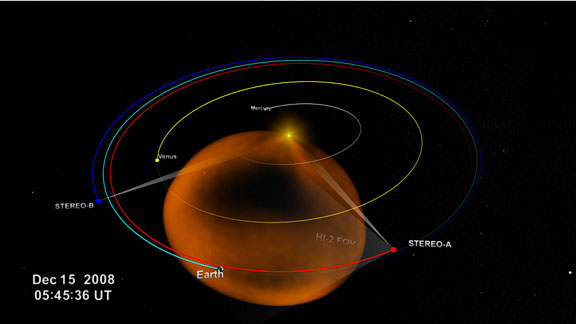

Illustration of the orbital positions and fields of view of the STEREO spacecraft during the December 2008 CME.

At the press conference, DeForest pointed out some of the movie’s highlights: When the CME first left the sun, it was cavernous, with walls of magnetism encircling a cloud of low-density gas. As the CME crossed the Sun-Earth divide, however, its shape changed. The CME “snow-plowed” through the solar wind, scooping up material to form a towering wall of plasma. By the time the CME reached Earth, its forward wall was sagging inward under the weight of accumulated gas. The kind of magnetic transformations revealed by the movie deeply impressed Guhathakurta: “I have always thought that in heliophysics understanding the magnetic field is equivalent to the ‘dark energy’ problem of astrophysics. Often, we cannot see the magnetic field, yet it orchestrates almost everything. These images from STEREO give us a real sense of what the underlying magnetic field is doing. “This is what the STEREO mission was launched to do,” concludes Guhathakurta, “and it is terrific to see it live up to that promise.”

You can download a video of NASA’s STEREO spacecraft and new data processing techniques as they succeed in tracking space weather events from their origin in the sun’s corona to impact with the Earth. This resolved a 40-year mystery about the structure of the structures that cause space weather: how the structures that impact the Earth relate to the corresponding structures in the solar corona. Credit: NASA/STEREO/Scott Wiessinger

Filed Under: Exploration & Science Missions

Primary Sidebar

Coverage

  • Missions & Constellations
  • Business & Finance
  • Military & Defense
  • Launch
  • Software Automation & Ground Systems
  • Government & Regulation
  • Services & Applications

Most Read Stories

  • SmallSat Europe Speaker Focus: Frank M. Salzgeber, Nadir Space Venture
  • SpaceX Debuts Starship V3: Redefining Heavy-Lift Launch Capability
  • SpaceX Is Worth $1.75 Trillion. Only 7% of That Is Real.
  • SpaceX: 10,000 Launches Annually
  • FCC Approves Landmark Spectrum Sharing and Direct-to-Device Frameworks

Secondary Sidebar

Footer


Satnews is a leading provider of satellite news, events, publications, research and other satellite industry information in both commercial and military enterprises worldwide.

Stories By Category

  • Business & Finance
  • Government & Regulation
  • Launch
  • Military & Defense
  • Missions & Constellations
  • Services & Applications
  • Software Automation & Ground Systems
  • Spectrum & Licensing
  • Startups & NewSpace Business

About Us

  • Leadership & Editorial Team
  • SatNews History
  • Free Satnews Subscription
  • SatNews Events
  • Magazines

Navigation

  • Latest Stories
  • Magazines
  • Events
  • Contact
  • Cookie & Privacy Policy for Satnews

We use cookies to ensure that we give you the best experience on our website. If you continue to use this site we will assume that you are happy with it.
x
Sign up Now (For Free)
Access daily or weekly satellite news updates covering all aspects of the commercial and military satellite industry.
Invalid email address
Notify Me Regarding ( At least one ):
We value your privacy and will not sell or share your email or other information with any other company. You may also unsubscribe at anytime.

Click Here to see our full privacy policy.
Thanks for subscribing!