

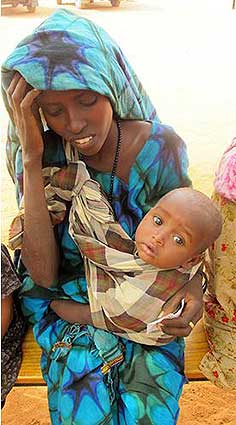
Benliye Issa, 25, with baby daughter Isa, walked from central Somalia with seven other families. It took the group of 51 people 18 days to get to Dadaab. “We are herders and did a little farming,” Beniye told me. “But there hasn’t been rain now for two years and we haven’t been able to farm. That’s the reason why we came. We left nothing behind. My cattle died tow months ago.” Beniye’s husband stayed in Somalia to care for his sick father. Photo: Sophia Jones-Mwang/IRC (International Rescue Committee)
So much of the world could never comprehend the dispair that comes with lack of food. Unable to provide for their families, children and elders fall ill. Who is in need of what, and relocation of families, the lack of communications further compounds the crisis. Télécoms Sans Frontières (TSF) has once again embarked on a journey to offer their assistance.
Crisis in the Horn of Africa TSF intervenes in the Dadaab and Garissa regions In response to the acute food crisis that is now affecting the north of Kenya and its neighboring countries. In the Horn of Africa, Télécoms Sans Frontières (TSF) is dispatching a team to the affected region of Dadaab, north-east Kenya.
More than 10 million people are directly threatened by the famine prominent in three countries in the Horn of Africa, Kenya, Somalia and Ethiopia, which have been hit by the worst period of drought for 60 years. Every day, thousands are pouring into the humanitarian camps in Dadaab (Dagahaley, Hagadera and Ifo), which today shelter close to 400,000 refugees; more than four times the predicted initial capacity.

As soon as the TSF team touches down, they will set up a crisis center in the Garissa region, several kilometers from the Dadaab camps, to the benefit of the international NGOs. TSF will establish a technical and telecoms infrastructure necessary for effective emergency operations (Internet and telephone connections, computers and peripheral IT materials…). Emergency kits are provided to country offices, made of satellite communications and IT equipment and including power supplies, so that when commercial infrastructure is cut, offices can stay connected, report and coordinate with the central agency. These long-term education and training projects lead to positive impacts in economic development as well as capacity building of humanitarian organizations.
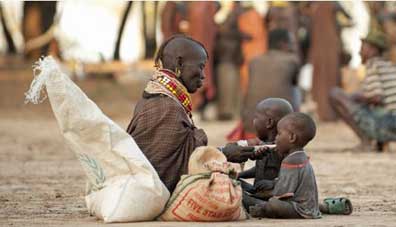
Photo from Samaritan’s Purse website
