

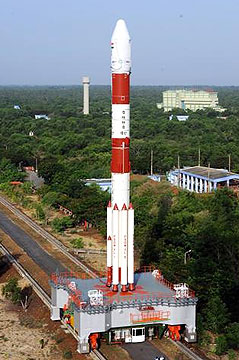
The fully stacked-up PSLV-C17 being ferried on the Mobile Launch Pedestal to the second launch pad at Sriharikota. The PSLV-C17 is scheduled to lift off on July 15 at 4:48 p.m. to put GSAT-12, a communication satellite, into orbit. Photo Courtesy: ISRO
With the 53-hour countdown for the launch of the Polar Satellite Launch Vehicle (PSLV-C17) commencing at 11.48 a.m. on Wednesday (local time), the stage is set for the rocket’s lift-off from Sriharikota at 4.48 p.m. on Friday. The PSLV-C17 will place into orbit communication satellite GSAT-12, which weighs 1,410 kg. It is a more powerful version of the standard PSLV, called PSLV-XL, that will put the satellite in orbit after a 20-minute flight. This is the second time that a powerful PSLV-XL version will lift off from the second launch pad at Sriharikota. It was earlier used to put Chandrayaan-1 into orbit on October 22, 2008. While the six strap-on booster motors of the standard version of the PSLV carry a total of nine tonnes of solid propellants, the strap-on motors in the XL version are powered by a total of 12 tons of fuel.
The PSLV-C17 will put GSAT-12 in a sub-GTO with a perigee (nearest point to the Earth) of 284 km and an apogee (farthest point from the Earth) of 21,000 km. After it is put in a sub-GTO, commands will be given to the liquid apogee motor (LAM) on board the satellite to boost the apogee to 36,000 km. After it is done, commands will be given to boost the perigee from 284 km to 36,000 km. The GSAT-12, with 12 extended C-band transponders, will be used for tele-medicine, tele-education, telephone and various other communication purposes. This is the 19th PSLV mission, out of which 17 have been successful in a row. The PSLV-C17 weighs 310 tons and is 44 metres tall. (Source: The Hindu, T.S. Subramanian)
