

• Skip to primary navigation
  • Skip to main content
  • Skip to primary sidebar
  • Skip to secondary sidebar
  • Skip to footer
  • NEWS:
  • SatNews
  • SatMagazine
  • MilSatMagazine
  • SmallSat News
  • |     EVENTS:
  • SmallSat Symposium
  • Satellite Innovation
  • MilSat Symposium
  • SmallSat Europe

SatNews

Satellite Industry Intelligence Since 1983

Subscribe
  • LATEST
  • SatNews Events
  • Magazines
  • Calendar
  • Subscribe
  • Missions & Constellations
    • Exploration & Science Missions
    • In-Orbit Servicing & Orbital Operations
    • LEO Constellations
    • Mission Autonomy & Onboard Systems
    • Mission Deployments & Manifests
    • Navigation & PNT
    • SmallSat
    • Spacecraft & Payload Technology
    View All in Missions & Constellations →
    SpaceX’s Secret ‘Starfall’ Capsule Wins FAA Approval for Pacific Reentry TestsSpaceX’s Secret ‘Starfall’ Capsule Wins FAA Approval for Pacific Reentry Tests
    NOAA Activates First Dedicated U.S. Space Weather Satellite One Million Miles from EarthNOAA Activates First Dedicated U.S. Space Weather Satellite One Million Miles from Earth
    Thales Alenia Space to coordinate EROSS SC On-Orbit Servicing projectThales Alenia Space to coordinate EROSS SC On-Orbit Servicing project
    Astroscale Launches Industry Initiative to Study Atmospheric Impact of Spacecraft ReentryAstroscale Launches Industry Initiative to Study Atmospheric Impact of Spacecraft Reentry
  • Business
    • Contracts & Commercial Deals
    • Earnings & Financial Reporting
    • Events & Conferences
    • Funding & Venture Capital
    • Market Forecasts
    • Mergers & Acquisitions
    • Personnel Moves & Appointments
    View All in Business & Finance →
    Isar Aerospace Secures €270 Million Series D to Ramp Up Spectrum Launch Vehicle ProductionIsar Aerospace Secures €270 Million Series D to Ramp Up Spectrum Launch Vehicle Production
    Made in Space: UK funding boosts breakthrough space technologiesMade in Space: UK funding boosts breakthrough space technologies
    Investor Scrutiny Mounts for York Space Systems Following Pentagon Contract TurmoilInvestor Scrutiny Mounts for York Space Systems Following Pentagon Contract Turmoil
    IEC Telecom Establishes Local Indonesian Entity to Address Archipelago’s Expanding Satellite Connectivity DemandsIEC Telecom Establishes Local Indonesian Entity to Address Archipelago’s Expanding Satellite Connectivity Demands
  • Defense
    • Counterspace & ASAT
    • Defense Budgets & Procurement
    • ISR & Reconnaissance
    • MILSATCOM
    • Missile Warning & Defense
    • National Security Programs
    • Space Domain Awareness
    View All in Military & Defense →
    Qorvo Unveils Compact X-Band Radar Module to Enhance Defense System PerformanceQorvo Unveils Compact X-Band Radar Module to Enhance Defense System Performance
    Energration and Atombeam Partner on DARPA Proposal to Revolutionize Tactical Data Movement at the Defense EdgeEnergration and Atombeam Partner on DARPA Proposal to Revolutionize Tactical Data Movement at the Defense Edge
    American military space closed around one company in seven daysAmerican military space closed around one company in seven days
    MDA Space Selected by BAE Systems for U.S. Space Force Missile Warning ConstellationMDA Space Selected by BAE Systems for U.S. Space Force Missile Warning Constellation
  • Gov
    • Export Controls & Compliance
    • International Space Agreements
    • National Space Policy
    • Space Law & Treaties
    • Space Sustainability & Debris Policy
    • Space Traffic Management / Debris Removal
    View All in Government & Regulation →
    Major opportunities for 2 GHz over EuropeMajor opportunities for 2 GHz over Europe
    “Dual-use” is the funding word. It’s also the label operators want off.“Dual-use” is the funding word. It’s also the label operators want off.
    Sovereignty got an answer on Day 3. Two answers, actually, and a commercial veto.Sovereignty got an answer on Day 3. Two answers, actually, and a commercial veto.
    Dependency killed the old debate. Sovereignty is the new one, and Europe hasn’t agreed what it means.Dependency killed the old debate. Sovereignty is the new one, and Europe hasn’t agreed what it means.
  • Launch
    • Launch Providers
    • Launch Schedule & Calendars
    • Launch Sites & Infrastructure
    • Rocket Technology & Vehicles
    View All in Launch →
    Breaking the TRL Bottleneck: Space Phoenix Systems Debuts Cost-Effective Space Test-and-Return ServiceBreaking the TRL Bottleneck: Space Phoenix Systems Debuts Cost-Effective Space Test-and-Return Service
    Twelve Scientific Payloads Experience Microgravity Aboard SubOrbital Express-5Twelve Scientific Payloads Experience Microgravity Aboard SubOrbital Express-5
    Amazon Leo Constellation Surpasses 330 Satellites Following Latest Atlas V LaunchAmazon Leo Constellation Surpasses 330 Satellites Following Latest Atlas V Launch
    If You Thought Space Was Hard Try to Get Your Satellite On a RocketIf You Thought Space Was Hard Try to Get Your Satellite On a Rocket
  • Software
    • Autonomous Ground Operations
    • Data Processing & AI/ML
    • Digital Twins & Modeling
    • Ground Segment & Teleports
    • Mission Planning & Simulation
    • Space Systems Software Engineering
    • Spectrum & Licensing
    View All in Software Automation & Ground Systems →
    Three LEO Operators Bet 2026 on a Supply Chain Built for 2027Three LEO Operators Bet 2026 on a Supply Chain Built for 2027
    NASA Advances Interoperable Space Networks with Successful PExT DemonstrationNASA Advances Interoperable Space Networks with Successful PExT Demonstration
    KSAT and iQPS Expand Strategic Alliance to Accelerate High-Frequency SAR ConstellationKSAT and iQPS Expand Strategic Alliance to Accelerate High-Frequency SAR Constellation
    KSAT and Axelspace Expand Strategic Partnership to Accelerate Earth ObservationKSAT and Axelspace Expand Strategic Partnership to Accelerate Earth Observation
  • Services & Apps
    • Climate & Environmental Monitoring
    • Disaster Response & Security Mapping
    • Earth Observation & Imaging
    • Maritime & Aviation Satcom
    • Satellite Communications
    View All in Services & Applications →
    Eutelsat and Tototheo Global Forge Partnership to Deliver LEO Connectivity Across Maritime and Government SectorsEutelsat and Tototheo Global Forge Partnership to Deliver LEO Connectivity Across Maritime and Government Sectors
    Marlink Equips Groupama-FDJ Cycling Team with Hybrid Starlink and LTE NetworkMarlink Equips Groupama-FDJ Cycling Team with Hybrid Starlink and LTE Network
    Viasat Secures Lockheed Martin Contract for NOAA’s Next-Generation AircraftViasat Secures Lockheed Martin Contract for NOAA’s Next-Generation Aircraft
    SES Partners with Viva to Launch Multi-Orbit In-Flight ConnectivitySES Partners with Viva to Launch Multi-Orbit In-Flight Connectivity

NASA… Star Wreckage Wreaks Scientific Astonishment (Imagery)

January 13, 2011

[SatNews] The combined data from several NASA satellites has astonished astronomers by revealing unexpected changes in X-ray emission from the Crab Nebula, once thought to be the steadiest high-energy source in the sky.

“For 40 years, most astronomers regarded the Crab as a standard candle,” said Colleen Wilson-Hodge, an astrophysicist at NASA‘s Marshall Space Flight Center in Huntsville, Ala., who presented the findings at the American Astronomical Society meeting in Seattle. “Now, for the first time, we’re clearly seeing how much our candle flickers.”

The Crab Nebula is the wreckage of an exploded star whose light reached Earth in 1054. It is one of the most studied objects in the sky. At the heart of an expanding gas cloud lies what’s left of the original star’s core, a superdense neutron star that spins 30 times a second. All of the Crab’s high-energy emissions are thought to be the result of physical processes that tap into this rapid spin. For decades, astronomers have regarded the Crab’s X-ray emissions as so stable that they’ve used it to calibrate space-borne instruments. They also customarily describe the emissions of other high-energy sources in “millicrabs,” a unit derived from the nebula’s output.
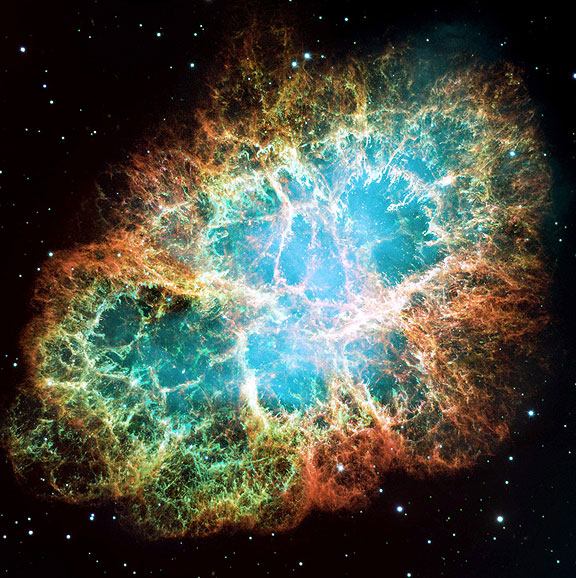

This view of the Crab Nebula in visible light comes from the Hubble Space Telescope and spans 12 light-years. The supernova remnant, located 6,500 light-years away in the constellation Taurus, is among the best-studied objects in the sky. Credit: NASA/ESA/ASU/J. Hester

“The Crab Nebula is a cornerstone of high-energy astrophysics,” said team member Mike Cherry at Louisiana State University in Baton Rouge, La. (LSU), “and this study shows us that our foundation is slightly askew.” The story unfolded when Cherry and Gary Case, also at LSU, first noticed the Crab’s dimming in observations by the Gamma-ray Burst Monitor (GBM) aboard NASA’s Fermi Gamma-ray Space Telescope. The team then analyzed GBM observations of the object from August 2008 to July 2010 and found an unexpected but steady decline of several percent at four different “hard” X-ray energies, from 12,000 to 500,000 electron volts (eV). For comparison, visible light has energies between 2 and 3 eV. With the Crab’s apparent constancy well established, the scientists needed to prove that the fadeout was real and was not an instrumental problem associated with the GBM. “If only one satellite instrument had reported this, no one would have believed it,” Wilson-Hodge said.

So the team amassed data from the fleet of sensitive X-ray observatories now in orbit: NASA’s Rossi X-Ray Timing Explorer (RXTE) and Swift satellites and the European Space Agency‘s International Gamma-Ray Astrophysics Laboratory (INTEGRAL). The results confirm a real intensity decline of about 7 percent at energies between 15,000 to 50,000 eV over two years. They also show that the Crab has brightened and faded by as much as 3.5 percent a year since 1999. The scientists say that astronomers will need to find new ways to calibrate instruments in flight and to explore the possible effects of the inconstant Crab on past findings. A paper on the results will appear in the Feb. 1 issue of The Astrophysical Journal Letters.

Fermi‘s other instrument, the Large Area Telescope, has detected unprecedented gamma-ray flares from the Crab, showing that it is also surprisingly variable at much higher energies. A study of these events was published on Thursday, Jan. 6, in Science Express. The nebula’s power comes from the central neutron star, which is also a pulsar that emits fast, regular radio and X-ray pulses. This pulsed emission exhibits no changes associated with the decline, so it cannot be the source. Instead, researchers suspect that the long-term changes probably occur in the nebula’s central light-year, but observations with future telescopes will be needed to know for sure. This region is dominated by four high-energy structures: an X-ray-emitting jet; an outflow of particles moving near the speed of light, called a “pulsar wind”; a disk of accumulating particles where the wind terminates; and a shock front where the wind abruptly slows. The Crab Nebula is a supernova remnant located 6,500 light-years away in the constellation Taurus.

Filed Under: Exploration & Science Missions

Primary Sidebar

Coverage

  • Missions & Constellations
  • Business & Finance
  • Military & Defense
  • Launch
  • Software Automation & Ground Systems
  • Government & Regulation
  • Services & Applications

Most Read Stories

  • SpaceX Debuts Starship V3: Redefining Heavy-Lift Launch Capability
  • SpaceX Is Worth $1.75 Trillion. Only 7% of That Is Real.
  • FCC Approves Landmark Spectrum Sharing and Direct-to-Device Frameworks
  • SpaceX: 10,000 Launches Annually
  • The end of GEO?

Secondary Sidebar

Footer


Satnews is a leading provider of satellite news, events, publications, research and other satellite industry information in both commercial and military enterprises worldwide.

Stories By Category

  • Business & Finance
  • Government & Regulation
  • Launch
  • Military & Defense
  • Missions & Constellations
  • Services & Applications
  • Software Automation & Ground Systems
  • Spectrum & Licensing
  • Startups & NewSpace Business

About Us

  • Leadership & Editorial Team
  • SatNews History
  • Free Satnews Subscription
  • SatNews Events
  • Magazines

Navigation

  • Latest Stories
  • Magazines
  • Events
  • Contact
  • Cookie & Privacy Policy for Satnews

We use cookies to ensure that we give you the best experience on our website. If you continue to use this site we will assume that you are happy with it.
x
Sign up Now (For Free)
Access daily or weekly satellite news updates covering all aspects of the commercial and military satellite industry.
Invalid email address
Notify Me Regarding ( At least one ):
We value your privacy and will not sell or share your email or other information with any other company. You may also unsubscribe at anytime.

Click Here to see our full privacy policy.
Thanks for subscribing!