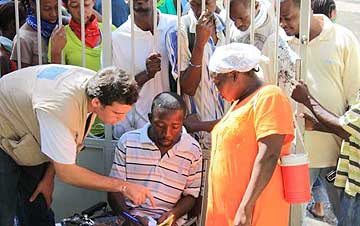
The airport gathers a great part of emergency operations, with individual organizations coordinating their efforts in order to respond as soon as possible to immediate needs (search and rescue, medical services and supplies, clean water and sanitation, emergency shelter, food, logistics and telecommunications). After their arrival, TSF experts immediately installed a satellite connection mostly dedicated to UNDAC teams and to emergency responders.
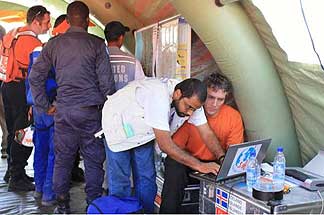
Thanks to TSF, Haitian government coordinating offices are also connected to the outside world and can coordinate the emergency responses thanks to fixed and mobile connections. They also aim at opening TSF long-term emergency telecom centers to the benefit of the entire humanitarian community.
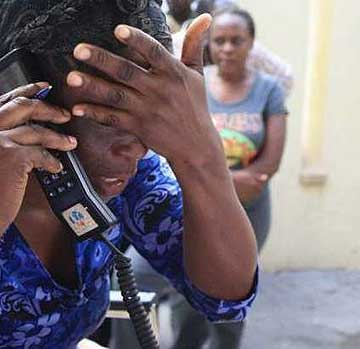
Then on January 16th, TSF started running humanitarian calling operations. A phoning centre was opened in Saint-Pierre square, located in Petion-ville district in Port-au-Prince. Today, two centers are established in the district of Boyer and to Sylvio Cator Stadium.
The first days of the calling operations reveals that Haitian community is very important abroad (100 percent of the calls were international), and especially in the United States (95 percent of those calls). In this desperate situation, giving affected people a link with the outside world is vital and the possibility to reassure their loved ones only with one single sentence “I am alive” is essential for them, as a Haitian student told us on the ground: When the earthquake struck Haiti on Tuesday January, 12th, Vilemé Emmanuel, student, was fortunately outside. He first thought that it was an explosion, with such a loud noise. But, when he saw building collapsing, including a church, he understood that it was an earthquake. People began running and crying. Thanks to the free call provided by TSF, he could call his brother in the United States, in Massachusetts, to reassure him about his situation and his father’s, safe and sound as well.