

The Heterodyne Instrument for the Far Infrared (HIFI) is a very high-resolution heterodyne spectrometer. It works by mixing the incoming signal with a stable monochromatic signal, generated by a local oscillator, and extracting the frequency difference for further processing in a spectrometer. HIFI will have seven separate local oscillators covering two bands from 480-1250 GHz and 1410– 1910 GHz. The instrument was developed by a consortium led by SRON Netherlands Institute for Space Research. Courtesy of ESA
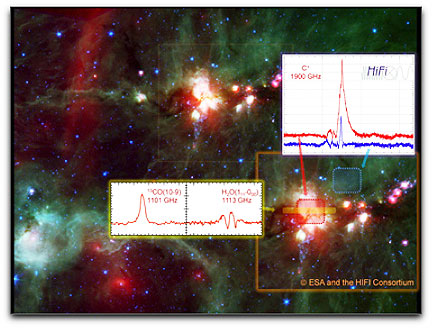
HIFI obtained its first spectra on June 22, 2009, during the in-orbit commissioning phase of the Herschel mission.
HIFI was built specifically to observe water in a number of different celestial targets as part of the investigation into the role of gas and dust in the formation of stars and planets, and the evolution of galaxies. The successful activation of HIFI comes as an important target, the star forming regions of the Orion Nebula or M42, approaches the instruments field of view.
