

• Skip to primary navigation
  • Skip to main content
  • Skip to primary sidebar
  • Skip to secondary sidebar
  • Skip to footer
  • NEWS:
  • SatNews
  • SatMagazine
  • MilSatMagazine
  • SmallSat News
  • |     EVENTS:
  • SmallSat Symposium
  • Satellite Innovation
  • MilSat Symposium
  • SmallSat Europe

SatNews

Satellite Industry Intelligence Since 1983

Subscribe
  • LATEST
  • SatNews Events
  • Magazines
  • Calendar
  • Subscribe
  • Missions & Constellations
    • Exploration & Science Missions
    • In-Orbit Servicing & Orbital Operations
    • LEO Constellations
    • Mission Autonomy & Onboard Systems
    • Mission Deployments & Manifests
    • Navigation & PNT
    • SmallSat
    • Spacecraft & Payload Technology
    View All in Missions & Constellations →
    SpaceX’s Secret ‘Starfall’ Capsule Wins FAA Approval for Pacific Reentry TestsSpaceX’s Secret ‘Starfall’ Capsule Wins FAA Approval for Pacific Reentry Tests
    NOAA Activates First Dedicated U.S. Space Weather Satellite One Million Miles from EarthNOAA Activates First Dedicated U.S. Space Weather Satellite One Million Miles from Earth
    Thales Alenia Space to coordinate EROSS SC On-Orbit Servicing projectThales Alenia Space to coordinate EROSS SC On-Orbit Servicing project
    Astroscale Launches Industry Initiative to Study Atmospheric Impact of Spacecraft ReentryAstroscale Launches Industry Initiative to Study Atmospheric Impact of Spacecraft Reentry
  • Business
    • Contracts & Commercial Deals
    • Earnings & Financial Reporting
    • Events & Conferences
    • Funding & Venture Capital
    • Market Forecasts
    • Mergers & Acquisitions
    • Personnel Moves & Appointments
    View All in Business & Finance →
    SOMA Satellite Factory: Planet Labs Expands San Francisco HQ to Supercharge Production PipelineSOMA Satellite Factory: Planet Labs Expands San Francisco HQ to Supercharge Production Pipeline
    Riding the Starship: The SpaceX IPO Is Set to Rocket Seattle’s Aerospace EcosystemRiding the Starship: The SpaceX IPO Is Set to Rocket Seattle’s Aerospace Ecosystem
    Space Race Moves to Wall Street: China’s Private Rocket Makers Target IPOs as Historic SpaceX Flotation NearsSpace Race Moves to Wall Street: China’s Private Rocket Makers Target IPOs as Historic SpaceX Flotation Nears
    Behind the Screens: The Massive Video Over-IP Infrastructure Powering the World CupBehind the Screens: The Massive Video Over-IP Infrastructure Powering the World Cup
  • Defense
    • Counterspace & ASAT
    • Defense Budgets & Procurement
    • ISR & Reconnaissance
    • MILSATCOM
    • Missile Warning & Defense
    • National Security Programs
    • Space Domain Awareness
    View All in Military & Defense →
    Space-Based Shield: Spire Global and Diehl Defence Partner to Build European Missile Warning NetworkSpace-Based Shield: Spire Global and Diehl Defence Partner to Build European Missile Warning Network
    Qorvo Unveils Compact X-Band Radar Module to Enhance Defense System PerformanceQorvo Unveils Compact X-Band Radar Module to Enhance Defense System Performance
    Energration and Atombeam Partner on DARPA Proposal to Revolutionize Tactical Data Movement at the Defense EdgeEnergration and Atombeam Partner on DARPA Proposal to Revolutionize Tactical Data Movement at the Defense Edge
    American military space closed around one company in seven daysAmerican military space closed around one company in seven days
  • Gov
    • Export Controls & Compliance
    • International Space Agreements
    • National Space Policy
    • Space Law & Treaties
    • Space Sustainability & Debris Policy
    • Space Traffic Management / Debris Removal
    View All in Government & Regulation →
    Major opportunities for 2 GHz over EuropeMajor opportunities for 2 GHz over Europe
    “Dual-use” is the funding word. It’s also the label operators want off.“Dual-use” is the funding word. It’s also the label operators want off.
    Sovereignty got an answer on Day 3. Two answers, actually, and a commercial veto.Sovereignty got an answer on Day 3. Two answers, actually, and a commercial veto.
    Dependency killed the old debate. Sovereignty is the new one, and Europe hasn’t agreed what it means.Dependency killed the old debate. Sovereignty is the new one, and Europe hasn’t agreed what it means.
  • Launch
    • Launch Providers
    • Launch Schedule & Calendars
    • Launch Sites & Infrastructure
    • Rocket Technology & Vehicles
    View All in Launch →
    Breaking the TRL Bottleneck: Space Phoenix Systems Debuts Cost-Effective Space Test-and-Return ServiceBreaking the TRL Bottleneck: Space Phoenix Systems Debuts Cost-Effective Space Test-and-Return Service
    Twelve Scientific Payloads Experience Microgravity Aboard SubOrbital Express-5Twelve Scientific Payloads Experience Microgravity Aboard SubOrbital Express-5
    Amazon Leo Constellation Surpasses 330 Satellites Following Latest Atlas V LaunchAmazon Leo Constellation Surpasses 330 Satellites Following Latest Atlas V Launch
    If You Thought Space Was Hard Try to Get Your Satellite On a RocketIf You Thought Space Was Hard Try to Get Your Satellite On a Rocket
  • Software
    • Autonomous Ground Operations
    • Data Processing & AI/ML
    • Digital Twins & Modeling
    • Ground Segment & Teleports
    • Mission Planning & Simulation
    • Space Systems Software Engineering
    • Spectrum & Licensing
    View All in Software Automation & Ground Systems →
    Software Over the Air: FatPipe Launches Acceleration Tool to Unclog Starlink and Amazon LEO LinksSoftware Over the Air: FatPipe Launches Acceleration Tool to Unclog Starlink and Amazon LEO Links
    Three LEO Operators Bet 2026 on a Supply Chain Built for 2027Three LEO Operators Bet 2026 on a Supply Chain Built for 2027
    NASA Advances Interoperable Space Networks with Successful PExT DemonstrationNASA Advances Interoperable Space Networks with Successful PExT Demonstration
    KSAT and iQPS Expand Strategic Alliance to Accelerate High-Frequency SAR ConstellationKSAT and iQPS Expand Strategic Alliance to Accelerate High-Frequency SAR Constellation
  • Services & Apps
    • Climate & Environmental Monitoring
    • Disaster Response & Security Mapping
    • Earth Observation & Imaging
    • Maritime & Aviation Satcom
    • Satellite Communications
    View All in Services & Applications →
    Eutelsat and Tototheo Global Forge Partnership to Deliver LEO Connectivity Across Maritime and Government SectorsEutelsat and Tototheo Global Forge Partnership to Deliver LEO Connectivity Across Maritime and Government Sectors
    Marlink Equips Groupama-FDJ Cycling Team with Hybrid Starlink and LTE NetworkMarlink Equips Groupama-FDJ Cycling Team with Hybrid Starlink and LTE Network
    Viasat Secures Lockheed Martin Contract for NOAA’s Next-Generation AircraftViasat Secures Lockheed Martin Contract for NOAA’s Next-Generation Aircraft
    SES Partners with Viva to Launch Multi-Orbit In-Flight ConnectivitySES Partners with Viva to Launch Multi-Orbit In-Flight Connectivity

MESSENGER Almost Delivers Mercury Completely

November 3, 2009

A NASA spacecraft’s third and final flyby of Mercury gives scientists, for the first time, an almost complete view of the planet’s surface and provides new scientific findings about this relatively unknown world.

The Mercury Surface, Space Environment, Geochemistry and Ranging spacecraft, known as MESSENGER, flew by Mercury on September 29. The probe completed a critical gravity assist to remain on course to enter into orbit around Mercury in 2011. Despite shutting down temporarily because of a power system switchover during a solar eclipse, the spacecraft’s cameras and instruments collected high-resolution and color images unveiling another 6 percent of the planet’s surface never before seen at close range.

Approximately 98 percent of Mercury’s surface now has been imaged by NASA spacecraft. After MESSENGER goes into orbit around Mercury, it will see the polar regions, which are the only unobserved areas of the planet.

“Although the area viewed for the first time by spacecraft was less than 350 miles across at the equator, the new images reminded us that Mercury continues to hold surprises,” said Sean Solomon, principal investigator for the mission and director of the Department of Terrestrial Magnetism at the Carnegie Institution of Washington.

Many new features were revealed during the third flyby, including a region with a bright area surrounding an irregular depression, suspected to be volcanic in origin. Other images revealed a double-ring impact basin approximately 180 miles across. The basin is similar to a feature scientists call the Raditladi basin, which was viewed during the probe’s first flyby of Mercury in January 2008.
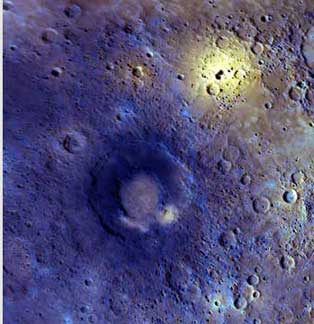
Messenger “This double-ring basin, seen in detail for the first time, is remarkably well preserved,” said Brett Denevi, a member of the probe’s imaging team and a postdoctoral researcher at Arizona State University in Tempe. “One similarity to Raditladi is its age, which has been estimated to be approximately one billion years old. Such an age is quite young for an impact basin, because most basins are about four times older. The inner floor of this basin is even younger than the basin itself and differs in color from its surroundings. We may have found the youngest volcanic material on Mercury.”

Photo on right: Selected features revealed during MESSENGER’s third flyby. This enhanced-color view was created with a statistical technique that highlights subtle color variations seen in the 11 filters of MESSENGER’s wide-angle camera that are often related to composition. Merged with images from the higher-resolution narrow-angle camera, the two sets of observations tell the story of the geology of the area and the compositional differences of the features observed. This region, viewed in detail for the first time during the third flyby, appears to have experienced a high level of volcanic activity. The bright yellow area near the top right is centered on a rimless depression (Image 4.4) that is a candidate site for an explosive volcanic vent. The 290-km-diameter double-ring basin in the center of the image has a smooth interior (Image 4.5) that may be the result of effusive volcanism. Smooth plains, thought to be a result of earlier episodes of volcanic activity, cover much of the surrounding area. Image resolution is 1 km/pixel.

One of the spacecraft’s instruments conducted its most extensive observations to date of Mercury’s exosphere, or thin atmosphere, during this encounter. The flyby allowed for the first detailed scans over Mercury’s north and south poles. The probe also has begun to reveal how Mercury’s atmosphere varies with its distance from the sun.

“A striking illustration of what we call ‘seasonal’ effects in Mercury’s exosphere is that the neutral sodium tail, so prominent in the first two flybys, is 10 to 20 times less intense in emission and significantly reduced in extent,” says participating scientist Ron Vervack, of the Johns Hopkins University Applied Physics Laboratory, or APL, in Laurel, Maryland. “This difference is related to expected variations in solar radiation pressure as Mercury moves in its orbit and demonstrates why Mercury’s exosphere is one of the most dynamic in the solar system.”

The observations also show that calcium and magnesium exhibit different seasonal changes than sodium. Studying the seasonal changes in all exospheric constituents during the mission orbital phase will provide key information on the relative importance of the processes that generate, sustain, and modify Mercury’s atmosphere.

The third flyby also revealed new information on the abundances of iron and titanium in Mercury’s surface materials. Earlier Earth and spacecraft-based observations showed that Mercury’s surface has a very low concentration of iron in silicate minerals, a result that led to the view that the planet’s crust is generally low in iron.

The spacecraft has completed nearly three-quarters of its 4.9-billion-mile journey to enter orbit around Mercury. The full trip will include more than 15 trips around the sun. In addition to flying by Mercury, the spacecraft flew past Earth in August 2005 and Venus in October 2006 and June 2007.

Filed Under: Exploration & Science Missions

Primary Sidebar

Coverage

  • Missions & Constellations
  • Business & Finance
  • Military & Defense
  • Launch
  • Software Automation & Ground Systems
  • Government & Regulation
  • Services & Applications

Most Read Stories

  • SpaceX Debuts Starship V3: Redefining Heavy-Lift Launch Capability
  • SpaceX Is Worth $1.75 Trillion. Only 7% of That Is Real.
  • SpaceX: 10,000 Launches Annually
  • The end of GEO?
  • American military space closed around one company in seven days

Secondary Sidebar

Footer


Satnews is a leading provider of satellite news, events, publications, research and other satellite industry information in both commercial and military enterprises worldwide.

Stories By Category

  • Business & Finance
  • Government & Regulation
  • Launch
  • Military & Defense
  • Missions & Constellations
  • Services & Applications
  • Software Automation & Ground Systems
  • Spectrum & Licensing
  • Startups & NewSpace Business

About Us

  • Leadership & Editorial Team
  • SatNews History
  • Free Satnews Subscription
  • SatNews Events
  • Magazines

Navigation

  • Latest Stories
  • Magazines
  • Events
  • Contact
  • Cookie & Privacy Policy for Satnews

We use cookies to ensure that we give you the best experience on our website. If you continue to use this site we will assume that you are happy with it.
x
Sign up Now (For Free)
Access daily or weekly satellite news updates covering all aspects of the commercial and military satellite industry.
Invalid email address
Notify Me Regarding ( At least one ):
We value your privacy and will not sell or share your email or other information with any other company. You may also unsubscribe at anytime.

Click Here to see our full privacy policy.
Thanks for subscribing!