

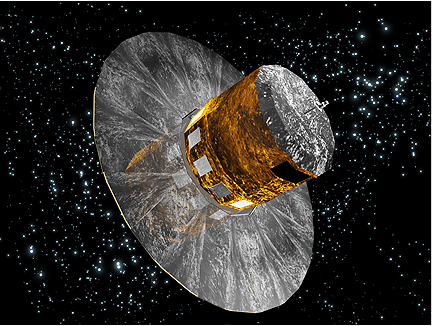
 Over the coming days, the DSA will undergo a thermal vacuum and thermal balance test in simulated space conditions. The LSS is the only facility in Europe large enough to perform this test. Gaia will perform micro-arcsecond astrometry of 1 billion objects in our Galaxy and beyond. In order to achieve the required measurement precision, the spacecraft and payload must be shielded from direct sunlight and maintained at a stable, low temperature as any thermal instability can affect the final accuracy of the measurements that will be made. The thermal stability of the Gaia spacecraft will be largely determined by a large sunshield with a diameter of 10.2 metres (33 feet, 5.57 inches) when fully deployed, which Sun-facing area must remain flat within 10mm deviation over the entire spacecraft lifetime. The sunshield assembly is composed of 12 rigid rectangular panels and 12 foldable triangular sections. In order to fit inside the launcher fairing the assembly must be folded against the sides of the Gaia spacecraft. After launch the sunshield will deploy to form a large flat structure at the base of the spacecraft, supporting two parallel blankets of multi-layer insulation (MLI) which will act as thermal shields so that the solar flux is damped by a factor of 280. The large size and foldable MLI sections make this a unique sunshield design.
On July 11th, the sunshield was lowered, in stowed configuration, into the LSS chamber using an overhead crane. In the remaining days leading up to TV/TB test, the set-up and the sunshield were prepared inside the LSS chamber. A dry run of the deployment inside the LSS was performed on July 17th under normal cleanroom conditions with the chamber still open. After bringing the sunshield back to its stowed configuration, the chamber door was closed on July 20th, signalling the start of the TV/TB test in simulated space conditions. The test ran through July 27th and when the TV/TB test was completed, the QM DSA was removed from the LSS and moved back to the clean room where the life cycle deployment testing in ambient conditions will be completed before delivering the qualification model of the DSA to the Gaia prime contractor. Upon successful completion of this test campaign, the manufacture of Gaia’s flight model sunshield will commence, incorporating all results from the QM test campaign in the definitive design and assembly of the flight model DSA.
