

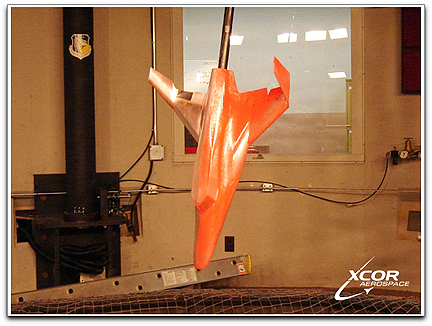
 The tests took place at the U.S. Air Force test facility located at Wright-Patterson Air Base near Dayton, OH, using an all-metal 1/16th scale model of the Lynx. “Ever since the Wright Brothers pioneered wind tunnel testing here in Dayton, aerospace engineers have used it as a tool to improve aerodynamic design,” said XCOR CEO Jeff Greason. “Computational Fluid Dynamics and other computer design tools are very useful, but you have to build real models and let real air flow around them to get real results. We are grateful that the U.S. Air Force made this facility available to do our first subsonic wind tunnel testing under a Cooperative Research and Development Agreement (CRADA).” Greason said that in return for the subsonic wind tunnel testing, the AFRL will get access to the data derived from the process. XCOR has already won several contracts with the AFRL, including a Phase II Small Business Innovation Research contract to supply operational data from the Lynx, which will help in the development of operationally responsive space craft. The Lynx, which is designed to safely fly to the edge of space and back multiple times a day, is expected to make its first flight in 2010.
Lynx Model Takes On USAF Windiness
XCOR Aerospace, Inc. has finished a series of wind tunnel tests of the aerodynamic design of its Lynx suborbital launch vehicle.
The tests took place at the U.S. Air Force test facility located at Wright-Patterson Air Base near Dayton, OH, using an all-metal 1/16th scale model of the Lynx. “Ever since the Wright Brothers pioneered wind tunnel testing here in Dayton, aerospace engineers have used it as a tool to improve aerodynamic design,” said XCOR CEO Jeff Greason. “Computational Fluid Dynamics and other computer design tools are very useful, but you have to build real models and let real air flow around them to get real results. We are grateful that the U.S. Air Force made this facility available to do our first subsonic wind tunnel testing under a Cooperative Research and Development Agreement (CRADA).” Greason said that in return for the subsonic wind tunnel testing, the AFRL will get access to the data derived from the process. XCOR has already won several contracts with the AFRL, including a Phase II Small Business Innovation Research contract to supply operational data from the Lynx, which will help in the development of operationally responsive space craft. The Lynx, which is designed to safely fly to the edge of space and back multiple times a day, is expected to make its first flight in 2010.
The tests took place at the U.S. Air Force test facility located at Wright-Patterson Air Base near Dayton, OH, using an all-metal 1/16th scale model of the Lynx. “Ever since the Wright Brothers pioneered wind tunnel testing here in Dayton, aerospace engineers have used it as a tool to improve aerodynamic design,” said XCOR CEO Jeff Greason. “Computational Fluid Dynamics and other computer design tools are very useful, but you have to build real models and let real air flow around them to get real results. We are grateful that the U.S. Air Force made this facility available to do our first subsonic wind tunnel testing under a Cooperative Research and Development Agreement (CRADA).” Greason said that in return for the subsonic wind tunnel testing, the AFRL will get access to the data derived from the process. XCOR has already won several contracts with the AFRL, including a Phase II Small Business Innovation Research contract to supply operational data from the Lynx, which will help in the development of operationally responsive space craft. The Lynx, which is designed to safely fly to the edge of space and back multiple times a day, is expected to make its first flight in 2010.
