

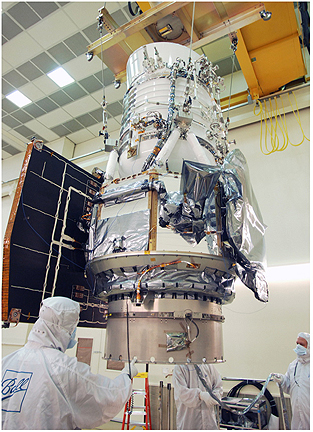
 WISE is working to a date of November 1, 2009, for launch from Vandenberg Air Force Base, California. WISE environmental testing included thermal vacuum, electromagnetic compatibility, electromagnetic interference, vibration, shock and acoustic testing to confirm the design integrity of the spacecraft. Earlier this year, Ball Aerospace integrated the WISE infrared cryogenic science instrument built by Space Dynamics Laboratory. The WISE RS-300 spacecraft derives from the Ball Aerospace NextSat spacecraft built for the successful Orbital Express mission launched on March 9, 2007. The flight system has an estimated mass of 560 Kg (about 1,175 pounds) and will fly at an altitude of about 313 miles. The spacecraft will be three-axis stabilized, with body-fixed solar arrays and use a high-gain antenna to transmit to ground through the TDRSS geostationary system. In addition to building the spacecraft, Ball Aerospace will perform testing requirements and flight system integration.
WISE will survey the entire sky with sensitivity hundreds of times better than previous infrared missions. It is designed to identify stars closest to the sun, enable a wide variety of studies in star formation and galactic structures, and assist the James Webb Space Telescope program identify which objects to observe following its expected 2014 launch. Ball is the principal subcontractor for James Webb, providing the advanced optical technology and lightweight mirror system. WISE is one of several cryogenically cooled infrared systems supported by Ball Aerospace. Other programs have included the Infrared Astronomical Satellite (IRAS), the Cosmic Background Explorer (COBE), the Spitzer Space Telescope, and the Near Infrared Camera and Multi-Object Spectrometer (NICMOS) for the Hubble Space Telescope. The Jet Propulsion Laboratory, Pasadena, California, manages WISE for NASA’s Science Mission Directorate.
