

 The engine testing took place using the proprietary induction system operating with the “weightless” FuelGas mixture in a mountainous region at 9,000 ft altitude, simulating real-life environments. The next step will be testing of the propulsion system at increasing altitudes. In addition to the success of the propulsion system tests, scientific teams involved with the STS-111 testing have invented an Adaptive Trim System (ATS) to be used exclusively on the STS Segmented airship line. ATS automatically senses and alters the center of gravity throughout flight. In flight tests with the 23m (76 ft) scaled prototype at 3,000 feet, ATS reduced the overall drag, increased the maneuverability, and led to greater flight duration. The system will be integrated into the STS-111 and future Sanswire models and will be controlled by the proprietary autonomous flight control module.
Sanswire’s 120 Mile Cone Of Surveillance Passes Propulsion Push
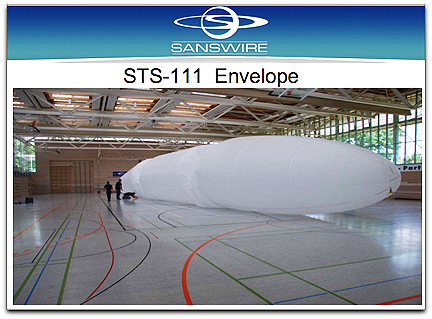
Sanswire-TAO Corp. has successfully completed testing of the FuelGas powered propulsion system that will be used on the STS-111 commercial airship, designed to operate at an altitude of 15,000 ft. and providing a surveillance cone of approximately 120 miles.
The engine testing took place using the proprietary induction system operating with the “weightless” FuelGas mixture in a mountainous region at 9,000 ft altitude, simulating real-life environments. The next step will be testing of the propulsion system at increasing altitudes. In addition to the success of the propulsion system tests, scientific teams involved with the STS-111 testing have invented an Adaptive Trim System (ATS) to be used exclusively on the STS Segmented airship line. ATS automatically senses and alters the center of gravity throughout flight. In flight tests with the 23m (76 ft) scaled prototype at 3,000 feet, ATS reduced the overall drag, increased the maneuverability, and led to greater flight duration. The system will be integrated into the STS-111 and future Sanswire models and will be controlled by the proprietary autonomous flight control module.
The engine testing took place using the proprietary induction system operating with the “weightless” FuelGas mixture in a mountainous region at 9,000 ft altitude, simulating real-life environments. The next step will be testing of the propulsion system at increasing altitudes. In addition to the success of the propulsion system tests, scientific teams involved with the STS-111 testing have invented an Adaptive Trim System (ATS) to be used exclusively on the STS Segmented airship line. ATS automatically senses and alters the center of gravity throughout flight. In flight tests with the 23m (76 ft) scaled prototype at 3,000 feet, ATS reduced the overall drag, increased the maneuverability, and led to greater flight duration. The system will be integrated into the STS-111 and future Sanswire models and will be controlled by the proprietary autonomous flight control module.
