

• Skip to primary navigation
  • Skip to main content
  • Skip to primary sidebar
  • Skip to secondary sidebar
  • Skip to footer
  • NEWS:
  • SatNews
  • SatMagazine
  • MilSatMagazine
  • SmallSat News
  • |     EVENTS:
  • SmallSat Symposium
  • Satellite Innovation
  • MilSat Symposium
  • SmallSat Europe

SatNews

Satellite Industry Intelligence Since 1983

Subscribe
  • LATEST
  • SatNews Events
  • Magazines
  • Calendar
  • Subscribe
  • Missions & Constellations
    • Exploration & Science Missions
    • In-Orbit Servicing & Orbital Operations
    • LEO Constellations
    • Mission Autonomy & Onboard Systems
    • Mission Deployments & Manifests
    • Navigation & PNT
    • SmallSat
    • Spacecraft & Payload Technology
    View All in Missions & Constellations →
    SpaceX’s Secret ‘Starfall’ Capsule Wins FAA Approval for Pacific Reentry TestsSpaceX’s Secret ‘Starfall’ Capsule Wins FAA Approval for Pacific Reentry Tests
    NOAA Activates First Dedicated U.S. Space Weather Satellite One Million Miles from EarthNOAA Activates First Dedicated U.S. Space Weather Satellite One Million Miles from Earth
    Thales Alenia Space to coordinate EROSS SC On-Orbit Servicing projectThales Alenia Space to coordinate EROSS SC On-Orbit Servicing project
    Astroscale Launches Industry Initiative to Study Atmospheric Impact of Spacecraft ReentryAstroscale Launches Industry Initiative to Study Atmospheric Impact of Spacecraft Reentry
  • Business
    • Contracts & Commercial Deals
    • Earnings & Financial Reporting
    • Events & Conferences
    • Funding & Venture Capital
    • Market Forecasts
    • Mergers & Acquisitions
    • Personnel Moves & Appointments
    View All in Business & Finance →
    SOMA Satellite Factory: Planet Labs Expands San Francisco HQ to Supercharge Production PipelineSOMA Satellite Factory: Planet Labs Expands San Francisco HQ to Supercharge Production Pipeline
    Riding the Starship: The SpaceX IPO Is Set to Rocket Seattle’s Aerospace EcosystemRiding the Starship: The SpaceX IPO Is Set to Rocket Seattle’s Aerospace Ecosystem
    Space Race Moves to Wall Street: China’s Private Rocket Makers Target IPOs as Historic SpaceX Flotation NearsSpace Race Moves to Wall Street: China’s Private Rocket Makers Target IPOs as Historic SpaceX Flotation Nears
    Behind the Screens: The Massive Video Over-IP Infrastructure Powering the World CupBehind the Screens: The Massive Video Over-IP Infrastructure Powering the World Cup
  • Defense
    • Counterspace & ASAT
    • Defense Budgets & Procurement
    • ISR & Reconnaissance
    • MILSATCOM
    • Missile Warning & Defense
    • National Security Programs
    • Space Domain Awareness
    View All in Military & Defense →
    Space-Based Shield: Spire Global and Diehl Defence Partner to Build European Missile Warning NetworkSpace-Based Shield: Spire Global and Diehl Defence Partner to Build European Missile Warning Network
    Qorvo Unveils Compact X-Band Radar Module to Enhance Defense System PerformanceQorvo Unveils Compact X-Band Radar Module to Enhance Defense System Performance
    Energration and Atombeam Partner on DARPA Proposal to Revolutionize Tactical Data Movement at the Defense EdgeEnergration and Atombeam Partner on DARPA Proposal to Revolutionize Tactical Data Movement at the Defense Edge
    American military space closed around one company in seven daysAmerican military space closed around one company in seven days
  • Gov
    • Export Controls & Compliance
    • International Space Agreements
    • National Space Policy
    • Space Law & Treaties
    • Space Sustainability & Debris Policy
    • Space Traffic Management / Debris Removal
    View All in Government & Regulation →
    Major opportunities for 2 GHz over EuropeMajor opportunities for 2 GHz over Europe
    “Dual-use” is the funding word. It’s also the label operators want off.“Dual-use” is the funding word. It’s also the label operators want off.
    Sovereignty got an answer on Day 3. Two answers, actually, and a commercial veto.Sovereignty got an answer on Day 3. Two answers, actually, and a commercial veto.
    Dependency killed the old debate. Sovereignty is the new one, and Europe hasn’t agreed what it means.Dependency killed the old debate. Sovereignty is the new one, and Europe hasn’t agreed what it means.
  • Launch
    • Launch Providers
    • Launch Schedule & Calendars
    • Launch Sites & Infrastructure
    • Rocket Technology & Vehicles
    View All in Launch →
    Breaking the TRL Bottleneck: Space Phoenix Systems Debuts Cost-Effective Space Test-and-Return ServiceBreaking the TRL Bottleneck: Space Phoenix Systems Debuts Cost-Effective Space Test-and-Return Service
    Twelve Scientific Payloads Experience Microgravity Aboard SubOrbital Express-5Twelve Scientific Payloads Experience Microgravity Aboard SubOrbital Express-5
    Amazon Leo Constellation Surpasses 330 Satellites Following Latest Atlas V LaunchAmazon Leo Constellation Surpasses 330 Satellites Following Latest Atlas V Launch
    If You Thought Space Was Hard Try to Get Your Satellite On a RocketIf You Thought Space Was Hard Try to Get Your Satellite On a Rocket
  • Software
    • Autonomous Ground Operations
    • Data Processing & AI/ML
    • Digital Twins & Modeling
    • Ground Segment & Teleports
    • Mission Planning & Simulation
    • Space Systems Software Engineering
    • Spectrum & Licensing
    View All in Software Automation & Ground Systems →
    Software Over the Air: FatPipe Launches Acceleration Tool to Unclog Starlink and Amazon LEO LinksSoftware Over the Air: FatPipe Launches Acceleration Tool to Unclog Starlink and Amazon LEO Links
    Three LEO Operators Bet 2026 on a Supply Chain Built for 2027Three LEO Operators Bet 2026 on a Supply Chain Built for 2027
    NASA Advances Interoperable Space Networks with Successful PExT DemonstrationNASA Advances Interoperable Space Networks with Successful PExT Demonstration
    KSAT and iQPS Expand Strategic Alliance to Accelerate High-Frequency SAR ConstellationKSAT and iQPS Expand Strategic Alliance to Accelerate High-Frequency SAR Constellation
  • Services & Apps
    • Climate & Environmental Monitoring
    • Disaster Response & Security Mapping
    • Earth Observation & Imaging
    • Maritime & Aviation Satcom
    • Satellite Communications
    View All in Services & Applications →
    Eutelsat and Tototheo Global Forge Partnership to Deliver LEO Connectivity Across Maritime and Government SectorsEutelsat and Tototheo Global Forge Partnership to Deliver LEO Connectivity Across Maritime and Government Sectors
    Marlink Equips Groupama-FDJ Cycling Team with Hybrid Starlink and LTE NetworkMarlink Equips Groupama-FDJ Cycling Team with Hybrid Starlink and LTE Network
    Viasat Secures Lockheed Martin Contract for NOAA’s Next-Generation AircraftViasat Secures Lockheed Martin Contract for NOAA’s Next-Generation Aircraft
    SES Partners with Viva to Launch Multi-Orbit In-Flight ConnectivitySES Partners with Viva to Launch Multi-Orbit In-Flight Connectivity

BBC News: The space giant is coming

May 4, 2009

The most distant cosmic explosion ever recorded would have made a fascinating target for the James Webb Space Telescope (JWST), according to scientists now building the successor to the Hubble Space Telescope.

The cataclysmic detonation reported this week is the most far-flung object in the Universe yet seen.
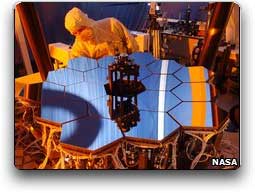
New GAlileos Photo: BBC R4: THE NEW GALILEOS Mirror model (Nasa)

It was a class of celestial object known as a gamma-ray blast. At a distance of 13 billion light-years away, the blast was so remote that today’s telescopes were stretched to their limits in revealing much information about it.

Nasa’s James Webb is designed with the purpose of imaging and studying this realm of the cosmos – and beyond – in extraordinary detail.

It is scheduled for launch in 2013.

To see so far, the observatory will be the space agency’s largest and most technically challenging telescope mission to date.

Its primary mirror is 6.5m (21ft) across – close to three times wider than Hubble’s.

Major deployment

The huge reflector will sit behind an even more expansive sun shield, the area of a tennis court.

This structure will shield the observatory from radiation from the Sun and the Earth.
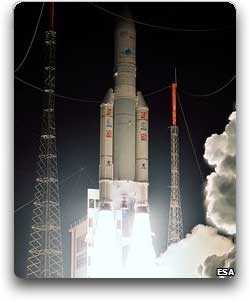
Instrument for JWST Photo: JWST will be folded to fit inside the top of an Ariane 5 rocket Ariane 5 (Esa)

It will keep the scope at a temperature of minus 250C in its deep space orbit, 1.5 million km away.

The mind-numbing temperature is necessary because the James Webb is to image the Universe with infra-red vision.

Heat is infra-red light, so any extraneous warmth from the Sun or even the Earth would spoil the telescope’s images and measurements of galaxies and exploding stars in the deep cosmos.

When the observatory is in the shade of its five-layer sunscreen, less than a millionth of the Sun’s energy will reach it.

The great size of everything on the James Webb calls for the most complicated space deployment ever attempted by Nasa and its partners on the mission, the European and Canadian space agencies.

‘Like a chrysalis’

The whole spacecraft has to be folded up for its launch so that it can fit into the nose of Europe’s Ariane 5 rocket.

Then, as members of the James Webb team describe in The New Galileos programme on BBC Radio 4, the observatory starts to unfurl like a butterfly emerging from its chrysalis as the journey into space begins.
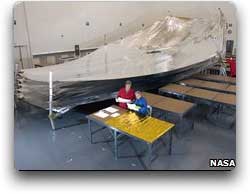
Sunscreen layers Photo JWST sunshield (Nasa) The sunscreen is made of layers of very thin material

During three tense days, commands beamed from mission control will instruct two wide booms to swing out. From these, the giant aluminium and silicon-coated sunshield membranes will inch out into position.

Then, the main mirror can be deployed. It has a segmented structure – a mosaic of exquisitely polished hexagonal sections of the lightweight metal beryllium.

In the style of a drop-leaf table, two sides of the mirror are folded back on hinges for launch. Small motors will raise the two sections into position to re-make the 6.5m light-collecting dish.

After several months of testing and allowing the James Webb to chill to its working temperature, the observations will begin.

When astronomers are able to see the most distant objects in the Universe, they can also access the deep history of the cosmos.
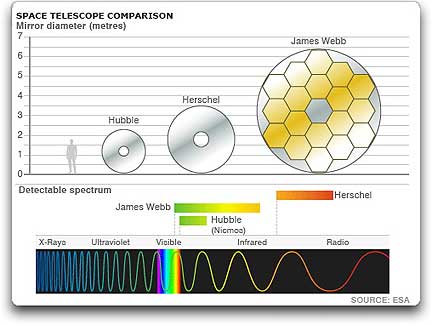
Image Herschel BBC Image: Herschel (BBC) Hubble views some near-infrared wavelengths. James Webb will seek longer wavelengths; and Europe’s soon-to-launch Herschel telescope will go longer still

The speed of light might be quick but it is finite. So when they picked up that record-breaking gamma-ray burst, they detected something that happened 13 billion light years ago: possibly some kind of giant star exploding with so much energy that it far outshone the invisible primordial galaxy which was its home.

According to Marcia Rieke, principal investigator for the James Webb’s Near Infra Red Camera (NIRCam), it is difficult for the current generation of telescopes to say anything other than that the colossal explosion happened.
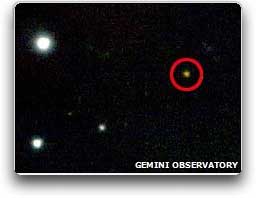
GRB GRB 090423 (Gemini Observatory/NSF/AURA/D.Fox/A.Cucchiara) Light from the furthest single object yet detected by telescopes

She told BBC News: “JWST would be able to see the galaxy which the gamma-ray burst resided in” and that “it could likely also get a spectrum of its stars”.

This information would help astronomers narrow down what kind of star was responsible for the blast.

Early in the Universe’s history, most galaxies were much smaller than they are now and many of the stars were much larger.

The very first stars in the Universe are thought to have been monsters.

They began to form between one and two hundred million years after the Big Bang. At this time, the universe was a dark void of hydrogen and helium gas which was the cooling debris of the Big Bang itself.

But here and there, primordial stars started to condense and ignite in denser patches of the blackness.

Brief but brilliant

Theorists calculate that because these stellar giants were formed from just hydrogen and helium, they could have grown to be as massive as 300 suns. These simple ingredients would have also made them much hotter, brighter and much shorter lived than our Sun.

“All of these things have been calculated and predicted in tremendous detail and we have the most amazing computer movies of what might have been,” says James Webb chief project scientist and Nasa’s first Nobel Laureate, John Mather.
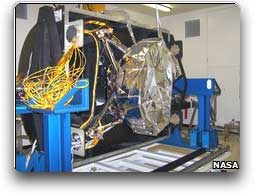
Instrument for JWST Instruments for JWST are being prepared in the US and in Europe

“What would be extremely exciting is to find out if any of them are true.”

Even the James Webb is unlikely to have the power to penetrate to the very earliest individual stars. It will not resolve them as single objects at such a distant epoch.

However, John Mather is optimistic that if first generation stars formed in groups of a few hundred, the telescope will find these “micro-galaxies“.

He adds that there is another way the James Webb will detect them.

“A star lasts three million years when it’s one of these. It blows up in what we call a supernova explosion which means that it’s millions of times brighter than it was. So we should be able to see an individual supernova coming from almost the visible edge of the Universe.”

By Andrew Luck-Baker, BBC Radio 4, The New Galileos

The article is found at this site.

Filed Under: Exploration & Science Missions

Primary Sidebar

Coverage

  • Missions & Constellations
  • Business & Finance
  • Military & Defense
  • Launch
  • Software Automation & Ground Systems
  • Government & Regulation
  • Services & Applications

Most Read Stories

  • SpaceX Debuts Starship V3: Redefining Heavy-Lift Launch Capability
  • SpaceX Is Worth $1.75 Trillion. Only 7% of That Is Real.
  • SpaceX: 10,000 Launches Annually
  • American military space closed around one company in seven days
  • The end of GEO?

Secondary Sidebar

Footer


Satnews is a leading provider of satellite news, events, publications, research and other satellite industry information in both commercial and military enterprises worldwide.

Stories By Category

  • Business & Finance
  • Government & Regulation
  • Launch
  • Military & Defense
  • Missions & Constellations
  • Services & Applications
  • Software Automation & Ground Systems
  • Spectrum & Licensing
  • Startups & NewSpace Business

About Us

  • Leadership & Editorial Team
  • SatNews History
  • Free Satnews Subscription
  • SatNews Events
  • Magazines

Navigation

  • Latest Stories
  • Magazines
  • Events
  • Contact
  • Cookie & Privacy Policy for Satnews

We use cookies to ensure that we give you the best experience on our website. If you continue to use this site we will assume that you are happy with it.
x
Sign up Now (For Free)
Access daily or weekly satellite news updates covering all aspects of the commercial and military satellite industry.
Invalid email address
Notify Me Regarding ( At least one ):
We value your privacy and will not sell or share your email or other information with any other company. You may also unsubscribe at anytime.

Click Here to see our full privacy policy.
Thanks for subscribing!