

• Skip to primary navigation
  • Skip to main content
  • Skip to primary sidebar
  • Skip to secondary sidebar
  • Skip to footer
  • NEWS:
  • SatNews
  • SatMagazine
  • MilSatMagazine
  • SmallSat News
  • |     EVENTS:
  • SmallSat Symposium
  • Satellite Innovation
  • MilSat Symposium
  • SmallSat Europe

SatNews

Satellite Industry Intelligence Since 1983

Subscribe
  • LATEST
  • SatNews Events
  • Magazines
  • Calendar
  • Subscribe
  • Missions & Constellations
    • Exploration & Science Missions
    • In-Orbit Servicing & Orbital Operations
    • LEO Constellations
    • Mission Autonomy & Onboard Systems
    • Mission Deployments & Manifests
    • Navigation & PNT
    • SmallSat
    • Spacecraft & Payload Technology
    View All in Missions & Constellations →
    Analyst Projects Massive Subscription Growth for Starlink Ahead of Imminent SpaceX IPOAnalyst Projects Massive Subscription Growth for Starlink Ahead of Imminent SpaceX IPO
    KSAT and iQPS Expand Strategic Alliance to Accelerate High-Frequency SAR ConstellationKSAT and iQPS Expand Strategic Alliance to Accelerate High-Frequency SAR Constellation
    Kaman Precision Products Deploys Advanced Magnetic Sensors for Next-Generation Launch PropulsionKaman Precision Products Deploys Advanced Magnetic Sensors for Next-Generation Launch Propulsion
    Beyond Gravity Launches Advanced Propulsion Pointing Mechanism for LEO ConstellationsBeyond Gravity Launches Advanced Propulsion Pointing Mechanism for LEO Constellations
  • Business
    • Contracts & Commercial Deals
    • Earnings & Financial Reporting
    • Events & Conferences
    • Funding & Venture Capital
    • Market Forecasts
    • Mergers & Acquisitions
    • Personnel Moves & Appointments
    View All in Business & Finance →
    Pilot Photonics Secures €1M ESA Contract to Advance Space PhotonicsPilot Photonics Secures €1M ESA Contract to Advance Space Photonics
    Space Stocks in Focus: Zacks Investment Ideas Highlights Gilat, Satellogic, and EchoStarSpace Stocks in Focus: Zacks Investment Ideas Highlights Gilat, Satellogic, and EchoStar
    Lockheed Martin UK Announces Major Workforce Expansion with Up to 2,000 New Space JobsLockheed Martin UK Announces Major Workforce Expansion with Up to 2,000 New Space Jobs
    Voyager Technologies Acquires Astrobotic for $300 MillionVoyager Technologies Acquires Astrobotic for $300 Million
  • Defense
    • Counterspace & ASAT
    • Defense Budgets & Procurement
    • ISR & Reconnaissance
    • MILSATCOM
    • Missile Warning & Defense
    • National Security Programs
    • Space Domain Awareness
    View All in Military & Defense →
    American military space closed around one company in seven daysAmerican military space closed around one company in seven days
    MDA Space Selected by BAE Systems for U.S. Space Force Missile Warning ConstellationMDA Space Selected by BAE Systems for U.S. Space Force Missile Warning Constellation
    ParaZero Secures First DefendAir Order from U.S. Tier-1 Defense CorporationParaZero Secures First DefendAir Order from U.S. Tier-1 Defense Corporation
    Northrop Grumman Partners with Apex for Space-Based Interceptors Targeting 2027 DeliveryNorthrop Grumman Partners with Apex for Space-Based Interceptors Targeting 2027 Delivery
  • Gov
    • Export Controls & Compliance
    • International Space Agreements
    • National Space Policy
    • Space Law & Treaties
    • Space Sustainability & Debris Policy
    • Space Traffic Management / Debris Removal
    View All in Government & Regulation →
    Major opportunities for 2 GHz over EuropeMajor opportunities for 2 GHz over Europe
    “Dual-use” is the funding word. It’s also the label operators want off.“Dual-use” is the funding word. It’s also the label operators want off.
    Sovereignty got an answer on Day 3. Two answers, actually, and a commercial veto.Sovereignty got an answer on Day 3. Two answers, actually, and a commercial veto.
    Dependency killed the old debate. Sovereignty is the new one, and Europe hasn’t agreed what it means.Dependency killed the old debate. Sovereignty is the new one, and Europe hasn’t agreed what it means.
  • Launch
    • Launch Providers
    • Launch Schedule & Calendars
    • Launch Sites & Infrastructure
    • Rocket Technology & Vehicles
    View All in Launch →
    Twelve Scientific Payloads Experience Microgravity Aboard SubOrbital Express-5Twelve Scientific Payloads Experience Microgravity Aboard SubOrbital Express-5
    Amazon Leo Constellation Surpasses 330 Satellites Following Latest Atlas V LaunchAmazon Leo Constellation Surpasses 330 Satellites Following Latest Atlas V Launch
    If You Thought Space Was Hard Try to Get Your Satellite On a RocketIf You Thought Space Was Hard Try to Get Your Satellite On a Rocket
    Blue Origin Suffers Major Setback as New Glenn Rocket Explodes During Static Fire TestBlue Origin Suffers Major Setback as New Glenn Rocket Explodes During Static Fire Test
  • Software
    • Autonomous Ground Operations
    • Data Processing & AI/ML
    • Digital Twins & Modeling
    • Ground Segment & Teleports
    • Mission Planning & Simulation
    • Space Systems Software Engineering
    • Spectrum & Licensing
    View All in Software Automation & Ground Systems →
    KSAT and Axelspace Expand Strategic Partnership to Accelerate Earth ObservationKSAT and Axelspace Expand Strategic Partnership to Accelerate Earth Observation
    Europe has ships. SmallSat Europe said it doesn’t have ports.Europe has ships. SmallSat Europe said it doesn’t have ports.
    The orbital data center thesis just became an economics question.The orbital data center thesis just became an economics question.
    AI just reached production in European space. The trust problem is what comes next.AI just reached production in European space. The trust problem is what comes next.
  • Services & Apps
    • Climate & Environmental Monitoring
    • Disaster Response & Security Mapping
    • Earth Observation & Imaging
    • Maritime & Aviation Satcom
    • Satellite Communications
    View All in Services & Applications →
    Viasat Secures Lockheed Martin Contract for NOAA’s Next-Generation AircraftViasat Secures Lockheed Martin Contract for NOAA’s Next-Generation Aircraft
    SES Partners with Viva to Launch Multi-Orbit In-Flight ConnectivitySES Partners with Viva to Launch Multi-Orbit In-Flight Connectivity
    Resolve Optics Delivers Radiation-Resistant Lenses for LEO SatellitesResolve Optics Delivers Radiation-Resistant Lenses for LEO Satellites
    SITAEL Unveils €200 Million Growth Strategy and ESA Mission Contract at SmallSat EuropeSITAEL Unveils €200 Million Growth Strategy and ESA Mission Contract at SmallSat Europe

NASA and ESA’s Excellent Adventure to Jupiter and Family

February 18, 2009

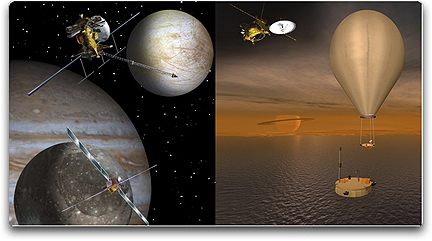
Jupiter system They will continue with their pursuit of studying all aspects of a mission to Jupiter and its four largest moons, and to plan for another potential mission to visit Saturn’s largest moon Titan and Enceladus. At a meeting in Washington last week, National Aeronautics and Space Administration and European Space Agency came to this consensus. Artist concept of proposed missions to the Jupiter system (left) and the Saturn system (right). Image credit: NASA/JPL

Both of these proposed missions are grand endeavors that set the stage for future planetary science research. These outer planet flagship missions could eventually answer questions about how our solar system formed and whether life exists elsewhere in the universe.

The missions, called the Europa Jupiter System Mission and the Titan Saturn System Mission, are the result of NASA and ESA merging their separate mission concepts. NASA originally studied four mission concepts during 2007, which were narrowed down to two proposals in 2008. One finalist was a Europa Orbiter to explore that icy moon of Jupiter and its subsurface water ocean. The other was a Titan Orbiter to visit the Saturn moon. Independently, in 2007, ESA also initiated a competition to select its flagship mission for the Cosmic Vision 2015-2025 slot of the ESA scientific program. Two finalists, called Laplace and Tandem, were selected by ESA for further study. Laplace was a set of spacecraft to orbit Jupiter and eventually orbit and land on Europa. Tandem was a set of spacecraft intended to orbit Titan and explore its surface, after also exploring the surface of Saturn’s moon Enceladus.

NASA and ESA engineers and scientists carefully studied both potential missions in preparation for last week’s meeting. Based on these and other studies as well as stringent independent assessment reviews, NASA and ESA agreed that the Europa Jupiter System Mission, called Laplace in Europe, was the most technically feasible to do first. However, ESA’s Solar System Working Group concluded the scientific merits of this mission and a Titan Saturn System Mission could not be separated. The group recommended, and NASA agreed, that both missions should move forward for further study and implementation.

“The decision means a win, win situation for all parties involved,” said Ed Weiler, associate administrator for NASA’s Science Mission Directorate in Washington. “Although the Jupiter system mission has been chosen to proceed to an earlier flight opportunity, a Saturn system mission clearly remains a high priority for the science community.”

Both agencies will need to undertake several more steps and detailed studies before officially moving forward. “This joint endeavor is a wonderful new exploration challenge and will be a landmark of 21st Century planetary science,” said David Southwood, ESA Director of Science and Robotic Exploration. “What I am especially sure of is that the cooperation across the Atlantic that we have had so far and we see in the future, between America and Europe, NASA and ESA, and in our respective science communities is absolutely right. Let’s get to work.”

New Exploration Challenges at Jupiter and Saturn

The Europa Jupiter System Mission would use two robotic orbiters to conduct unprecedentedly detailed studies of the giant gaseous planet Jupiter and its moons Io, Europa, Ganymede and Callisto. NASA would build one orbiter, initially named Jupiter Europa. ESA would build the other orbiter, initially named Jupiter Ganymede. The probes would launch in 2020 on two separate launch vehicles from different launch sites. The orbiters would reach the Jupiter system in 2026 and spend at least three years conducting research.

Europa has a surface of ice, and scientists theorize it has an ocean of water beneath that could provide a home for living things. Ganymede, the largest moon in the solar system, is the only moon known to have its own internally generated magnetic field and is suspected to have a deep undersurface water ocean. Scientists long have sought to understand the causes of the magnetic field. Callisto’s surface is extremely heavily cratered and ancient, providing a clear indication of a record of events from the early history of the Solar System. Finally, Io is the most volcanically active body in the solar system.

The orbiters would spend nearly a year orbiting Europa and Ganymede. NASA’s probe would investigate whether Europa might harbor life, and ESA’s spacecraft would orbit Ganymede to conduct investigations of the surface and interior of this satellite, to better understand the formation and evolution of the Jovian system.

The Titan Saturn System Mission would consist of a NASA orbiter and an ESA lander and research balloon. The complex mission faces several technical challenges requiring significant study and technology development. NASA will continue studying and developing those technologies. Future work also will provide important input into the next Planetary Science Decadal Survey by the National Research Council of the U.S. National Academy of Sciences, which will serve as a roadmap for new NASA planetary missions to begin after 2013. On the European side, the interested community of scientists will have to re-submit the Titan mission at the next opportunity for mission proposals in the Cosmic Vision program in the years to come.

NASA’s Jet Propulsion Laboratory in Pasadena, California, will manage NASA’s contributions to the projects for NASA’s Science Mission Directorate in Washington. ESA’s Directorate of Science and Robotic Exploration will manage the European contribution to the Jupiter mission.

Filed Under: Exploration & Science Missions

Primary Sidebar

Coverage

  • Missions & Constellations
  • Business & Finance
  • Military & Defense
  • Launch
  • Software Automation & Ground Systems
  • Government & Regulation
  • Services & Applications

Most Read Stories

  • AST SpaceMobile Pivots to SpaceX for Mid-June Launch of Three BlueBird Satellites
  • SmallSat Europe Speaker Focus: Merek Chertkow, The Radiation Team
  • SmallSat Europe Speaker Focus: Frank M. Salzgeber, Nadir Space Venture
  • SpaceX Debuts Starship V3: Redefining Heavy-Lift Launch Capability
  • SpaceX Accelerates Transition from Falcon 9 to Next-Generation Starship Fleet

Secondary Sidebar

Footer


Satnews is a leading provider of satellite news, events, publications, research and other satellite industry information in both commercial and military enterprises worldwide.

Stories By Category

  • Business & Finance
  • Government & Regulation
  • Launch
  • Military & Defense
  • Missions & Constellations
  • Services & Applications
  • Software Automation & Ground Systems
  • Spectrum & Licensing
  • Startups & NewSpace Business

About Us

  • Leadership & Editorial Team
  • SatNews History
  • Free Satnews Subscription
  • SatNews Events
  • Magazines

Navigation

  • Latest Stories
  • Magazines
  • Events
  • Contact
  • Cookie & Privacy Policy for Satnews

We use cookies to ensure that we give you the best experience on our website. If you continue to use this site we will assume that you are happy with it.
x
Sign up Now (For Free)
Access daily or weekly satellite news updates covering all aspects of the commercial and military satellite industry.
Invalid email address
Notify Me Regarding ( At least one ):
We value your privacy and will not sell or share your email or other information with any other company. You may also unsubscribe at anytime.

Click Here to see our full privacy policy.
Thanks for subscribing!