

• Skip to primary navigation
  • Skip to main content
  • Skip to primary sidebar
  • Skip to secondary sidebar
  • Skip to footer
  • NEWS:
  • SatNews
  • SatMagazine
  • MilSatMagazine
  • SmallSat News
  • |     EVENTS:
  • SmallSat Symposium
  • Satellite Innovation
  • MilSat Symposium
  • SmallSat Europe

SatNews

Satellite Industry Intelligence Since 1983

Subscribe
  • LATEST
  • SatNews Events
  • Magazines
  • Calendar
  • Subscribe
  • Missions & Constellations
    • Exploration & Science Missions
    • In-Orbit Servicing & Orbital Operations
    • LEO Constellations
    • Mission Autonomy & Onboard Systems
    • Mission Deployments & Manifests
    • Navigation & PNT
    • SmallSat
    • Spacecraft & Payload Technology
    View All in Missions & Constellations →
    Satellite and the Upcoming Spectrum AuctionSatellite and the Upcoming Spectrum Auction
    ExoMars 2028 Structural Models Arrive in Cannes for Environmental TestingExoMars 2028 Structural Models Arrive in Cannes for Environmental Testing
    Consumer NPU Boom Accelerates Autonomous Satellite ProcessingConsumer NPU Boom Accelerates Autonomous Satellite Processing
    SmallSat Europe Speaker Focus: Gregg Burgess, Orion Space SolutionsSmallSat Europe Speaker Focus: Gregg Burgess, Orion Space Solutions
  • Business
    • Contracts & Commercial Deals
    • Earnings & Financial Reporting
    • Events & Conferences
    • Funding & Venture Capital
    • Market Forecasts
    • Mergers & Acquisitions
    • Personnel Moves & Appointments
    View All in Business & Finance →
    Space42 Taps Skylo for Standards-Based Direct-to-Device Services via Thuraya-4Space42 Taps Skylo for Standards-Based Direct-to-Device Services via Thuraya-4
    SmallSat Europe Speaker Focus: Frank M. Salzgeber, Nadir Space VentureSmallSat Europe Speaker Focus: Frank M. Salzgeber, Nadir Space Venture
    Ted Turner: “Shake with Terror”Ted Turner: “Shake with Terror”
    Globalstar Reports 17 Percent Revenue Growth in Q1 Amid Pending Amazon MergerGlobalstar Reports 17 Percent Revenue Growth in Q1 Amid Pending Amazon Merger
  • Defense
    • Counterspace & ASAT
    • Defense Budgets & Procurement
    • ISR & Reconnaissance
    • MILSATCOM
    • Missile Warning & Defense
    • National Security Programs
    • Space Domain Awareness
    View All in Military & Defense →
    US Air Force Taps L3Harris to Bolster ABMS Digital InfrastructureUS Air Force Taps L3Harris to Bolster ABMS Digital Infrastructure
    U.S. and Australia Expand Space Surveillance Network to Counter Emerging ASAT ThreatsU.S. and Australia Expand Space Surveillance Network to Counter Emerging ASAT Threats
    U.S. Space Force Awards $3.2 Billion for Space-Based Interceptor LayerU.S. Space Force Awards $3.2 Billion for Space-Based Interceptor Layer
    U.S. Space Force Integrates Domain Awareness Capabilities into Balikatan 2026U.S. Space Force Integrates Domain Awareness Capabilities into Balikatan 2026
  • Gov
    • Export Controls & Compliance
    • International Space Agreements
    • National Space Policy
    • Space Law & Treaties
    • Space Sustainability & Debris Policy
    • Space Traffic Management / Debris Removal
    View All in Government & Regulation →
    FCC Approves Landmark Spectrum Sharing and Direct-to-Device FrameworksFCC Approves Landmark Spectrum Sharing and Direct-to-Device Frameworks
    ATVA Urges FCC to Close “Affiliation-Swap” Loopholes Impacting Satellite OperatorsATVA Urges FCC to Close “Affiliation-Swap” Loopholes Impacting Satellite Operators
    UAE Space Agency Drives Public-Private Collaboration at MIITE 2026UAE Space Agency Drives Public-Private Collaboration at MIITE 2026
    SmallSat Europe Speaker Focus: Araz Feyzi, Kayhan SpaceSmallSat Europe Speaker Focus: Araz Feyzi, Kayhan Space
  • Launch
    • Launch Providers
    • Launch Schedule & Calendars
    • Launch Sites & Infrastructure
    • Rocket Technology & Vehicles
    View All in Launch →
    AST SpaceMobile Pivots to SpaceX for Mid-June Launch of Three BlueBird SatellitesAST SpaceMobile Pivots to SpaceX for Mid-June Launch of Three BlueBird Satellites
    SpaceX Accelerates Transition from Falcon 9 to Next-Generation Starship FleetSpaceX Accelerates Transition from Falcon 9 to Next-Generation Starship Fleet
    NanoAvionics Satellites Reach Orbit on SpaceX CAS500-2 MissionNanoAvionics Satellites Reach Orbit on SpaceX CAS500-2 Mission
    GalaxEye Successfully Launches “Mission Drishti” OptoSAR SatelliteGalaxEye Successfully Launches “Mission Drishti” OptoSAR Satellite
  • Software
    • Autonomous Ground Operations
    • Data Processing & AI/ML
    • Digital Twins & Modeling
    • Ground Segment & Teleports
    • Mission Planning & Simulation
    • Space Systems Software Engineering
    • Spectrum & Licensing
    View All in Software Automation & Ground Systems →
    Your anomaly detection isn’t the problemYour anomaly detection isn’t the problem
    SmallSat Europe Speaker Focus: Olaf Eckart, BMW GroupSmallSat Europe Speaker Focus: Olaf Eckart, BMW Group
    SES Accelerates Multi-Orbit IFC Strategy with meoSphere and Next-Gen ESA DevelopmentSES Accelerates Multi-Orbit IFC Strategy with meoSphere and Next-Gen ESA Development
    SmallSat Europe Speaker Focus: Koen Willems, ST Engineering iDirect EuropeSmallSat Europe Speaker Focus: Koen Willems, ST Engineering iDirect Europe
  • Services & Apps
    • Climate & Environmental Monitoring
    • Disaster Response & Security Mapping
    • Earth Observation & Imaging
    • Maritime & Aviation Satcom
    • Satellite Communications
    View All in Services & Applications →
    Satellite Technology and the Legacy of the Media PioneerSatellite Technology and the Legacy of the Media Pioneer
    SmallSat Europe Speaker Focus: Massimo Comparini, Leonardo Space DivisionSmallSat Europe Speaker Focus: Massimo Comparini, Leonardo Space Division
    The waiver was the policy. Thursday is the paperwork.The waiver was the policy. Thursday is the paperwork.
    Solstar Confirms Successful On-Orbit Operation of Deke Space Communicator Following Launch on SpaceX Transporter-16 MissionSolstar Confirms Successful On-Orbit Operation of Deke Space Communicator Following Launch on SpaceX Transporter-16 Mission

NASA’s Dawn Plummeting Toward Mars For Good Reason

February 13, 2009

Launched in September of 2007, and propelled by any one of a trio of hyper-efficient ion engines, NASA’s Dawn spacecraft passed the orbit of Mars last summer.

At that time, the asteroid belt (where Dawn’s two targets, asteroid Vesta and the dwarf planet Ceres reside), had never been closer. In early July, the spacecraft began to lose altitude, falling back towards the inner solar system. Then, on October 31, 2008, after 270 days of almost continuous thrusting, the ion drive turned off. “Not only are our thrusters off and we are dropping in altitude, we are plunging toward Mars,” said Marc Rayman, the Dawn project’s chief engineer from NASA’s Jet Propulsion Laboratory in Pasadena, Calif. “And everybody here on Dawn could not be happier.”
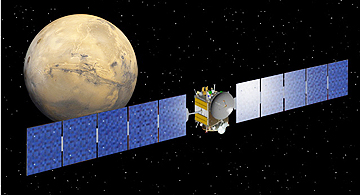
NASA's Dawn satellite The team’s delight at plummeting towards a planet named for the Roman god of war is not unfounded. Mars, the final stop for many a NASA spacecraft, was always an important, and weighty, waypoint for the Dawn mission. It all has to do with one of the heavy subjects of rocket science, gravity assists, which is the use of the relative movement and gravity of a planet or other celestial body to alter the path and speed of a spacecraft, typically in order to save fuel, time, and expense. A spacecraft traveling to an outer planet (or in this case asteroid) will decelerate because the incessant tug of the sun’s gravity slows it down. By flying a spacecraft close by a large planet and its large gravity field, some of the planet’s speed as it orbits the sun is transferred to the spacecraft. In Dawn’s case, it is using the Red Planet’s tremendous angular momentum (the speed at which Mars orbits the sun) to give it a little extra oomph.

“A big oomph actually,” said Rayman. “The gravity of Mars will change Dawn’s path about the sun, enlarging its elliptical orbit and sending the probe farther from the sun. It will also change Dawn’s orbital plane by more than 5 degrees. This is important because Dawn has to maneuver into the same plane in which Vesta orbits the sun.” If Dawn had to perform these orbital adjustments on its own with no Mars gravitational deflection, it would have required the spacecraft to fire up its engines and change velocity by more than 5,800 miles per hour (9,330 kilometers per second). Such velocity changes would have required Dawn to carry an extra 230 pounds (104 kilograms) of xenon fuel. Also happy for the opportunity to fly past the fourth rock from the sun is Dawn’s science team. With asteroid Vesta still more than two-and-a-half years away, Mars provides the perfect opportunity to give their highly-tuned instruments a workout.

But the Mars gravity assist is not the final hurdle on Dawn’s road to the asteroid belt. The subsequent 30 months include more than 27 months of blue-green tinged ion thrusting to successfully rendezvous with Dawn’s first target — Vesta. While an accurately flown encounter with the planet Mars makes a big difference in the life of NASA’s asteroid pioneer, the planet itself does not come out unscathed. Weighing in at all of 2,500 pounds (1,134 kilograms), Dawn has its own mass and thereby its own gravitational field. In contrast, the somewhat more massive planet is almost 600 million-million-million times more substantial than that of the spacecraft. Dawn’s 4.8-billion-kilometer (3-billion-mile) odyssey includes orbiting asteroid Vesta in 2011 and the dwarf planet Ceres in 2015. These two giants of the asteroid belt have been witness to much of our solar system’s history. By using Dawn’s instruments to study both objects for several months, scientists can more accurately compare and contrast the two. Dawn’s science instrument suite will measure geology, elemental and mineral composition, shape, surface topography, geomorphology and tectonic history, and will also seek water-bearing minerals. In addition, the Dawn spacecraft’s orbit characteristics around Vesta and Ceres will be used to measure the celestial bodies’ masses and gravity fields.

(Image source: NASA’s Jet Propulsion Laboratory)

Filed Under: Exploration & Science Missions

Primary Sidebar

Coverage

  • Missions & Constellations
  • Business & Finance
  • Military & Defense
  • Launch
  • Software Automation & Ground Systems
  • Government & Regulation
  • Services & Applications

Most Read Stories

  • NASA Shuts Off Instrument on Voyager 1 to Extend Interstellar Mission
  • Bad news, but good news followed
  • Amazon to Acquire Globalstar for $11.6 Billion to Fuel D2D Expansion
  • Blue Origin Achieves First Booster Reuse but Satellite Enters Off-Nominal Orbit
  • The Smartest Money in the Room Is Looking Up

Secondary Sidebar

Footer


Satnews is a leading provider of satellite news, events, publications, research and other satellite industry information in both commercial and military enterprises worldwide.

Stories By Category

  • Business & Finance
  • Government & Regulation
  • Launch
  • Military & Defense
  • Missions & Constellations
  • Services & Applications
  • Software Automation & Ground Systems
  • Spectrum & Licensing
  • Startups & NewSpace Business

About Us

  • Leadership & Editorial Team
  • SatNews History
  • Free Satnews Subscription
  • SatNews Events
  • Magazines

Navigation

  • Latest Stories
  • Magazines
  • Events
  • Contact
  • Cookie & Privacy Policy for Satnews

We use cookies to ensure that we give you the best experience on our website. If you continue to use this site we will assume that you are happy with it.
x
Sign up Now (For Free)
Access daily or weekly satellite news updates covering all aspects of the commercial and military satellite industry.
Invalid email address
Notify Me Regarding ( At least one ):
We value your privacy and will not sell or share your email or other information with any other company. You may also unsubscribe at anytime.

Click Here to see our full privacy policy.
Thanks for subscribing!