

 The LCROSS mission is a small companion mission to the Lunar Reconnaissance Orbiter, scheduled to launch from Cape Canaveral, Florida, in spring 2009. Instruments aboard the satellite are designed to search for evidence of water ice on the moon as the spacecraft collides with a permanently shadowed crater near one of the moon’s poles. The resulting debris plumes are expected to be visible from Earth with telescopes 10-to-12 inches in diameter or larger. These selected observation teams will provide additional data and analysis about permanently shadowed craters to help researchers determine if water exists on the moon and in what form. The LCROSS mission and the Universities Space Research Association, or USRA, of Columbia, Maryland, established specific selection criteria. USRA administered the rigorous selection process. The selected proposals are:
- Accessing LCROSS Ejecta: Water Vapor and Particle Size and Composition from Keck, Gemini, and the IRFT Telescopes; principle investigator Eliot Young, Southwest Research Institute in Boulder, Colorado
- LCROSS Lunar Plume Observations with the Apache Point Observatory; principle investigator Nancy Chanover, New Mexico State University in Las Cruces
- Multi-spectral Imaging of the LCROSS Impact; principle investigator Marc Buie, Southwest Research Institute
- Searching for Polar Water Ice During the LCROSS Impact Using the MMT Observatory; principle investigator Faith Vilas, University of Arizona in Tucson
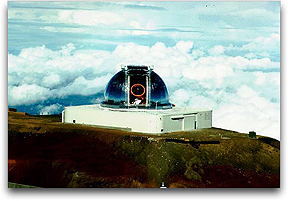
(NASA’s Infrared Telescope Facility. Credit: NASA)
