

• Skip to primary navigation
  • Skip to main content
  • Skip to primary sidebar
  • Skip to secondary sidebar
  • Skip to footer
  • NEWS:
  • SatNews
  • SatMagazine
  • MilSatMagazine
  • SmallSat News
  • |     EVENTS:
  • SmallSat Symposium
  • Satellite Innovation
  • MilSat Symposium
  • SmallSat Europe

SatNews

Satellite Industry Intelligence Since 1983

Subscribe
  • LATEST
  • SatNews Events
  • Magazines
  • Calendar
  • Subscribe
  • Missions & Constellations
    • Exploration & Science Missions
    • In-Orbit Servicing & Orbital Operations
    • LEO Constellations
    • Mission Autonomy & Onboard Systems
    • Mission Deployments & Manifests
    • Navigation & PNT
    • SmallSat
    • Spacecraft & Payload Technology
    View All in Missions & Constellations →
    Gen Z Influence on AI-Driven Audio MarketGen Z Influence on AI-Driven Audio Market
    SmallSat Europe Speaker Focus: Stefano Antonetti, D-OrbitSmallSat Europe Speaker Focus: Stefano Antonetti, D-Orbit
    Satellite and the Upcoming Spectrum AuctionSatellite and the Upcoming Spectrum Auction
    ExoMars 2028 Structural Models Arrive in Cannes for Environmental TestingExoMars 2028 Structural Models Arrive in Cannes for Environmental Testing
  • Business
    • Contracts & Commercial Deals
    • Earnings & Financial Reporting
    • Events & Conferences
    • Funding & Venture Capital
    • Market Forecasts
    • Mergers & Acquisitions
    • Personnel Moves & Appointments
    View All in Business & Finance →
    Gilat Wins Big Military Contracts, Expands India FootprintGilat Wins Big Military Contracts, Expands India Footprint
    SmallSat Europe Speaker Focus: Gregg Burgess, Orion Space SolutionsSmallSat Europe Speaker Focus: Gregg Burgess, Orion Space Solutions
    Space42 Taps Skylo for Standards-Based Direct-to-Device Services via Thuraya-4Space42 Taps Skylo for Standards-Based Direct-to-Device Services via Thuraya-4
    SmallSat Europe Speaker Focus: Frank M. Salzgeber, Nadir Space VentureSmallSat Europe Speaker Focus: Frank M. Salzgeber, Nadir Space Venture
  • Defense
    • Counterspace & ASAT
    • Defense Budgets & Procurement
    • ISR & Reconnaissance
    • MILSATCOM
    • Missile Warning & Defense
    • National Security Programs
    • Space Domain Awareness
    View All in Military & Defense →
    iDirect Government Launches 450 Rackmount Software-Defined Modem for Multi-Orbit DefenseiDirect Government Launches 450 Rackmount Software-Defined Modem for Multi-Orbit Defense
    US Air Force Taps L3Harris to Bolster ABMS Digital InfrastructureUS Air Force Taps L3Harris to Bolster ABMS Digital Infrastructure
    U.S. and Australia Expand Space Surveillance Network to Counter Emerging ASAT ThreatsU.S. and Australia Expand Space Surveillance Network to Counter Emerging ASAT Threats
    U.S. Space Force Awards $3.2 Billion for Space-Based Interceptor LayerU.S. Space Force Awards $3.2 Billion for Space-Based Interceptor Layer
  • Gov
    • Export Controls & Compliance
    • International Space Agreements
    • National Space Policy
    • Space Law & Treaties
    • Space Sustainability & Debris Policy
    • Space Traffic Management / Debris Removal
    View All in Government & Regulation →
    SES Extends IRIS² Review as Consortium Reaches Initial Project MilestoneSES Extends IRIS² Review as Consortium Reaches Initial Project Milestone
    FCC Approves Landmark Spectrum Sharing and Direct-to-Device FrameworksFCC Approves Landmark Spectrum Sharing and Direct-to-Device Frameworks
    ATVA Urges FCC to Close “Affiliation-Swap” Loopholes Impacting Satellite OperatorsATVA Urges FCC to Close “Affiliation-Swap” Loopholes Impacting Satellite Operators
    UAE Space Agency Drives Public-Private Collaboration at MIITE 2026UAE Space Agency Drives Public-Private Collaboration at MIITE 2026
  • Launch
    • Launch Providers
    • Launch Schedule & Calendars
    • Launch Sites & Infrastructure
    • Rocket Technology & Vehicles
    View All in Launch →
    AST SpaceMobile Pivots to SpaceX for Mid-June Launch of Three BlueBird SatellitesAST SpaceMobile Pivots to SpaceX for Mid-June Launch of Three BlueBird Satellites
    SpaceX Accelerates Transition from Falcon 9 to Next-Generation Starship FleetSpaceX Accelerates Transition from Falcon 9 to Next-Generation Starship Fleet
    NanoAvionics Satellites Reach Orbit on SpaceX CAS500-2 MissionNanoAvionics Satellites Reach Orbit on SpaceX CAS500-2 Mission
    GalaxEye Successfully Launches “Mission Drishti” OptoSAR SatelliteGalaxEye Successfully Launches “Mission Drishti” OptoSAR Satellite
  • Software
    • Autonomous Ground Operations
    • Data Processing & AI/ML
    • Digital Twins & Modeling
    • Ground Segment & Teleports
    • Mission Planning & Simulation
    • Space Systems Software Engineering
    • Spectrum & Licensing
    View All in Software Automation & Ground Systems →
    Your anomaly detection isn’t the problemYour anomaly detection isn’t the problem
    SmallSat Europe Speaker Focus: Olaf Eckart, BMW GroupSmallSat Europe Speaker Focus: Olaf Eckart, BMW Group
    SES Accelerates Multi-Orbit IFC Strategy with meoSphere and Next-Gen ESA DevelopmentSES Accelerates Multi-Orbit IFC Strategy with meoSphere and Next-Gen ESA Development
    SmallSat Europe Speaker Focus: Koen Willems, ST Engineering iDirect EuropeSmallSat Europe Speaker Focus: Koen Willems, ST Engineering iDirect Europe
  • Services & Apps
    • Climate & Environmental Monitoring
    • Disaster Response & Security Mapping
    • Earth Observation & Imaging
    • Maritime & Aviation Satcom
    • Satellite Communications
    View All in Services & Applications →
    Consumer NPU Boom Accelerates Autonomous Satellite ProcessingConsumer NPU Boom Accelerates Autonomous Satellite Processing
    Ted Turner: “Shake with Terror”Ted Turner: “Shake with Terror”
    Satellite Technology and the Legacy of the Media PioneerSatellite Technology and the Legacy of the Media Pioneer
    SmallSat Europe Speaker Focus: Massimo Comparini, Leonardo Space DivisionSmallSat Europe Speaker Focus: Massimo Comparini, Leonardo Space Division

GOSAT + Six SatPals Successfully Launched By Japan

January 22, 2009

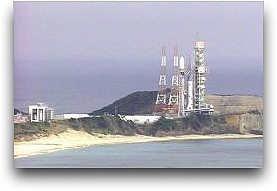
JAXA GOSAT launch site Japan has launched a satellite whose focus will be to observe the concentration distribution of greenhouse gases from space. The launch of the Ibuki satellite (also known by GOSAT – Greenhouse Gases Observing Satellite) took place on January 23rd at 03:54 UTC from the LP1 launch platform of the Yoshinubo launch complex on Tanegashima. Ibuki has a approximate mass of 1750 kg. Is equipped with two solar panels that generate 3.8 kW. The satellite will operate for 5 years on a sun-synchronous sub-recurrent orbit with a inclination of 98 degrees.
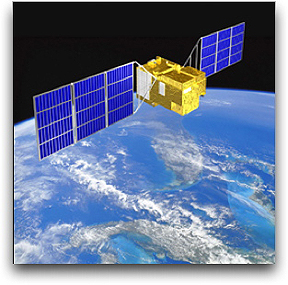
GOSAT Satellite
GOSAT ("Ibuki") satellite – photo courtesy of Mitsubishi Heavy Industries
The launch vehicle used was the 202 version of the H-2A rocket, equipped with two solid rocket boosters and with the 4S fairing design (4 meters in diameter). Mitsubishi Heavy Industries, Ltd. was in charge of the launch service of the H-IIA. According to JAXA, the Ibuki satellite is equipped with a greenhouse gas observation sensor (TANSO-FTS) and a cloud/aerosol sensor (TANSO-CAI) that supplements TANSO-FTS. The greenhouse gas observation sensor of Ibuki observes a wide range of wave lengths (near infrared region — thermal infrared region) within the infrared band to enhance observation accuracy. The number of observation channels is as large as approx 18,500. A cloud/aerosol sensor observes clouds and aerosol that can be a factor leading to errors in the measurement of greenhouse gas in order to improve greenhouse gas observation accuracy.

The satellite will observes infrared rays radiated from the sun and reflected from the ground surface and the spectrum of infrared rays radiated from ground surface or the atmosphere itself. As they pass through a gas, infrared rays are absorbed only by specific colours, which means components with a specific wave length are revealed. Ibuki calculates the concentration of greenhouse gas in the atmosphere utilizing this principle. Ibuki is a cooperative project among JAXA, the National Institute for Environmental Studies (NIES) and the Ministry of the Environment (MOE). JAXA mainly takes charge of development, launching and operation of sensors and satellites. MOE and NIES carries out advanced processing of data and utilizes it.

There were other satellites on board the H-2A, namely the SDS-1 (Small Demonstration Satellite-1), the SOHLA-1 (Space Oriented Higashiosaka Leading Association), the SpriteSAT, the PRISM (Pico-satellite for Remote-sensing and Innovative Space Missions), the KKS-1 (Kouku-Kosen-Satellite-1), the STARS-1 and the Kagayaki (SorunSAT).
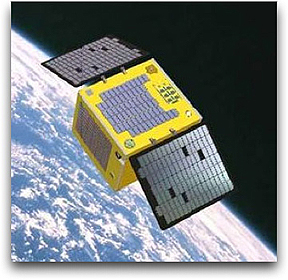
SDS-1 satelliet (JAXA)
SDS-1 satellite, image courtesy of JAXA
The SDS-1 satellite was developed by JAXA as part of an effort to improve the reliability of satellites and to verify new technologies at the part, material, or component level in space by using a small satellite to improve technological achievements. The satellite will carry out operational experiments on new technologies in space to apply them for future satellite development. The SDS-1 has a mass of about 100 kg. The SDS-1 carries three equipments: the Space Wire Demonstrations Module, the Multi-mode Transponder, and the Advanced Microprocessor In-Orbit Experiment Equipment.
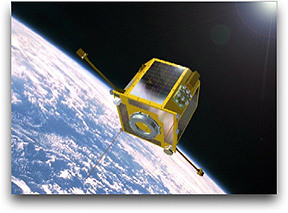
SOHLA-1 satellite (JAXA)
SOHLA-1 satellite (image courtesy of JAXA)
The SOHLA-1 satellite is a technical demo satellite developed by local small and medium-sized enterprises with technical support of JAXA and Osaka Prefecture University. The main objective of SOHLA-1 is to acquire and to accumulate various technologies for small satellite development. Another mission of SOHLA-1 is on-orbit demonstration of several new technologies, such as the VHF lightning impulse measurement. The satellite has a mass of 50 kg and is expected mission duration if of 1 year.
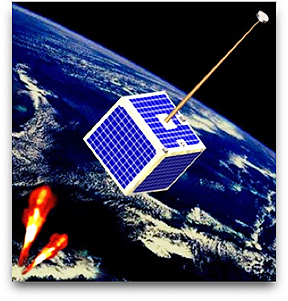
Sprite-SAT satellite (Tohoku Uinversity)
Sprite-SAT satellite, image courtesy Tohoku University
Sprite-SAT is a micro satellite in the size of 50 cm cube and weighing less than 50-kg. The satellite was developed by the Tohoku University and will conduct scientific observation of atmospheric luminous emissions called “sprites”.
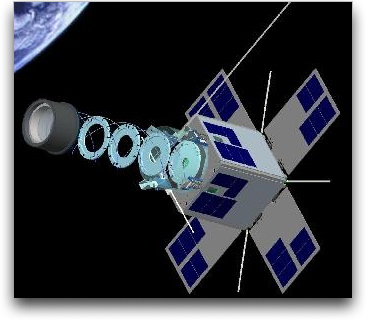
PRISM satellie (Univ. of Tokyo)
PRISM satellite, image courtesy of University of Tokyo
The PRISM satellite is to serve as a first attempt at applying nano-satellites to practical missions. The mission of PRISMs is to conduct technical experiments on Ground Image Acquisition using a refracted optical system with an extensible boom (expected resolution of 10 m to 30 m), to conduct technical experiments and demonstrate a nano-satellite bus using commercial off-the-shelf (COTS) parts, and to perform various services and experiments for the amateur radio community. The small satellite has a mass of 5 kg.

The KKS-1 is a small 3 kg, educational technology satellite built by the Tokyo Metropolitan College of Industrial Technology. The satellite will demonstrate experiments on micro-thrusters, will conduct basic experiments on 3-axis attitude control and is going to take land images with a small camera.
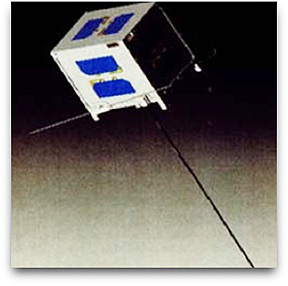
KKS-1 satellite
KKS-1 satellite, image courtesy of Tokyo Metropolitan College of Industrial Technology
The STARS-1 satellite consists of a Mother Satellite and a Daughter Satellite, connected by a tether. The Mother Satellite deploys the tether having the Daughter Satellite at its end. Daughter Satellite has one arm, and the tether is attached at its end. Then attitude control by arm motion using tether tension is possible. The main mission is to take pictures of a satellite during tether deployment. In this mission, the Mother Satellite deploys a tether with Daughter Satellite at its end. The Daughter Satellite controls the attitude of the CCD camera by robotic motion. The Mother Satellite and Daughter Satellite communicate through Bluetooth. The Daughter Satellite will take pictures of the Mother Satellite, and transmitters these to ground stations through amateur radio frequency.

The Kagayaki satellite is a small satellite to demo different technologies and to invite handicapped children to the launch site and carry their messages. Kagayaki will demonstrate technologies to perform an autonomous control system, to perform an inflatable progress boom. to detect space debris and to observe aurora.

(Source: NASA Spaceflight.com, Rui C. Barbosa)

Filed Under: Climate & Environmental Monitoring

Primary Sidebar

Coverage

  • Missions & Constellations
  • Business & Finance
  • Military & Defense
  • Launch
  • Software Automation & Ground Systems
  • Government & Regulation
  • Services & Applications

Most Read Stories

  • NASA Shuts Off Instrument on Voyager 1 to Extend Interstellar Mission
  • Bad news, but good news followed
  • Amazon to Acquire Globalstar for $11.6 Billion to Fuel D2D Expansion
  • Blue Origin Achieves First Booster Reuse but Satellite Enters Off-Nominal Orbit
  • The Smartest Money in the Room Is Looking Up

Secondary Sidebar

Footer


Satnews is a leading provider of satellite news, events, publications, research and other satellite industry information in both commercial and military enterprises worldwide.

Stories By Category

  • Business & Finance
  • Government & Regulation
  • Launch
  • Military & Defense
  • Missions & Constellations
  • Services & Applications
  • Software Automation & Ground Systems
  • Spectrum & Licensing
  • Startups & NewSpace Business

About Us

  • Leadership & Editorial Team
  • SatNews History
  • Free Satnews Subscription
  • SatNews Events
  • Magazines

Navigation

  • Latest Stories
  • Magazines
  • Events
  • Contact
  • Cookie & Privacy Policy for Satnews

We use cookies to ensure that we give you the best experience on our website. If you continue to use this site we will assume that you are happy with it.
x
Sign up Now (For Free)
Access daily or weekly satellite news updates covering all aspects of the commercial and military satellite industry.
Invalid email address
Notify Me Regarding ( At least one ):
We value your privacy and will not sell or share your email or other information with any other company. You may also unsubscribe at anytime.

Click Here to see our full privacy policy.
Thanks for subscribing!