

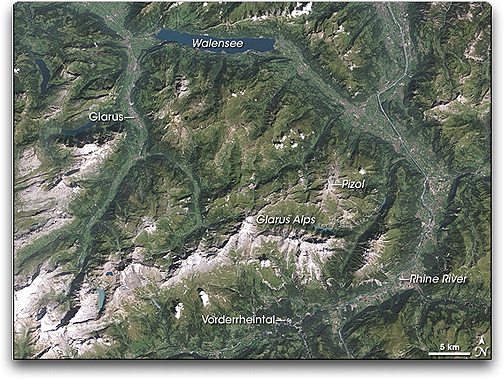
The Glarus Overthrust rock formation consists of slates (fine-grained rocks formed by heat and pressure), conglomerates (rocks composed of gravel, boulders, and mud), and sandstones. This rock layer ranges in age from 250 to 300 million years old. Underneath the Glarus Overthrust are limestones (calcium-rich rocks left by the remains marine organisms) that are 100 to 150 million years old, and schistose flysch rocks ranging in age from 35 to 50 million years old. These rocks are laminated sandstones and shales. How did the older rocks end up on top of newer ones? Geologists suspect the underground workings of plate tectonics. After these rock layers formed, they where eventually buried by newer rock layers until they lay well underground. Later on, as one tectonic plate pushed into another, the movement displaced the rock layers. The events likely occurred at a depth of 16 kilometers (10 miles) underground, at temperatures up to 320 degrees Celsius (about 600 degrees Fahrenheit). Several universities continue to conduct research in this area, however, and future discoveries about tectonics and mountain building processes are likely.
