

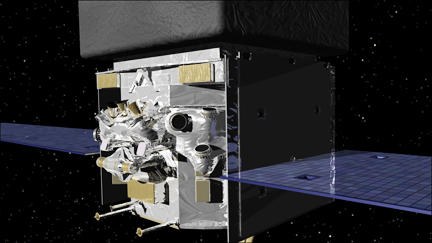
 BAE Systems computers are going to enable a new NASA satellite to examine gamma rays. These rays are the most intense form of radiation in the universe. Seven of the company’s RAD750™ computers are aboard the Gamma-ray Large Area Telescope (GLAST) whose mission is to measure and characterize the high-energy radiation emitted by black holes and emerging neutron stars. Of the seven BAE Systems computers aboard GLAST, two control spacecraft functions, such as position-keeping and data-handling. Five computers will manage functions on the satellite’s scientific instrument. Following a 60-day checkout and calibration period, GLAST will transmit more than 100 gigabits of information daily to NASA scientists.
BAE Gives GLAST Control + Functionality
BAE Systems computers are going to enable a new NASA satellite to examine gamma rays. These rays are the most intense form of radiation in the universe. Seven of the company’s RAD750™ computers are aboard the Gamma-ray Large Area Telescope (GLAST) whose mission is to measure and characterize the high-energy radiation emitted by black holes and emerging neutron stars. Of the seven BAE Systems computers aboard GLAST, two control spacecraft functions, such as position-keeping and data-handling. Five computers will manage functions on the satellite’s scientific instrument. Following a 60-day checkout and calibration period, GLAST will transmit more than 100 gigabits of information daily to NASA scientists.
