

Currently flight tests on NASA’s Ikhana, a modified Predator B unmanned aircraft adapted for civilian research (which we wrote about that is used to monitor California’s fires), are under way at NASA’s Dryden Flight Research Center at Edwards Air Force Base in California. The effort represents one of the first comprehensive flight validations of fiber optic sensor technology.
The weight reduction that fiber optic sensors would make possible could reduce operating costs and improve fuel efficiency, something even more critical, these days. The development also opens up new opportunities and applications that would not be achievable with conventional technology. For example, the new sensors could enable adaptive wing-shape control.
“Active wing-shape control represents the gleam in the eye of every aerodynamicist,” Lance Richards, Dryden’s Advanced Structures and Measurement group lead said. “If the shape of the wing can be changed in flight, then the efficiency and performance of the aircraft can be improved, from takeoff and landing to cruising and maneuvering.”
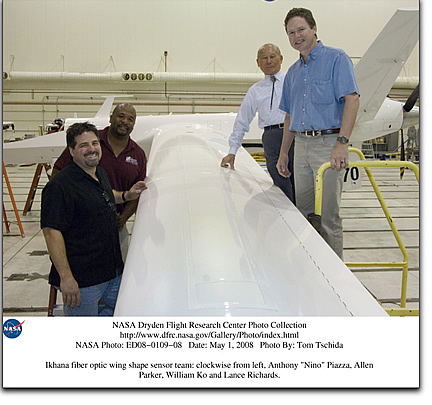
Six hair-like fibers located on the top surface of Ikhana’s wings provide more than 2,000 strain measurements in real time. With a combined weight of less than two pounds, the fibers are so small that they have no significant effects on aerodynamics. The sensors eventually could be embedded within composite wings in future aircraft. To validate the new sensors’ accuracy, the research team is comparing results obtained with the fiber optic wing shape sensors against those of 16 traditional strain gauges co-located on the wing alongside the new sensors.
“The sensors on Ikhana are imperceptibly small because they’re located on fibers approximately the diameter of a human hair,” Richards explained. “You can get the information you need from the thousands of sensors on a few fibers without the weight and complexity of conventional sensors. Strain gauges, for example, require three copper lead wires for every sensor.”
When using the fiber optic sensors, researchers do not require analytical models for determining strain and other measurements on the aircraft because data derived with the sensors include all of the actual measurements being sought.
Another safety-related benefit of the lightweight fiber optic sensors is that thousands of sensors can be left on the aircraft during its lifetime, gathering data on structural health and performance. By knowing the stress levels at thousands of locations on the aircraft, designers can more optimally design structures and reduce weight while maintaining safety. The net result could be a reduction in fuel costs and an increase in range.
Further, intelligent flight control software technology now being developed can incorporate structural monitoring data from the fiber optic sensors to compensate for stresses on the airframe, helping prevent situations that might otherwise result in a loss of flight control. By extension, the application of the technology to wind turbines could improve their performance by making their blades more efficient.
“An improvement of only a few percent equals a huge economic benefit,” Richards said. “The sensors could also be used to look at the stress of structures, like bridges and dams, and possibilities extend to potential biomedical uses as well. The applications of this technology are mind-boggling.”
