

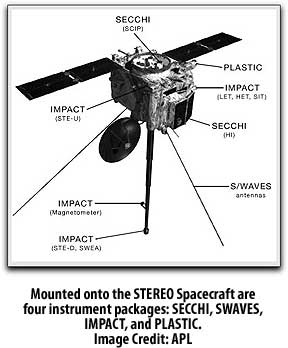
 NASA’s sun-focused Solar Terrestrial Relations Observatory, or STEREO, twin spacecraft unexpectedly detected particles from the edge of the solar system last year. This helped scientists map the energized particles where the hot solar wind slams into the cold interstellar medium. The two STEREO spacecraft were launched in 2006 into Earth’s orbit around the sun to obtain stereo pictures of the sun’s surface and measure magnetic fields and ion fluxes associated with solar explosions. From June to October 2007, sensors aboard both STEREO spacecraft detected energetic neutral atoms originating from the same spot in the sky, where the sun plunges through the interstellar medium.
 Mapping the region by means of neutral, or uncharged, atoms instead of
light “heralds a new kind of astronomy using neutral atoms,” said Dr.
Robert Lin, professor of physics at the University of California,
Berkeley, and lead for the suprathermal electron sensor aboard the
STEREO spacecraft. “You can’t get a global picture of this region,
one of the last unexplored regions of the heliosphere, through normal
telescopes,” Lin said. The heliosphere is a bubble in space produced
by the solar wind and stretches from the sun to beyond the orbit of
Pluto. The solar wind streams off the Sun in all directions at great
speeds. Once beyond the orbit of Pluto, this supersonic wind must
slow down to meet the gases in the interstellar medium. As the solar
wind slows, it changes direction to form a comet-like tail behind the
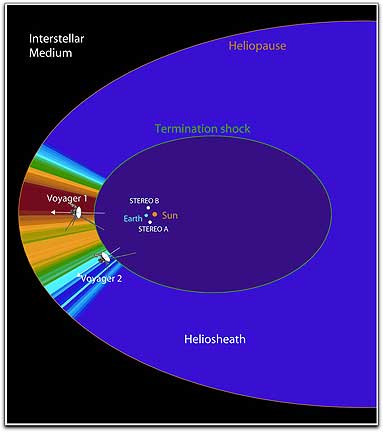
sun. This subsonic flow region is called the heliosheath. “This is the first mapping of energetic neutral particles from the edge of the heliosphere,” Lin said. According to Lin, the neutral atoms are probably hydrogen, which comprise most of the particles in the local interstellar medium. NASA plans to launch the Interstellar Boundary Explorer, or IBEX, later this year to more thoroughly map the boundary of the solar system.
Mapping the region by means of neutral, or uncharged, atoms instead of
light “heralds a new kind of astronomy using neutral atoms,” said Dr.
Robert Lin, professor of physics at the University of California,
Berkeley, and lead for the suprathermal electron sensor aboard the
STEREO spacecraft. “You can’t get a global picture of this region,
one of the last unexplored regions of the heliosphere, through normal
telescopes,” Lin said. The heliosphere is a bubble in space produced
by the solar wind and stretches from the sun to beyond the orbit of
Pluto. The solar wind streams off the Sun in all directions at great
speeds. Once beyond the orbit of Pluto, this supersonic wind must
slow down to meet the gases in the interstellar medium. As the solar
wind slows, it changes direction to form a comet-like tail behind the
sun. This subsonic flow region is called the heliosheath. “This is the first mapping of energetic neutral particles from the edge of the heliosphere,” Lin said. According to Lin, the neutral atoms are probably hydrogen, which comprise most of the particles in the local interstellar medium. NASA plans to launch the Interstellar Boundary Explorer, or IBEX, later this year to more thoroughly map the boundary of the solar system.
