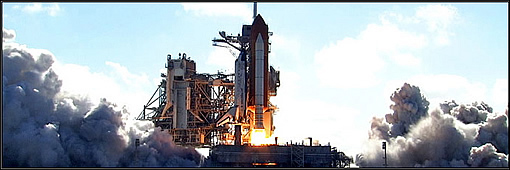
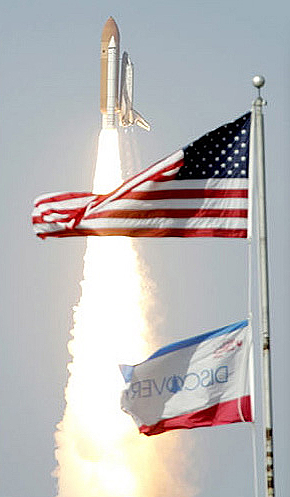
 Another great day for NASA. Earlier this week, the Phoenix landed on Mars and now the space shuttle Discovery and its seven-member crew lifted off from NASA‘s Kennedy Space Center. Launch time was 4:02 p.m. CDT Saturday, with the objective to deliver and install a Japanese laboratory on the International Space Station. Another important aspect of this flight is to bring a toilet pump, designed specifically for the space station’s toilet, which has been out of order for more than a week. The current Russian astronauts have had to use extra water, a critical commodity, to ensure the toilet flushes.
The mission, designated STS-124, is the second of three flights to launch components to complete the Japan Aerospace Exploration Agency’s Kibo laboratory. Discovery is carrying Kibo’s tour bus-sized Japanese Pressurized Module, or JPM, which will be the station’s largest module. The shuttle astronauts will work with the three-member station crew and ground teams around the world to install the JPM and Kibo’s robotic arm system. When operational, Kibo will house up to 23 racks of equipment. Experiments will be conducted in the interior of the Space Station that pertain to the areas of space medicine, biology, Earth observations, materials production, biotechnology and communications.
In addition to the plumbing tools and lab, there is a small toy that was brought along on this mission. A Buzz Lightyear action figure from the Disney film “Toy Story”. The action figure is part of NASA’s “toys in space” educational program for elementary students.

Joining Kelly on Discovery’s 14-day flight are Pilot Ken Ham and Mission Specialists Karen Nyberg, Ron Garan, Mike Fossum, Greg Chamitoff and Japan Aerospace Exploration Agency astronaut Akihiko Hoshide. Garan and Fossum will conduct three spacewalks during the mission. Chamitoff will replace current station crew member Garrett Reisman, who has lived on the outpost since mid-March. Chamitoff will return to Earth on Endeavour’s STS-126 mission, targeted for November 10. By the way, NASA Television features live mission events, daily mission status news conferences and 24-hour commentary. NASA TV webcast—Cape Canaveral, Florida