

The global satellite propulsion market is projected to expand from approximately $2.07 billion in 2026 to $4.66 billion by 2031, according to a market research report released on Nov. 13 by MarketsandMarkets Research Pvt. Ltd.
The forecast represents a compound annual growth rate (CAGR) of 17.6% over the five-year period, driven by expanding commercial satellite constellations, deep-space exploration programs, and stricter orbital debris mitigation rules.
Regional Demand and Constellation Economics
Rising orbital congestion and maturing commercial space operations have elevated propulsion subsystems into primary determinants of spacecraft lifespan and economic viability. Reliable station-keeping, collision-avoidance maneuvers, and end-of-life de-orbiting capabilities are required to comply with international space sustainability mandates while reducing launch mass penalties.
Regionally, North America holds the largest revenue share, supported by U.S. defense spending, private aerospace prime contractors, and large broadband constellation deployments. Asia-Pacific represents the fastest-growing regional market as government space agencies and commercial operators in India, China, Japan, and South Korea accelerate indigenous small-satellite and interplanetary missions. Meanwhile, European growth is shaped by European Space Agency (ESA) debris mitigation standards.
Commercial Scaling and Supply Chain Constraints
Industry analysts note that the sector is shifting from specialized defense procurement toward high-volume commercial manufacturing, aided by standardized satellite buses and modular propulsion units. Within the market’s component breakdown, propellant feed systems represent the fastest-growing hardware segment alongside thrusters, propellant tanks, flow control valves, pressure regulators, and electronics power control units (PCUs).
Sustaining the 17.6% annual growth trajectory through 2031 will require manufacturers to navigate raw material supply chain bottlenecks, radiation-hardening requirements, and lengthy flight-qualification timelines as commercial telecommunications, Earth observation, and defense operators scale fleet deployments.
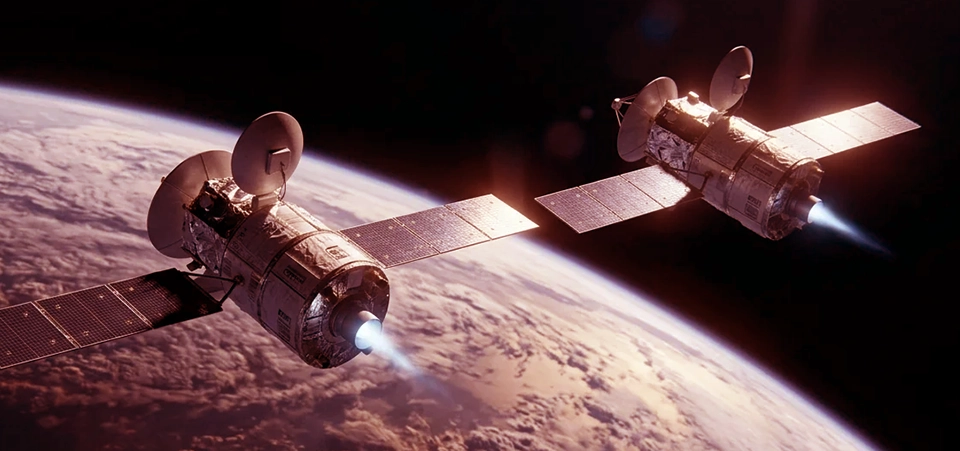
Images — Commercial and defense satellites rely on integrated propulsion modules for orbit raising, station-keeping, and end-of-life disposal.
