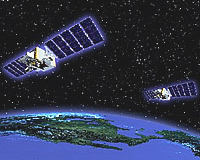
Artist’s Concept, STSS Satellite, Cycle 1, Flights 1 and 2 – STSS is a constellation of satellites in low-Earth orbit, each having a very capable set of infrared and visible sensors for detecting and tracking ballistic missiles launched from anywhere, to anywhere, at any time. Published with permission of Northrop Grumman Corporation.
REDONDO BEACH, CALIFORNIA: August 15, 2007—Satnews Daily—The prime contractor for the Missile Defense Agency’s (MDA) Space Tracking and Surveillance System (STSS) is Northrop Grumman Corporation. They have just successfully completed two major milestones for the space tracking and surveillance system.
The final ground segment acceptance test was completed at the STSS ground operations center located at the Missile Defense Space Experimentation Center at Schriever AFB in Colorado Springs, Colorado. Over the past 2-1/2 years, telemetry, tracking and commanding and mission data processing have been developed, tested and delivered to the STSS system test and operations team. This capability means early use of operational ground hardware and software in critical risk reduction testing of the STSS spacecraft and payload. Additionally, such finalizes the development and validation of STSS ground operations and maintenance procedures as well as training and certification of STSS ground operators.
The final STSS operational readiness demo was also conducted at the MDSEC. This was a 72-hour event successfully revealing the readiness of the ground system hardware and software to operate the first two STSS satellites that are scheduled to launch in 2008. A representative missile test scenario was demo’d that involved the surveillance, detection, tracking and reporting of a simulated test target launch from the Western Range (Vandenburg AFB in California).
Next up will find the STSS team preparing for the launch and testing of the STSS demo satellites in 2008. They’ll launch from Cape Canaveral and will communicate with MDA’s Ballistic Missile Defense Systems (BMDS) Test Bed via the MDSEC ground station. They will demo their ability to detect and track missiles in all phases of flight as well as their ability to operate with others parts of the multi-layered missile defense architecture.
- Skip to primary navigation
- Skip to main content
- Skip to primary sidebar
- Skip to secondary sidebar
- Skip to footer


Satellite Industry Intelligence Since 1983
Footer

Satnews is a leading provider of satellite news, events, publications, research and other satellite industry information in both commercial and military enterprises worldwide.