

On October 11, 2026, defense logistics contractor Sierra Space demonstrated the flight recovery capabilities of its Ghost reentry vehicle during high-altitude drop tests conducted under U.S. Space Command’s Apollo Nexus exercise.
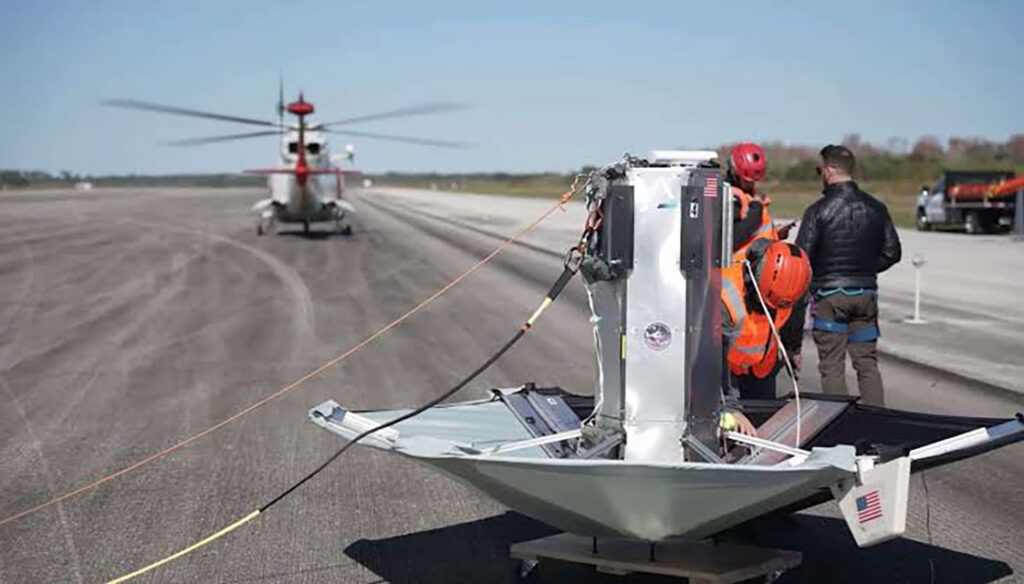
Dropped from high-altitude balloons at 68,500 feet over the Dugway Proving Ground in Utah, the 10-ton test article successfully recovered its internal payload—comprising a software-defined radio and a bottle of whiskey—intact, validating structural thermal protection and precision landing guidance systems.
Drop Test Specifications and Deceleration Architecture
The Ghost platform utilizes a deployable decelerator thermal shield designed to withstand atmospheric reentry temperatures up to 2,000°F (1,093°C). During the Dugway flight demonstration, the test vehicle executed automated shield jettison following terminal atmospheric entry before deploying a steerable parafoil system. The autonomous parafoil guided the payload module to a touchdown location within 100 meters of the targeted ground landing zone.
Designed for 5- to 10-ton cargo capacities, the Ghost reentry capsule can be pre-positioned in low Earth orbit for up to five years as an on-orbit emergency supply repository. Upon receiving a deorbit call-up signal, onboard thrusters slow the vehicle to 7,000 meters per second to initiate atmospheric reentry, delivering critical supplies to contested or austere ground locations anywhere on Earth within 90 minutes.
Program Heritage and Military Logistics Integration
The high-altitude test marks the latest milestone for Sierra Space’s logistics platform, building upon the original unveiling of the Sierra Space Ghost vehicle under the Axelerator program and the subsequent launch of the dedicated Sierra Space Defense operational unit.
The demonstration supports the Department of Defense’s Tactically Responsive Space (TacRS) framework, evaluating space-based point-to-point delivery as an alternative to conventional air mobility or sealift in contested operational theaters.
Operational Demonstration Roadmap
Following the successful balloon drop tests at 68,500 feet, Sierra Space plans to advance the Ghost platform toward full-scale suborbital and orbital flight tests. Future test phases will evaluate autonomous rendezvous, orbital deorbit firing, and high-velocity atmospheric reentry from low Earth orbit ahead of potential operational deployment with military logistics units.
