

• Skip to primary navigation
  • Skip to main content
  • Skip to primary sidebar
  • Skip to secondary sidebar
  • Skip to footer
  • NEWS:
  • SatNews
  • SatMagazine
  • MilSatMagazine
  • SmallSat News
  • |     EVENTS:
  • SmallSat Symposium
  • Satellite Innovation
  • MilSat Symposium
  • SmallSat Europe

SatNews

Satellite Industry Intelligence Since 1983

Subscribe
  • LATEST
  • SatNews Events
  • Magazines
  • Calendar
  • Subscribe
  • Missions & Constellations
    • Exploration & Science Missions
    • In-Orbit Servicing & Orbital Operations
    • LEO Constellations
    • Mission Autonomy & Onboard Systems
    • Mission Deployments & Manifests
    • Navigation & PNT
    • SmallSat
    • Spacecraft & Payload Technology
    View All in Missions & Constellations →
    Brian Cox Declares Humanity on the Threshold of Becoming a Multi-Planetary SpeciesBrian Cox Declares Humanity on the Threshold of Becoming a Multi-Planetary Species
    Access Hub and Maargin Release White Paper on Frugal LEO Constellations and Orbital AIAccess Hub and Maargin Release White Paper on Frugal LEO Constellations and Orbital AI
    SmallSat Europe Speaker Focus: Merek Chertkow, The Radiation Team
    U.S. Space Force Awards $3.2 Billion for Space-Based Interceptor LayerU.S. Space Force Awards $3.2 Billion for Space-Based Interceptor Layer
  • Business
    • Contracts & Commercial Deals
    • Earnings & Financial Reporting
    • Events & Conferences
    • Funding & Venture Capital
    • Market Forecasts
    • Mergers & Acquisitions
    • Personnel Moves & Appointments
    View All in Business & Finance →
    Sama Jordan TV Joins Es’hailSat Video Neighborhood at 26° EastSama Jordan TV Joins Es’hailSat Video Neighborhood at 26° East
    Anduril Secures $100M Modification to Modernize Space Surveillance NetworkAnduril Secures $100M Modification to Modernize Space Surveillance Network
    Real Wireless Tapped by UK Spectrum Policy Forum for Lunar Connectivity StudyReal Wireless Tapped by UK Spectrum Policy Forum for Lunar Connectivity Study
    PROFEN and Azercosmos Expand Satellite Services Across Europe, the Middle East, and AfricaPROFEN and Azercosmos Expand Satellite Services Across Europe, the Middle East, and Africa
  • Defense
    • Counterspace & ASAT
    • Defense Budgets & Procurement
    • ISR & Reconnaissance
    • MILSATCOM
    • Missile Warning & Defense
    • National Security Programs
    • Space Domain Awareness
    View All in Military & Defense →
    U.S. and Australia Expand Space Surveillance Network to Counter Emerging ASAT ThreatsU.S. and Australia Expand Space Surveillance Network to Counter Emerging ASAT Threats
    U.S. Space Force Integrates Domain Awareness Capabilities into Balikatan 2026U.S. Space Force Integrates Domain Awareness Capabilities into Balikatan 2026
    BAE Systems Enters Production for NavGuide M-Code GPS ReceiverBAE Systems Enters Production for NavGuide M-Code GPS Receiver
    Space Force Awards $3.2 Billion in Golden Dome Contracts for Orbital Interceptor ConstellationSpace Force Awards $3.2 Billion in Golden Dome Contracts for Orbital Interceptor Constellation
  • Gov
    • Export Controls & Compliance
    • International Space Agreements
    • National Space Policy
    • Space Law & Treaties
    • Space Sustainability & Debris Policy
    • Space Traffic Management / Debris Removal
    View All in Government & Regulation →
    SmallSat Europe Speaker Focus: Araz Feyzi, Kayhan SpaceSmallSat Europe Speaker Focus: Araz Feyzi, Kayhan Space
    Spectrum-Sharing Rules Get an OverhaulSpectrum-Sharing Rules Get an Overhaul
    NASA Objects to Blue Origin’s “Project Sunrise”NASA Objects to Blue Origin’s “Project Sunrise”
    ESA spells out satellite benefits – and risksESA spells out satellite benefits – and risks
  • Launch
    • Launch Providers
    • Launch Schedule & Calendars
    • Launch Sites & Infrastructure
    • Rocket Technology & Vehicles
    View All in Launch →
    AST SpaceMobile Pivots to SpaceX for Mid-June Launch of Three BlueBird SatellitesAST SpaceMobile Pivots to SpaceX for Mid-June Launch of Three BlueBird Satellites
    SpaceX Accelerates Transition from Falcon 9 to Next-Generation Starship FleetSpaceX Accelerates Transition from Falcon 9 to Next-Generation Starship Fleet
    NanoAvionics Satellites Reach Orbit on SpaceX CAS500-2 MissionNanoAvionics Satellites Reach Orbit on SpaceX CAS500-2 Mission
    GalaxEye Successfully Launches “Mission Drishti” OptoSAR SatelliteGalaxEye Successfully Launches “Mission Drishti” OptoSAR Satellite
  • Software
    • Autonomous Ground Operations
    • Data Processing & AI/ML
    • Digital Twins & Modeling
    • Ground Segment & Teleports
    • Mission Planning & Simulation
    • Space Systems Software Engineering
    • Spectrum & Licensing
    View All in Software Automation & Ground Systems →
    SmallSat Europe Speaker Focus: Olaf Eckart, BMW GroupSmallSat Europe Speaker Focus: Olaf Eckart, BMW Group
    SES Accelerates Multi-Orbit IFC Strategy with meoSphere and Next-Gen ESA DevelopmentSES Accelerates Multi-Orbit IFC Strategy with meoSphere and Next-Gen ESA Development
    SmallSat Europe Speaker Focus: Koen Willems, ST Engineering iDirect EuropeSmallSat Europe Speaker Focus: Koen Willems, ST Engineering iDirect Europe
    GMV to Lead Mission Planning for ESA’s Next-Generation Copernicus ExpansionGMV to Lead Mission Planning for ESA’s Next-Generation Copernicus Expansion
  • Services & Apps
    • Climate & Environmental Monitoring
    • Disaster Response & Security Mapping
    • Earth Observation & Imaging
    • Maritime & Aviation Satcom
    • Satellite Communications
    View All in Services & Applications →
    Satellite Technology and the Legacy of the Media PioneerSatellite Technology and the Legacy of the Media Pioneer
    SmallSat Europe Speaker Focus: Massimo Comparini, Leonardo Space DivisionSmallSat Europe Speaker Focus: Massimo Comparini, Leonardo Space Division
    The waiver was the policy. Thursday is the paperwork.The waiver was the policy. Thursday is the paperwork.
    Solstar Confirms Successful On-Orbit Operation of Deke Space Communicator Following Launch on SpaceX Transporter-16 MissionSolstar Confirms Successful On-Orbit Operation of Deke Space Communicator Following Launch on SpaceX Transporter-16 Mission

ESA spells out satellite benefits – and risks

May 3, 2026

Chris Forrester — As a regular reader of this site you will no doubt be aware of the benefits that satellites give humanity. But a major study on April 30 from the European Space Agency (ESA) reminds us of the aids provided by satellites in zones of interest outside our individual specialities.
The risks

And the benefits are not just considerable but in most cases they are growing in influence and revenues. But so are the risks associated with the failure of a sector.

The ESA study admits that its risk forecasts are hypothetical – and its numbers are very much focused on its European members – and Canada. Nevertheless, the predictions are by any measure worrying. It admits that in some sectors (and specifically mentions direct-to-device (D2D) connectivity) the forecasts could be underestimating the actual probabilities. As for D2D which ESA admits is a technology that is evolving quickly, “and [become] more automated, data-driven sectors, the potential economic consequences of future outages are likely to be even greater.”   In other words, the upside benefits are immense, but so might the consequences be of a sector’s failure.

“The sudden loss of satellite communications would lead to widespread disruption, affecting vital services such as air travel, maritime logistics and emergency response with an estimated economic impact of up to €20 billion. To highlight the economic importance of satellite-enabled connectivity, London Economics prepared a report for the European Space Agency, examining the effects of a hypothetical week-long outage of satellite communications across ESA Member States and Canada,” says ESA.

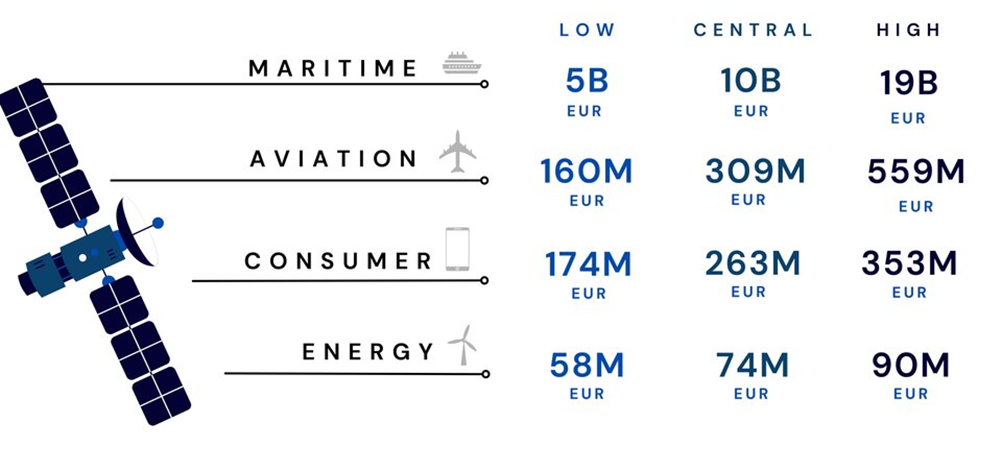
We only have to look at the current problems which revolve around the Straits of Hormuz and the impact from the stoppage of the flow of oil.  The ESA report suggests that Maritime and Aviation “would suffer the greatest financial losses during a [satellite] outage”. ESA adds: “Maritime shipping supports the transport of essential goods for manufacturing, energy, food, and retail sectors. The interruption of satellite services would critically disrupt supply chains, affecting not only shipping companies but also related industries such as port operations and warehousing. The projected economic loss is approximately €19 billion, consisting of €3.5 billion in direct impacts and €15.5 billion in indirect effects related mainly to supply-chain logistics,” says ESA.

Air passengers are – at long last – beginning to enjoy ‘gate-to-gate’ connectivity thanks to much improved satellite communications for In-Flight broadband. But ESA is blunt: “In aviation, lack of satellite connectivity for air traffic management could result in the cancellation or delay of around 4,000 transatlantic flights, leading to approximately 1,800 hours of cumulative delays. The economic loss to the sector is estimated at €558.7 million.”

Despite the benefits of the likes of Starlink, and the upcoming offerings from AST SpaceMobile, Amazon Leo, Telesat Lightspeed, Viasat/Space42 Equatys and the existing services from Eutelsat OneWeb and Iridium, millions of citizens – unfortunately for our industry – depend on ‘conventional land-based and wireless services for their broadband and telephony.  ESA states that around 2.2 million individuals in the ESA member states and Canada “particularly those in remote or mountainous regions, would be left without internet access . Emergency messaging systems, which rely on satellites to deliver critical information, would not be able to operate, compromising emergency response capabilities. The economic cost in this area is similar to that of aviation, at around €352.7 million.”

There would be another catastrophe in terms of cash supply. Despite more and more payments being made via a Smartphone, millions of us use ATMs regularly. “Cash machines and Point of Sale (POS) terminals in remote locations would not be operational. POS systems are devices used to process payments by card or mobile phone in shops and other venues. Because these systems rely on satellite connectivity in areas without reliable ground connections, their failure would stop physical transactions altogether,” says the report.

The ESA study used London Economics to research the core data. To arrive at these results, the research team reviewed existing data and reports and consulted 48 experts – including satellite operators, connectivity providers, national regulators, academics, and financial institutions. Five sectors were selected for analysis based on their reliance on satellite communications. The degree of dependence of the sector on satellites was categorised as high, medium, low. Using this information, they built an economic model to estimate the loss of economic activity (measured in Gross Value Added) and the loss of connectivity benefits for users. They also assessed wider social impacts, such as the number of households left without connectivity.

These three impact levels (Low, Central and High) are shown on the associated chart, and the numbers are shocking. We know that building in redundancy is a vital element in a system’s design, but the knock-on consequences are even greater than the threats listed.

However, all around us there are strong signs that the industry is building in compensation elements in order to avoid catastrophic consequences.  FCC Commissioner Brendan Carr last week announced significant permissions for today’s satellite operators to raise power levels: “Even though high-speed next-gen satellite services provide essential connectivity across the country already, Americans are now about to see a big upgrade. With today’s decision consumers could see a seven-fold increase in capacity for these high-speed satellite offerings,” said Commissioner Carr.

The FCC decision is good news for operators and consumers. Higher power levels, suitably coordinated between operators, can only benefit everyone and reduce the risks associated with a sector’s collapse.

Filed Under: Government & Regulation, Space Sustainability & Debris Policy Tagged With: Featured

Primary Sidebar

Coverage

  • Missions & Constellations
  • Business & Finance
  • Military & Defense
  • Launch
  • Software Automation & Ground Systems
  • Government & Regulation
  • Services & Applications

Most Read Stories

  • NASA Shuts Off Instrument on Voyager 1 to Extend Interstellar Mission
  • FCC Modernizes Satellite Spectrum Rules to Unleash Next-Generation Broadband
  • Bad news, but good news followed
  • Amazon to Acquire Globalstar for $11.6 Billion to Fuel D2D Expansion
  • The Smartest Money in the Room Is Looking Up

Secondary Sidebar

Footer


Satnews is a leading provider of satellite news, events, publications, research and other satellite industry information in both commercial and military enterprises worldwide.

Stories By Category

  • Business & Finance
  • Government & Regulation
  • Launch
  • Military & Defense
  • Missions & Constellations
  • Services & Applications
  • Software Automation & Ground Systems
  • Spectrum & Licensing
  • Startups & NewSpace Business

About Us

  • Leadership & Editorial Team
  • SatNews History
  • Free Satnews Subscription
  • SatNews Events
  • Magazines

Navigation

  • Latest Stories
  • Magazines
  • Events
  • Contact
  • Cookie & Privacy Policy for Satnews

We use cookies to ensure that we give you the best experience on our website. If you continue to use this site we will assume that you are happy with it.