

On August 23, 2026, market analysis highlighted how AST SpaceMobile’s sovereign contract strategy is driving revenue growth across defense and national security sectors, even as the operator navigates launch cadence dependencies for its direct-to-device (D2D) constellation.
Sovereign Strategy and Capital Allocation
AST SpaceMobile is leveraging its low Earth orbit (LEO) satellite architecture to secure government and military contracts requiring secure, sovereign communications channels. By integrating government payloads onto its commercial spacecraft buses, the company provides defense agencies with direct-to-cellular connectivity that bypasses terrestrial ground infrastructure.
The strategic pivot to government awards is supported by expanding institutional capital. On August 14, 2026, Norway’s Sovereign Wealth Fund disclosed an expanded equity stake in AST SpaceMobile, bringing its total holding to €256 million. This capital injection provides institutional liquidity as AST SpaceMobile expands its commercial agreements across nearly 60 mobile network operators representing over 3 billion subscribers globally.
Platform Architecture and Technical Specifications
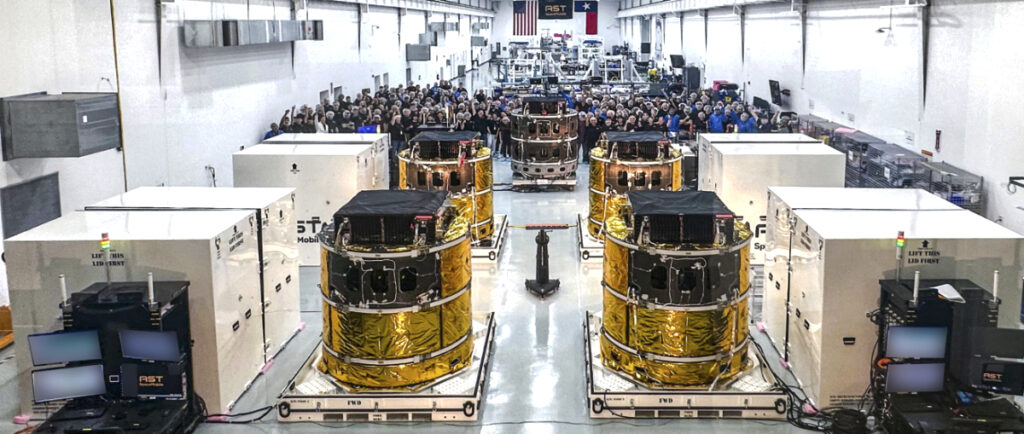
The company’s sovereign and commercial network relies on its Block 2 BlueBird spacecraft stack, which features the largest commercial phased array antennas deployed in low Earth orbit.
Each spacecraft features an unfurled phased array antenna measuring approximately 2,400 square feet (223 square meters). Powered by proprietary AST5000 application-specific integrated circuit (ASIC) cores, the spacecraft deliver peak data transmission speeds of up to 200 Mbps directly to standard, unmodified smartphones. The massive aperture enables targeted beamforming and high power generation to solve the physical challenges of space-to-cellular data routing.
Launch Manifest Dependencies and Operational Outlook
Despite commercial and government contract momentum, AST SpaceMobile’s operational timeline remains exposed to launch manifest availability and rideshare slot dependencies. Following the orbital deployment of its initial next-generation BlueBird satellites aboard a SpaceX Falcon 9 rocket, the company must maintain a rapid launch cadence to achieve its target of 100 active satellites in orbit. Any launch vehicle integration bottlenecks or manifest delays could slow the rollout of continuous, real-time cellular broadband coverage across targeted sovereign and commercial markets.
