

The ongoing bidding contest between Netflix and Paramount Global for Warner Bros. Discovery marks a pivotal moment in the media sector, with implications that extend well beyond streaming market share. For the satellite communications industry—encompassing operators, service providers, and technology integrators—this consolidation threatens to redefine traffic patterns and capacity planning strategies.
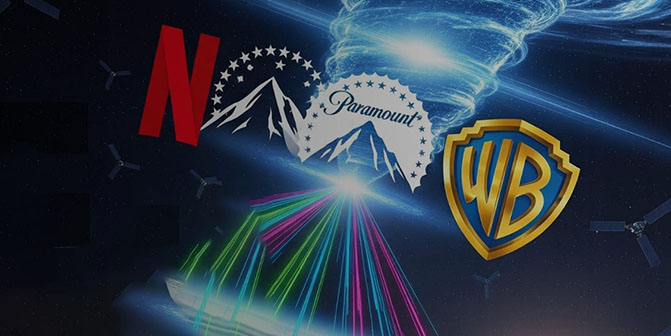
While the broader narrative focuses on regulatory scrutiny and intellectual property, the satellite sector is directly exposed to the structural shifts triggered by such mega-mergers. Networks that have historically supported video distribution, contribution, and live content workflows must now adapt to a landscape where media consumption is increasingly consolidated around a few dominant platforms.
The Market-Level Impact
The potential acquisition reshapes the demand for long-term satellite capacity. The outcome will be measured not just in subscriber growth, but in how high-resolution content delivery, global distribution, and multi-orbit architectures evolve to meet new data requirements.
Key areas of impact include:
- Video Distribution & Contribution: As content moves further toward IP-based delivery, legacy video distribution models face accelerated disruption, forcing operators to pivot toward hybrid connectivity solutions.
- Infrastructure Adaptation: Stakeholders—including Eutelsat OneWeb, SES, Intelsat, Viasat, and Starlink—must prepare for shifting data distribution realities.
- Cloud-Ground Integration: The role of cloud-ground integrators, such as AWS, becomes increasingly critical as the industry manages the transition from traditional broadcast to cloud-native workflows.
This analysis explores how these shifts will influence satellite demand and how the industry should prepare for the next phase of global content delivery.
Key Takeaways: Infrastructure & Spectrum Implications
- Accelerated C-Band Erosion vs. IP Transit Growth: The consolidation of Warner Bros. content onto a streaming-first platform (whether via Netflix or Paramount) accelerates the migration from linear broadcast to OTT. This will likely hasten the decline of traditional C-band video transponder leases—historically a high-margin revenue stream for operators like SES and Intelsat—forcing a faster pivot toward lower-margin, high-volume IP transit and backhaul services.
- “First Mile” Contribution Resilience: Despite the decline in distribution (DTH), satellite remains the gold standard for “contribution” (getting live feeds from stadiums to studios). With Warner Bros. Discovery holding massive sports rights and Netflix entering live events (e.g., NFL, WWE), demand for high-reliability, high-throughput satellite links for 4K/8K live backhaul will remain sticky and potentially grow.
- Edge Caching via High-Throughput Satellites (HTS): To serve global audiences without terrestrial bottlenecks, the combined entity may increasingly rely on Ka-band and Ku-band HTS spot beams to populate Content Delivery Network (CDN) edge servers in remote or island nations, effectively using satellite as a multicast delivery pipe for data rather than linear video.
- LEO and Low-Latency Requirements: As streaming giants explore interactive content and cloud gaming, the latency limitations of GEO stationary satellites become a hurdle. This opens a specific B2B opportunity for LEO constellations like Starlink and Eutelsat OneWeb to provide low-latency trunking for live, interactive media events where seconds of delay are unacceptable.
Conclusion: From Passive Distribution to Intelligent Infrastructure
Ultimately, the battle for Warner Bros. Discovery serves as more than a reshuffling of media assets; it is a catalyst for the next evolution of satellite architecture. As Netflix and Paramount vie for content supremacy, the satellite sector will adapt to provide the agile, multi-orbit connectivity required to deliver these massive content libraries to a global, bandwidth-hungry audience.
