

Chris Forrester
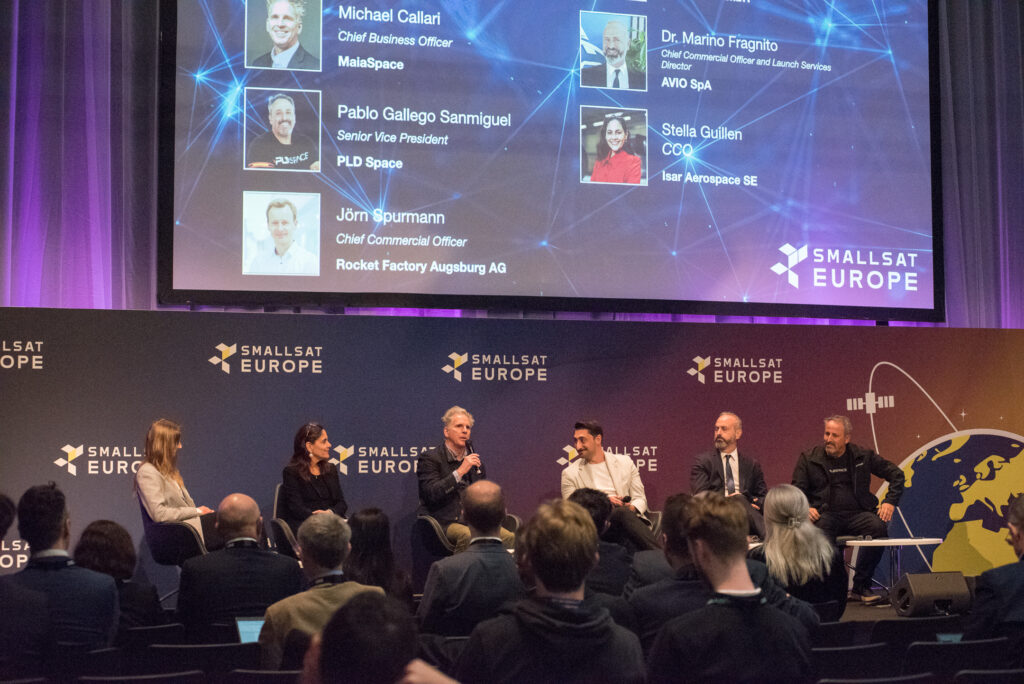
Steve Kaufman (Partner, Hogan Lovells) moderated this high-level panel of industry experts at the Smallsat Europe event in Amsterdam on May 27 and which looked at the availability of launch, now and in the future. Kaufman stated that if one talks to the bankers about launch providers they say ‘there are too many of them’, but talk to the customers and they’ll tell you, especially in the military, and they’ll say ‘there are not enough launch companies’. Our panel will examine these problems.
Pablo Gallego Sanmiguel (SVP, PLD Space), and formerly with SpaceX. Spanish-based Payload Space is developing two partially reusable rocket models (Miura 1 and Miura 5) and operates two spaceports (in Spain and Oman). Miura 5 is a two-stage vehicle and its Miura 5 NEXT version could handle medium-to-heavy satellite missions.
Dr. Marino Fragnito (CCO and Launch Services Director, AVIO SpA) and supplier of the Vega family of launchers. AVIO will carry out its next launch in July, 2025. Launch rate is being increased and the company has a full manifest through until 2028. Dr Fragnito says that the Vega rocket is “very competitive” with SpaceX’s Falcon 9 rocket.
Dr Ibrahim Ata (Head of Acquisition & Delivery, Rocket Factory Augsburg AG). Rocket Factory Augsburg AG is a German NewSpace start-up located in Augsburg, Germany. It was founded in 2018 with the mission to build rockets just like cars. Its 3-stage rocket, RFA One, is currently under development. Dr Ata told delegates that Rocket factory was now building two test vehicles in parallel. The first would launch later this year.
Michael Callari (Chief Business Officer, MaiaSpace). Maia Space is designing the first European reusable and eco-friendly launch vehicle that will provide affordable, innovative and sustainable launch services and space mobility solutions. Maia is targeting its debut launch before the end of 2026.
Stella Guillen (CCO, Isar Aerospace SE). Germany-based Isar recently carried out its first test flight of its Spectrum vehicle which was partly successful, and is planning a second before the end of this year. She told delegates that Isar’s manifest would ramp up once the second test is achieved. She said Isar has flight bookings which extend up to 2032, such is the demand for cargo space on the Spectrum rocket.
Nadine Smolka (Mission manager, Exolaunch GmbH). Berlin-based Exolaunch was present on the first flight of Ariane 6 with its EXOpod which carried 4 cubesats into space. She told delegates that Exolaunch had “stepped away” from its orbital mission extension plans as they were not cost effective. Exolaunch was now filling mission bookings beyond 2028.
Dr. Fragnito agreed with Steve Kaufman that rockets were getting bigger, but satellites were not getting bigger. “Our key customers are still looking for tailored missions,” he said. “But bigger rockets can handle bigger constellations. However, how many such large constellations will exist?”
Guillen said the world would need the likes of SpaceX’s Starship and that will change the picture dramatically, but the customer needs the regular 4 points answered: Reliability, Price, Schedule and Costs. “Currently, schedules dominate their requests, but this can change.”
Dr Ata said the risk for the rocket industry was price and commoditisation, and this could result in a ‘race to the bottom’. He stressed that bigger launches were inevitable to handle the different demands of the market. But in the ‘sweet spot’ range of 200-500 kgs then the demand will always be there, whether for Earth observation or other similar missions. But the trends in terms of pricing is seeing prices going down.
Maia Space’s Callari said all the market studies showed excellent demand and there remained a demand for bespoke solutions. “There’s a big enough market”.
Sanmiguel said that his company needed to stay agile and to be ready for any eventuality.
